Trademark Registration Online India, Process & Fees | ClearTax
This guide explains, at a practical level, how trademark registration for brands works in India and what a business owner should consider when protecting a brand identity. You will learn what a trademark is, who can apply, the broad steps involved in registration, how the online filing route typically operates, common checkpoints to track after filing, and the main commercial and legal reasons to register a trademark. The aim is to give founders, marketing heads, and legal counsels a clear roadmap so they can decide when to seek registration and how to prepare before approaching a practitioner or the official registry. The guide focuses on concepts, common pitfalls and planning advice rather than quoting specific fees or statutory timelines; for any precise numeric thresholds and formal forms you should consult the official trademark office website or a qualified trademark attorney. By the end you will know how to organise your files, what to expect from the online filing experience in broad terms, and what benefits a registered trademark brings to a brand’s long‑term strategy.
Trademark Registration, what it is and why it matters
A trademark is a sign that helps customers identify the source of goods or services and distinguishes them from those of others. It can be a word, logo, tagline, sound or other distinctive mark. Registering a trademark creates an enforceable right and builds an asset that the business can license, sell or use as a basis for enforcement against infringers.
Beyond enforcement, registration signals seriousness to investors, partners and customers. It reduces the risk of disputes later by creating public notice of your claim to the mark. Because trademarks are territorial and tied to the categories of goods or services for which they are registered, careful planning about how you will use and expand the brand is important before filing.
Who can apply for a trademark?
A trademark application can be filed by the owner of the business or by an authorised representative acting on the owner’s behalf. The owner may be an individual, a business entity or another legal person that claims rights in the mark. Choosing the correct applicant (for example the company that will commercially exploit the mark) avoids complications when enforcing or transferring rights later.
If you are using an agent or attorney to file, you should provide clear written authorisation and keep records of the relationship. If multiple parties claim usage or ownership, those competing claims should be clarified before filing to reduce the chance of opposition or procedural objections.
How to register a trademark, the high‑level process
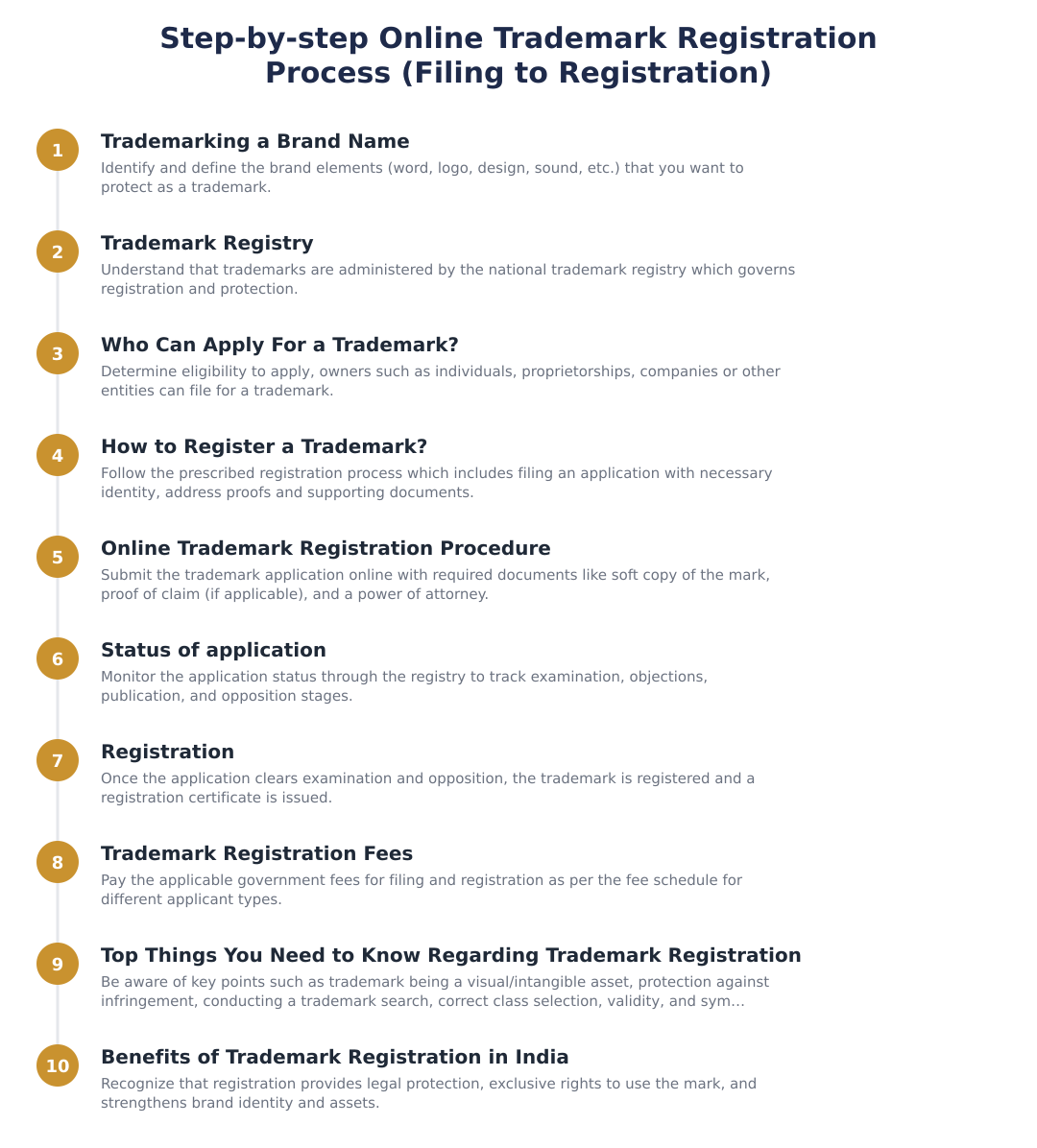
Trademark registration generally follows a sequence: choose and test the mark for distinctiveness, define the goods/services classes where the mark will be used, prepare and file an application with the trademark authority, respond to any formalities or oppositions, and finally obtain registration if the process completes without bar. Each of these stages can involve iterations, for example, a search may reveal pre‑existing marks that require changing your branding or narrowing the goods/services description.
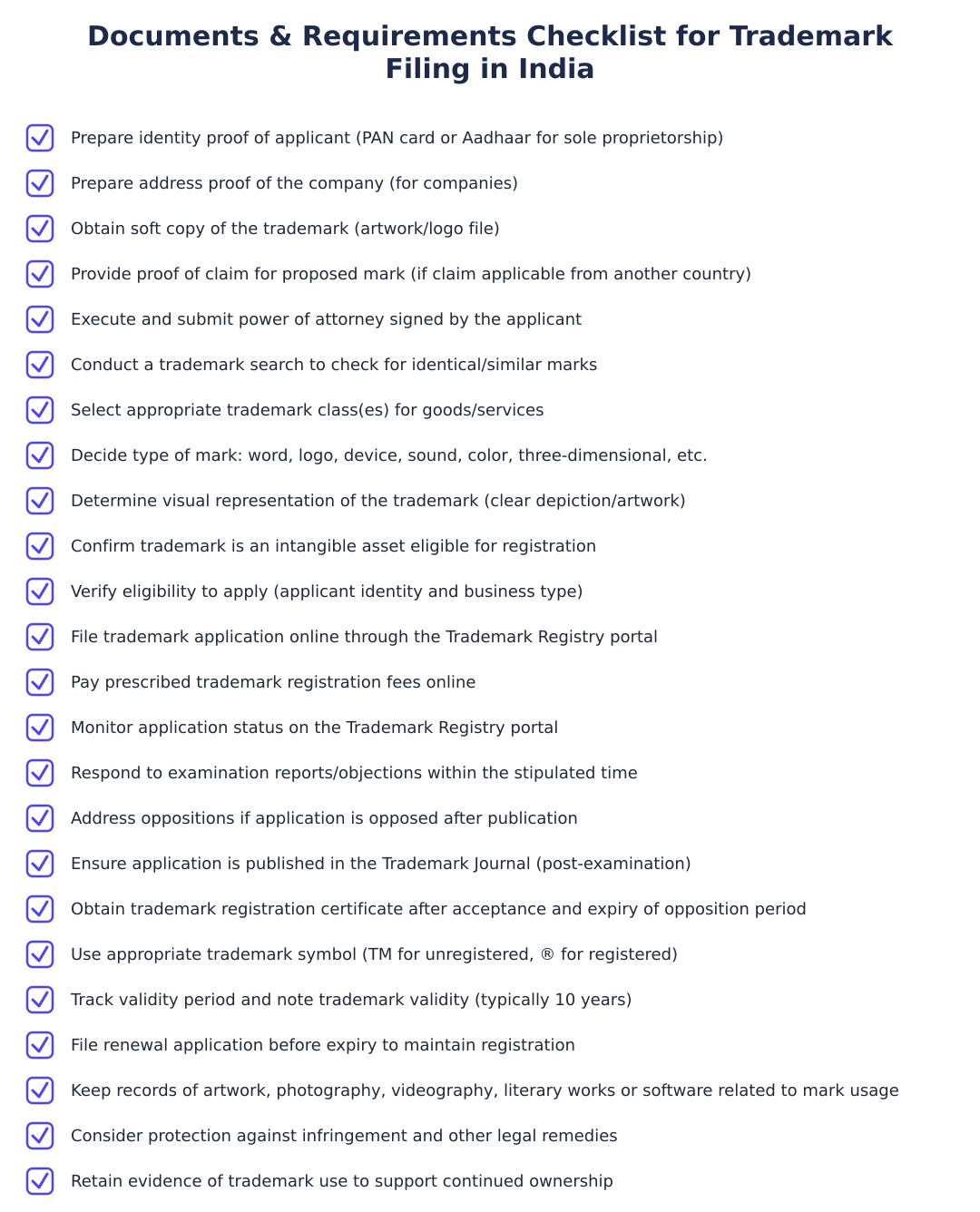
Successful preparation reduces avoidable delays. Good practice includes conducting a clearance search, preparing clean artwork and variants, documenting first use or proposed use, and having clear details of the applicant. Filing with accurate and complete information shortens the process and minimizes objections from the registry.
Online trademark registration procedure, what to expect
The online filing route typically involves creating an account on the official trademark portal, filling an electronic application form, uploading prescribed supporting files (such as representation of the mark and proof of authorisation) and paying the applicable fee through the portal. The interface usually guides applicants through selecting the goods/services and attaching digital files; many registries also provide help text and document checklists.
After filing, you will receive an acknowledgement and an application number that can be used to track status. The registry may issue formal objections or requests for clarification (formalities) which must be addressed through the portal or by submitting responses and supporting documents. If third parties oppose the application during the public opposition window, there will be a procedural path to respond and contest such oppositions.
Key practical points to know before you file
Pick a strong, distinctive mark rather than a descriptive term; distinctive marks are easier to register and enforce. Consider the format (word, logo, device) and whether you need protection for stylisation or colours. Also plan the classes of goods/services carefully, an overly broad list can invite objections, while a too narrow list might limit protection.
Keep organised records of first use, marketing, and evidence of adoption across territories if relevant. Consider whether you need to file in other jurisdictions and whether you will rely on priority claims or international systems; do not assume registration in one place automatically protects you elsewhere. Finally, if you are unsure about search clearance, class selection or handling objections, consult a trademark practitioner to avoid common procedural mistakes.
Benefits of registering a trademark
A registered trademark provides the owner with clearer legal standing to challenge infringers and unauthorised users. It simplifies enforcement through demonstrated ownership recorded at the trademark office. This legal foundation supports anti‑counterfeiting measures, marketplace takedowns and civil remedies where available.
Registration also adds commercial value: it becomes an intangible asset that can be licensed, franchised or assigned, and is often considered in brand valuation and investor due diligence. In addition, registration reduces the risk of costly rebranding later by establishing priority and public notice of your claim to the mark.
Trademark registration is a strategic decision that involves creative, legal and commercial judgment. This guide outlined the concepts and practical preparatory steps you should consider before starting an application online. For exact procedural rules, fees, timelines and official forms you should consult the authorised trademark registry website or retain a qualified trademark attorney who can apply the law to your specific facts.
Frequently asked questions
How do I register a trademark online in India?
You start by filing an application online on the Controller General of Patents, Designs and Trade Marks (IP India) portal and following the examination, publication and registration stages. After filing the e-form with details of the mark and selected class(es), the Registrar examines the application for compliance and distinctiveness; if objections arise they must be replied to before publication in the Trade Marks Journal. The published mark is open to opposition for a statutory period, and if no successful opposition is received the Registrar proceeds to register the trademark and issues a registration certificate. Along the way you will upload required documents (ID/address proof, artwork, proof of claim if any and POA if applicable) and monitor application status online.
Who can apply for trademark registration in India?
Any individual, company, Limited Liability Partnership (LLP) or legal entity can apply to register a trademark and will be named as the owner in the application. For sole proprietors the proprietor’s ID proof such as PAN or Aadhaar can be submitted, while companies must provide appropriate company address proof and director identity documents. The applicant must also supply a soft copy of the trademark, a proof of claim if the mark has prior use abroad (where applicable), and a power of attorney signed by the applicant if represented by an agent. Ownership rights vest in the person named as applicant once the mark is successfully registered.
What documents are required to file a trademark application in India?
You need identity proof and address proof of the applicant (PAN/Aadhaar for proprietors, company address proof for firms), a soft copy of the trademark, and a power of attorney if you appoint an agent. If you claim prior use or priority based on filing in another country, you should upload the supporting proof of claim or priority documents. Depending on the business entity, additional incorporation documents or director IDs may be required; keep digital artwork or sample usage evidence handy for logos, labels or device marks. These documents are uploaded on the IP India portal during the online filing process.
How do I choose the right class for my trademark?
You must select one or more classes from the 45 internationally-aligned trademark classes, classes 1–34 cover goods and classes 35–45 cover services, that accurately describe the goods or services you offer. Choosing the correct class is crucial because registration protection applies only to the class(es) you file under; you can file multiple classes in one application but fees and examination considerations will vary. If your business activities span different classes (for example manufacturing and related services), file for each relevant class to ensure full protection. When in doubt, conduct a class search or consult a trademark professional to avoid under- or over-inclusiveness.
What are the main stages and timeline of a trademark application in India?
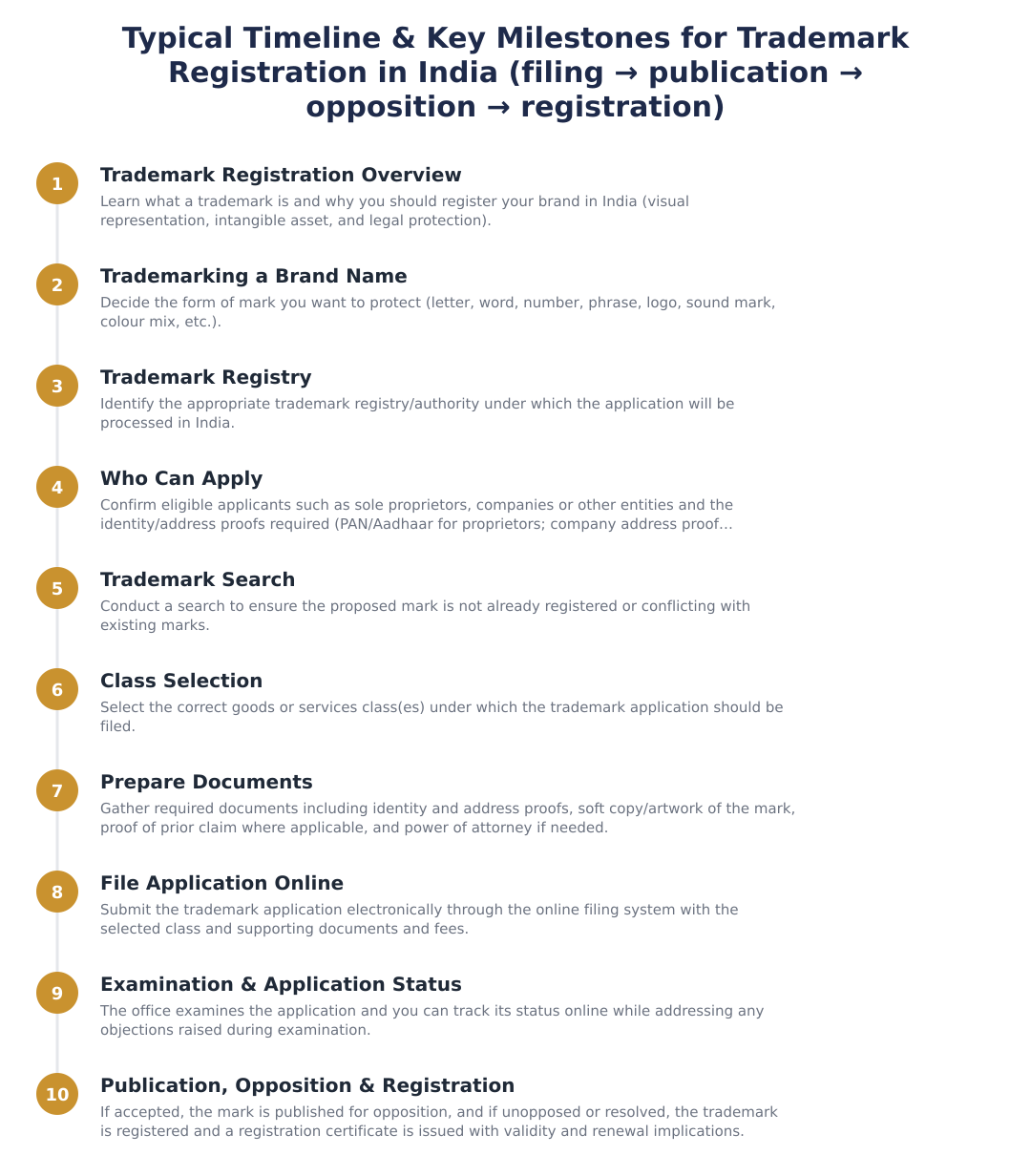
A trademark application goes through filing, examination by the Registrar, publication in the Trade Marks Journal, an opposition window, and finally registration if no adverse proceedings succeed. The initial examination may raise objections that require responses; after successful examination the mark is advertised and open to opposition from third parties for a statutory period (usually four months). If there are no oppositions or if oppositions are decided in your favour, the Registrar issues the registration certificate; the entire process commonly takes several months to a few years depending on objections or oppositions. You can track the application status at each stage on the IP India portal.
Is trademark registration compulsory for using a brand in India?
No, trademark registration is voluntary and not compulsory; however, registration gives exclusive rights and stronger legal remedies against infringement. Unregistered marks may still enjoy limited protection under common law or passing off actions, but enforcement is more difficult and remedies less certain than for a registered trademark. Because registration creates statutory rights, it is strongly recommended to register marks that are important to your business, especially for logos, brand names and distinctive elements. Registered marks also allow you to use ® (after registration) and enjoy a presumption of ownership and validity in court.
What is the validity of a registered trademark and how do I renew it?
A registered trademark in India is valid for 10 years from the date of registration and can be renewed indefinitely for further 10-year periods by paying renewal fees. Renewal applications must be filed before the expiry date; there is typically a grace period with payment of additional fees if renewal is late, but prolonged delay risks removal from the register. After renewal, the Registrar issues an updated registration showing the extended validity; keep track of renewal deadlines to maintain uninterrupted protection. You can also assign or license the trademark; relevant records should be submitted to the Registrar if ownership changes.
What are the benefits of registering a trademark in India?
Registering a trademark confers exclusive right to use the mark nationwide for the goods or services in the registered class(es), a legal presumption of ownership and validity, and stronger remedies against infringement and unauthorised use. Registered marks enable you to use the ® symbol, license or assign the mark commercially, and build intangible asset value, important for branding, investment and enforcement. Registration also deters potential infringers through public notice via the Trade Marks Journal and helps in customs enforcement or domain disputes. Overall, registration transforms a visual brand element into a protected business asset with legal enforceability.
What symbols and types of trademarks can I register in India?
You can register a wide variety of trademarks including word marks, service marks, logos and symbols, shape marks, series marks, collective and certification marks, geographical indications, pattern marks, sound marks, colour marks and three-dimensional marks. Symbols used are TM for an unregistered trademark and ® once the trademark is registered; service marks are often denoted as SM. Some marks such as sound or colour marks require appropriate representation or evidence of distinctiveness and may be examined more closely. Ensure you submit clear visual/audio representations and select the correct mark type during filing to match how the mark is used in commerce.
Need help staying Company Registration compliant?
MoneyGence's AI Finance OS tracks your compliance, wallet share, and finances in one place, built for agencies and growing businesses.
Get started with MoneyGence