What is Payroll? Basics, Process, Compliances & Methods
This guide explains payroll, what it is, how it works in India, the main activities involved before, during and after salary runs, the statutory payroll deductions employers must manage, and common approaches to processing payroll. You will learn a clear definition of payroll, the monthly rhythm of payroll operations for most Indian employers, the cross-team inputs required, the typical components and documents that form part of payroll, and the statutory items you must account for when paying employees. Understanding these basics helps business owners, HR professionals, payroll managers and finance teams design reliable processes, avoid missed deductions, and ensure employees receive accurate payslips and year-end documents. The guide focuses on practical payroll elements used continuously from hiring to retirement, highlights what needs to be collected and computed each cycle, and summarises the common statutory obligations that attach to salary payments. Whether you are implementing payroll for the first time, upgrading systems, or coordinating between HR and finance, this article gives a concise roadmap of the tasks and compliance items that must be handled every payroll cycle.
What is Payroll?
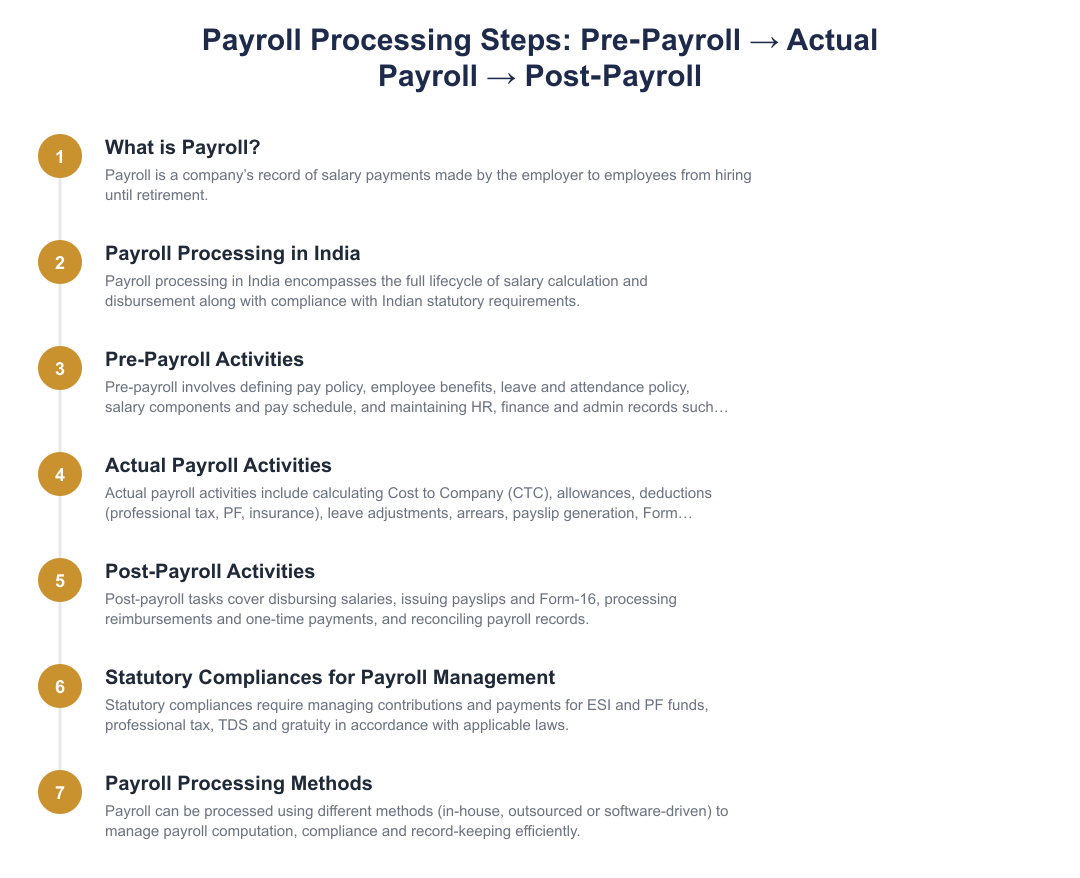
Payroll is a company’s record of salary payments made by the employer to employees from the time an employee is hired until retirement. It is the authoritative history that shows who was paid, how much, and on what basis across the employment relationship.
Beyond being a record, payroll is also the process of paying salary, preparing the list of employees to be paid, calculating dues for a payroll cycle after applying necessary adjustments and deductions, and recording those payments as expenses. Payroll therefore combines calculation, payment and accounting tasks into a recurring operational function.
Payroll Processing in India
In India, payroll is generally processed every month. That monthly cadence shapes the rhythm of activities for HR, payroll and finance teams and establishes regular deadlines for collecting attendance, applying adjustments and making payments.
Payroll processing requires different teams, notably HR, payroll and finance, to work together, though technology can simplify payroll management. Clear roles and timely data exchange between these teams reduce errors and ensure salary payments, deductions and records are consistent across the organisation.
Pre-Payroll Activities
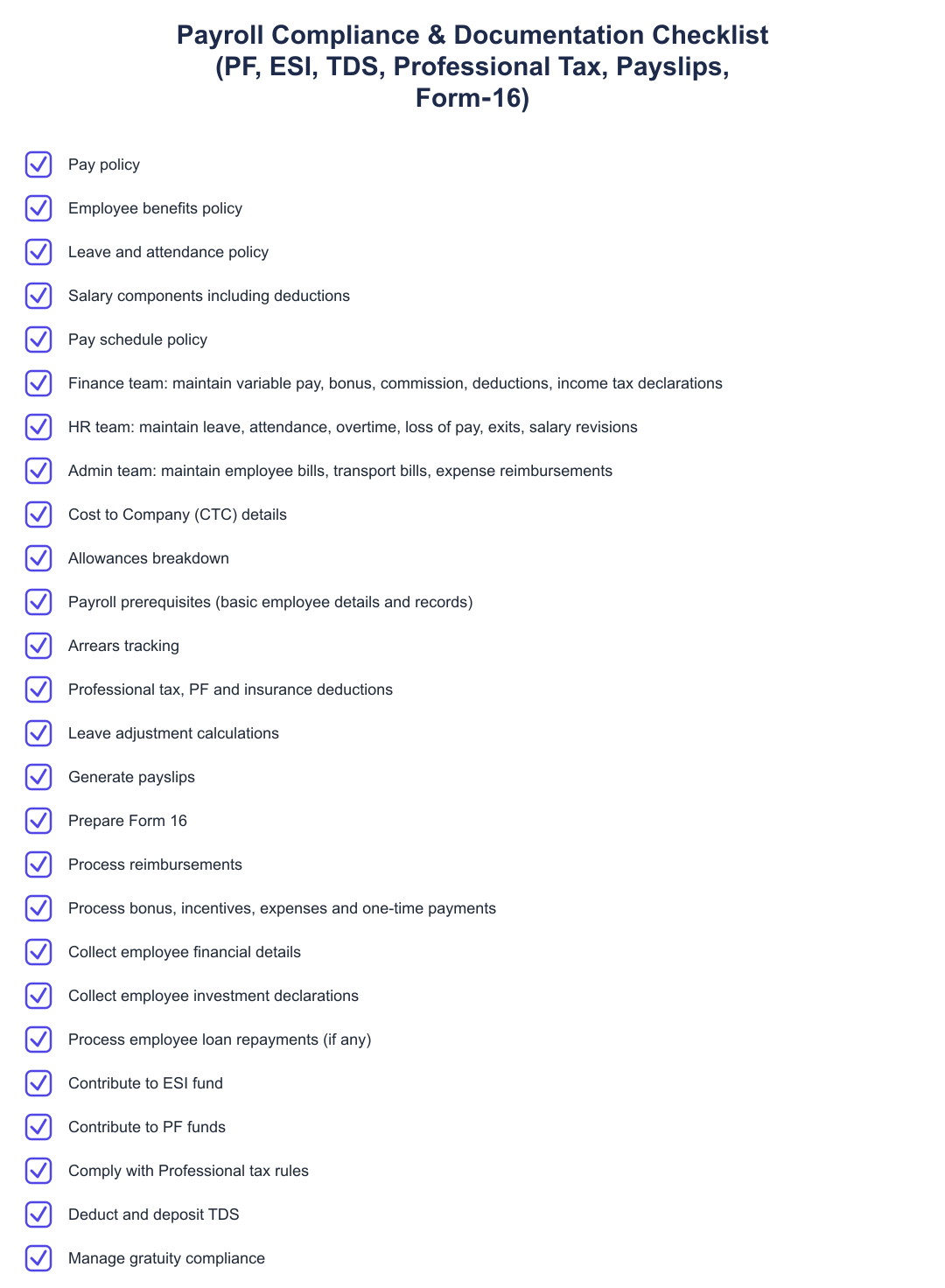
Pre-payroll work gathers the inputs needed to calculate salaries for the upcoming cycle. This includes maintaining employee-specific information such as cost-to-company (CTC), allowances, arrears, leave and attendance details, reimbursements, and any one-time or variable payments. Employers must also collect employee financial details and investment declarations that affect tax-related deductions.
Coordinating these inputs typically involves HR, payroll and finance teams: HR tracks leave, attendance and exit dates; finance maintains records of variable pay, commissions, deductions and tax declarations; and other functions may supply data about reimbursements or bills. Having accurate, up-to-date records at this stage reduces downstream corrections and reconciliation work.
Actual Payroll Activities
During the payroll run the employer prepares the pay list, computes gross and net pay for each employee, applies statutory and agreed deductions, and arranges payments. Typical deductions and adjustments include employee provident fund contributions, tax deduction at source (TDS), professional tax and other authorised deductions such as insurance or loan repayments.
Payslips are generated as part of the payroll run to communicate earnings and deductions to employees. Employers also record the payroll expenses in accounting systems and ensure funds are available to meet salary payments and statutory deposits.
Post-Payroll Activities
After salaries are paid, organisations complete statutory remittances, reconciliations and reporting. This includes depositing contributions to social security funds and making any required filings. Year-end documentation, notably Form 16, is also provided by employers to employees as part of payroll-related tax compliance.
Post-payroll also involves responding to queries, correcting any under- or over-payments found during reconciliation, and updating employee records for future cycles. Maintaining accurate post-payroll records supports audits and ensures continuity in benefits and statutory accounting.
Statutory Compliances for Payroll Management
| Compliance | Nature |
|---|---|
| Employees' State Insurance (ESI) fund | Contribution to a statutory social security fund |
| Provident Fund (PF) funds | Contribution to a statutory retirement savings fund |
| Professional Tax | Statutory payroll deduction |
| TDS (Tax Deduction at Source) | Statutory payroll deduction applied on salary payments |
| Gratuity | Statutory payroll-related liability |
Payroll Processing Methods
Organisations can process payroll using manual spreadsheets, outsourced payroll providers, or payroll software; regardless of method, the essential activities remain the same: gather inputs, calculate pay and deductions, make payments, and record the transactions. Technology can automate calculations, produce payslips and simplify statutory filings, reducing manual effort and errors.
Choosing a method should consider team structure and the need for coordination between HR, payroll and finance. Outsourcing or using integrated payroll systems can centralise data, enforce validation rules, and make it easier to generate required documents such as payslips and Form 16 at year-end.
Payroll is both a record and a recurring operational process that connects HR, payroll and finance functions. By understanding the monthly cycle, gathering accurate pre-payroll inputs, applying statutory deductions and completing post-payroll reconciliations, employers can ensure timely, compliant and transparent salary payments. Using appropriate systems or service models helps streamline these duties and reduces risk of errors in deductions and reporting.
Frequently asked questions
What exactly is payroll in simple terms?
Payroll is a company’s record and process of paying salaries to employees from the time they are hired until they retire. It includes calculating gross pay (CTC, allowances, overtime), applying statutory and voluntary deductions (PF, ESI, professional tax, TDS, insurance), and issuing net pay and payslips each pay cycle, typically monthly in India. Payroll also tracks one-time payments like bonuses, reimbursements, arrears and maintains documentation like Form 16 and payslips for compliance and audits.
What are the main stages of payroll processing?
The main stages of payroll processing are pre-payroll, actual payroll, and post-payroll activities. Pre-payroll includes setting pay policies, collecting employee benefits data, leave and attendance records, and salary component details; actual payroll covers salary calculation, statutory deductions (PF, ESI, TDS), and payslip generation; post-payroll includes salary disbursement, accounting entries, filing statutory returns, and maintaining records like Form 16 and payroll registers. Each stage requires coordination between HR, finance and admin teams to ensure accuracy and compliance.
What should be prepared during pre-payroll activities?
During pre-payroll you must prepare pay policy, employee benefits policy, leave and attendance policy, clear salary components including deductions, and a pay schedule policy. You also need to collect employee-specific data like investment declarations, bank details, loan repayments, and any one-time payments such as reimbursements or bonuses. Ensuring these prerequisites and up-to-date attendance/leave records prevents errors in the payroll run and statutory compliance issues.
Which teams maintain payroll-related information and what do they track?
HR, finance and admin teams jointly maintain payroll-related information with specific responsibilities: finance tracks variable pay, bonuses, commissions, deductions and tax declarations; HR maintains leave, attendance, overtime, exits and salary revisions; admin manages bills, reimbursements and transport claims. Clear division of duties ensures all components, like arrears, one-time payments and loan repayments, are captured before payroll calculation. Regular coordination and data reconciliation between these teams reduces discrepancies and audit issues.
What are the statutory compliances employers must follow for payroll in India?
Employers must comply with statutes such as Employees’ Provident Fund (PF), Employees’ State Insurance (ESI), professional tax, TDS (Tax Deducted at Source) and gratuity as applicable under Indian law. These deductions and employer contributions must be correctly calculated each payroll cycle, deposited within prescribed timelines, and reported in statutory returns; failure can lead to penalties and interest. Additionally, employers must issue Form 16 for TDS and maintain payroll records for audits and inspections.
What payroll components must be included in a salary calculation?
A salary calculation must include Cost to Company (CTC), basic pay, allowances, arrears, reimbursements, variable pay (bonuses, incentives), statutory deductions (employee PF, ESI, professional tax), loan repayments if any, and leave adjustments. It should also account for employee investment declarations that affect tax liability and any one-time payments or deductions. Accurate inclusion of these components ensures correct net pay and compliance with tax and labour laws.
What are the common payroll processing methods companies use?
Companies commonly process payroll in three ways: in-house/manual processing, using payroll software, or outsourcing to a payroll service provider. In-house/manual processing gives full control but is time-consuming and error-prone; payroll software automates calculations, statutory filings and payslips; outsourcing shifts compliance and execution responsibility to specialists, useful for small teams or complex multi-state operations. Choice depends on company size, complexity of payroll components and compliance burden.
What documents and outputs does payroll produce after processing?
After processing, payroll produces payslips, payroll registers, accounting entries, and statutory filings such as TDS returns and contribution statements for PF/ESI, plus Form 16 at year-end. It may also generate reports for leave adjustments, arrears, reimbursements, bonus calculations and audit evidence required by authorities. Maintaining these outputs accurately and securely is essential for employee records, tax compliance and financial audit trails.
Need help staying Payroll compliant?
MoneyGence's AI Finance OS tracks your compliance, wallet share, and finances in one place, built for agencies and growing businesses.
Get started with MoneyGence