How to Track Agency Client Profitability: Utilization, Realization, and Blended Rates
Agencies have a specific profitability problem product businesses don't: billable time that doesn't get billed, discounted rates that erode margin invisibly, and utilization that looks fine in aggregate while individual clients quietly lose
CMS PASTE GUIDE - How to Track Agency Client Profitability
Block labels match your editor toolbar. Skip the title - that goes in the "Guide title" field.
Our earlier guide on client profitability covered the basic formula: revenue minus cost equals profit. That's true, and it's also incomplete for agencies specifically, because agency cost isn't a clean number sitting in a vendor invoice. It's mostly people's time, and time has a habit of disappearing into client work that never gets billed, discounts that quietly erode a healthy rate, and scope that creeps without anyone updating the invoice. This guide covers the three numbers that actually explain why an agency client with a good-looking rate card can still lose you money.
Three Numbers Beyond Simple Revenue Minus Cost
Utilization rate
Utilization is the percentage of a team member's available hours that go toward billable client work, versus internal meetings, admin, pitching, or idle time. The formula: Billable Hours ÷ Available Hours × 100. A healthy agency benchmark is typically in the 70-85% range depending on role - account managers run lower, delivery staff should run higher.
Realization rate
Realization is the gap between what you theoretically could have billed at standard rates and what you actually invoiced. The formula: Amount Actually Billed ÷ (Hours Worked × Standard Rate) × 100. This is where discounts, write-offs, and "we won't charge for that revision" decisions quietly show up.
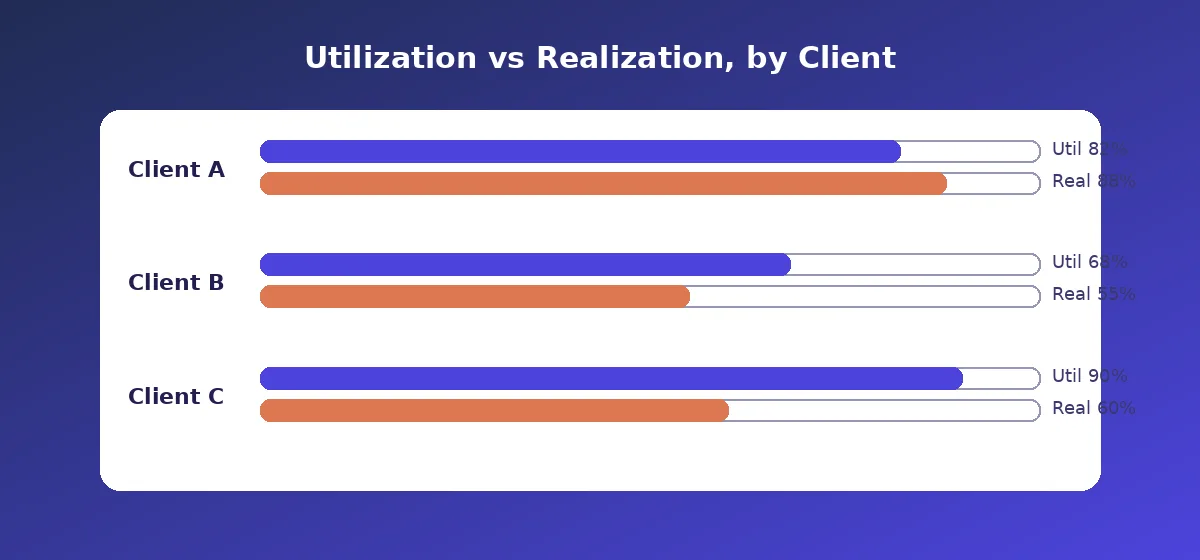
The pattern worth noticing: Client C has the highest utilization (your team spends the most time on them) but one of the lowest realization rates. That combination is a specific warning sign - a lot of hours going in, a shrinking share of it actually getting billed. Client B is low on both, which usually points to scope or relationship problems rather than a pricing issue alone.
Where the Rate Actually Goes: A Waterfall View
It helps to see this as a single flow rather than two separate percentages. Starting from your standard billing rate, here's a realistic breakdown of where it erodes on a typical client:
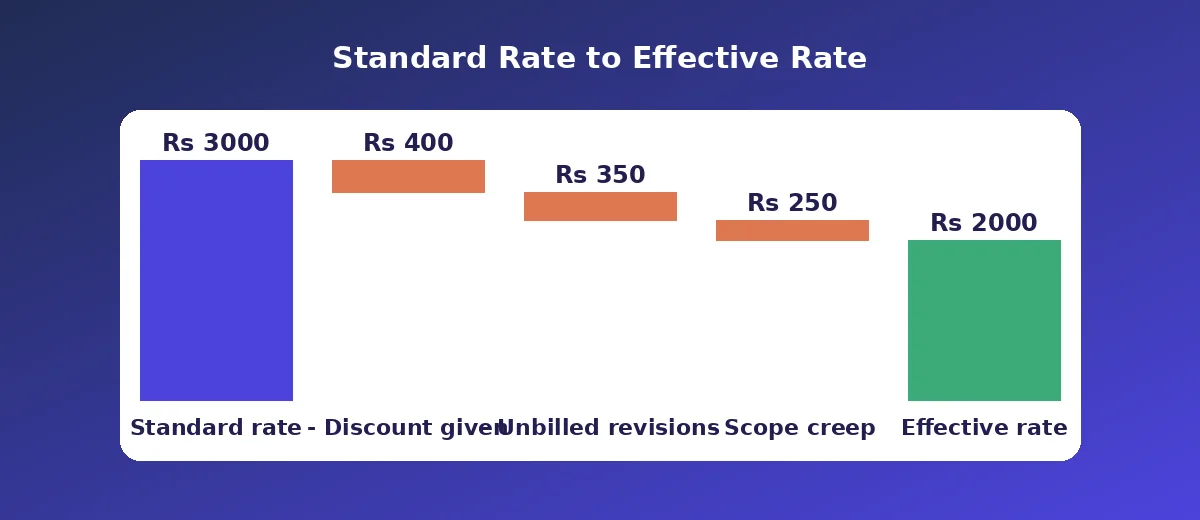
None of these three deductions are unusual on their own - a reasonable discount, the odd free revision, some unbilled scope creep. The problem is that none of them get tracked individually, so nobody notices they add up to a third of the rate disappearing before it reaches the P&L.
Blended Rate: The Number That Hides the Real Problem
Many agencies report a single blended hourly rate across the whole team or the whole agency. It's useful for quick benchmarking, but dangerous as a client-level health metric, because it averages away exactly the problem you're trying to find. A client served mostly by junior staff at a low cost basis can look profitable on a blended view while an identical client served by senior staff at the same billing rate is actually losing money.
Setting This Up Without a Dedicated Tool
- Track time by client, not just by project. Most time-tracking tools support client tagging; the discipline is getting the team to actually use it consistently.
- Log the reason for every discount and write-off. "Discount," "unbilled revision," "scope creep absorbed" - three different problems that need three different fixes.
- Calculate utilization and realization monthly, per client, not just in aggregate across the agency.
- Review clients with high utilization and low realization first. That combination is the clearest signal of a client quietly costing you money.
- Revisit standard rates at least annually against what you're actually realizing - if realization is consistently below 80% across most clients, the standard rate itself may be set wrong, not just individual client behavior.
Common Mistakes Specific to Agencies
- Treating utilization as the only health metric. High utilization with low realization means your team is busy, not that the client is profitable.
- Not separating discount types. A negotiated discount at the start of a relationship is a pricing decision. Unbilled scope creep six months in is a process failure. Treating them the same hides which one to fix.
- Using agency-wide blended rate as a client health check. It averages away the exact variance you need to see.
- Letting account managers "comp" small things informally. Individually harmless, collectively a meaningful chunk of realization lost with no record of why.
- Reviewing this annually instead of monthly. By the time an annual review catches a realization problem, you've absorbed a full year of it.
Frequently Asked Questions
What's a good utilization rate for an agency?
It varies by role, but 70-85% is a common healthy range for billable staff. Account and strategy roles often run lower by design since part of their time is relationship management rather than directly billable work.
What's the difference between utilization and realization?
Utilization measures how much of your team's time goes toward client work at all. Realization measures how much of that work's value actually gets billed and collected at standard rates. A team can be fully utilized and still have poor realization if a lot of that time isn't being charged for.
Why would a client with high utilization still be unprofitable?
Because utilization only shows that your team's time is going toward that client, not whether that time was billed. High utilization paired with low realization usually means significant unbilled work, heavy discounting, or scope creep absorbed without being re-billed.
How is this different from the general client profitability formula?
The general formula (revenue minus cost) is accurate but treats cost as a single number. Utilization and realization break that cost side open specifically for service businesses, where the real driver of margin erosion is usually time and billing discipline rather than a hard vendor cost.
Official references
Need help staying Accounting compliant?
MoneyGence's AI Finance OS tracks your compliance, wallet share, and finances in one place, built for agencies and growing businesses.
Get started with MoneyGence