How to Track Client Receivables: A Practical System for Indian Agencies
Unpaid invoices are the most common reason profitable-looking agencies run out of cash. This guide covers ageing buckets, days sales outstanding, a practical follow-up cadence, and how to set up receivables tracking that actually gets acted
CMS PASTE GUIDE - How to Track Client Receivables
Block labels match your editor toolbar. Skip the title - that goes in the "Guide title" field.
Ask most agency founders how their business is doing and they'll quote revenue. Ask them how much of that revenue is actually sitting in a bank account and a lot of them go quiet for a second. Receivables are the gap between those two numbers - money you've earned, invoiced, and are legally owed, but haven't actually collected. Left untracked, that gap is how profitable-looking businesses run out of cash.
This isn't a bookkeeping nicety. It's the difference between knowing you have a cash problem in week two and finding out in week six, when payroll is due and three clients are all sitting past due at once.
What "Receivables" Actually Means, Practically
A receivable is any invoice you've raised that hasn't been paid yet. That's the textbook definition. The practical definition - the one that actually helps you run a business - adds two more things: how old it is, and how likely it is to actually get collected.
Ageing Buckets: The Core Tool
The standard way to make receivables visible is to sort every open invoice into age buckets. This is not a novel idea - it's standard practice in every finance team globally - but most small agencies never actually set it up, and instead just eyeball a list of unpaid invoices without grouping by urgency.
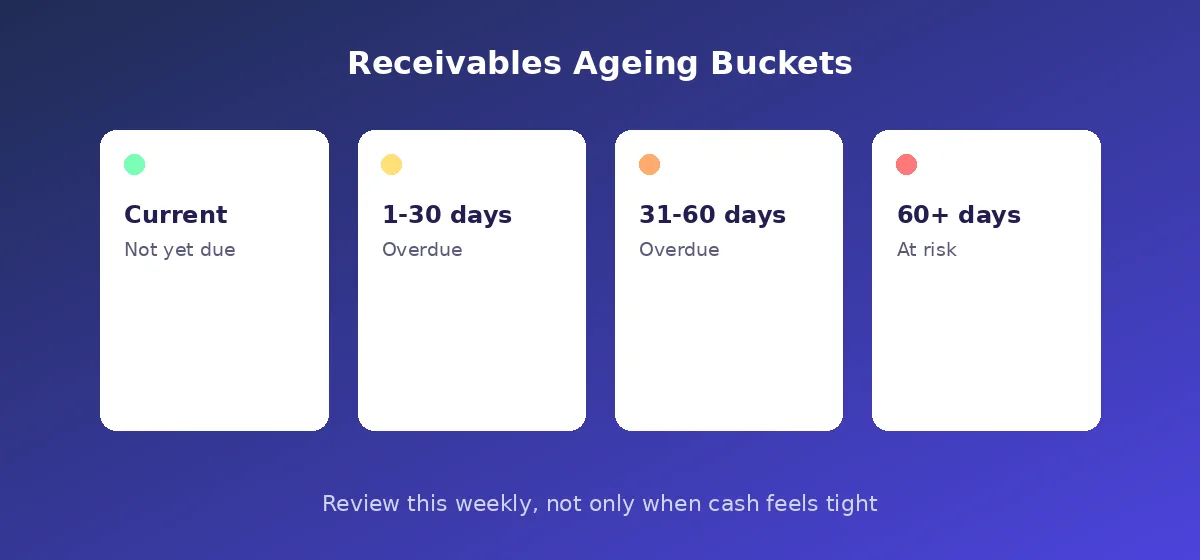
- Current - invoiced, not yet due. No action needed, just visibility.
- 1-30 days overdue - normal follow-up territory. A polite nudge, not a crisis.
- 31-60 days overdue - needs a direct conversation, not just an automated reminder email.
- 60+ days overdue - treat as at-risk. This is where you loop in whoever owns the client relationship, not just finance.
Days Sales Outstanding (DSO): Your One Health Number
If ageing buckets are the detailed view, Days Sales Outstanding is the single number that tells you whether collections are getting better or worse over time. DSO estimates the average number of days it takes you to collect payment after a sale.
The standard formula: (Accounts Receivable ÷ Total Credit Sales) × Number of Days in Period. You don't need to calculate this by hand every week - most accounting tools will surface it, or you can approximate it monthly from your ageing report. What matters is tracking it as a trend, not a one-time snapshot.
A Follow-Up Cadence That Actually Gets Used
The single biggest reason receivables go unmanaged isn't a lack of tools - it's that follow-up is reactive. Someone chases an invoice only once they've already noticed cash is tight, which is far too late. A fixed cadence removes the guesswork.
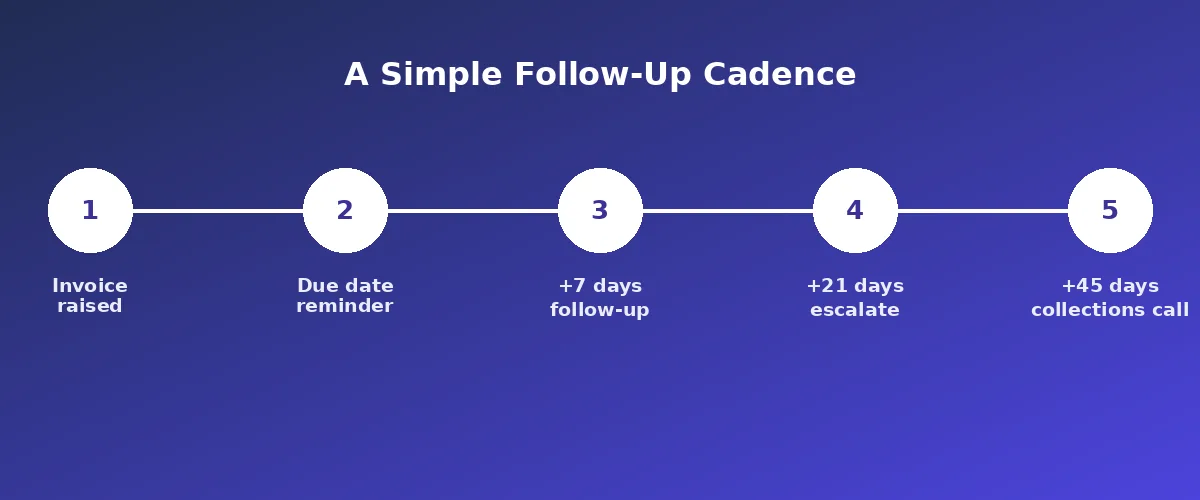
- Invoice raised - logged immediately with issue date and due date, not batched at month-end.
- Due date reminder - an automated or scheduled reminder sent on or just before the due date. Not aggressive, just a nudge.
- +7 days: follow-up - a direct, personal message if payment hasn't landed a week past due.
- +21 days: escalate - involve whoever owns the client relationship, not just accounts. A message from the account lead lands differently than one from "accounts@".
- +45 days: collections conversation - a direct call, and a clear-eyed decision about whether continuing to deliver work for this client without payment makes sense.
Common Mistakes
- Only checking receivables when cash feels tight. By definition, this means you're always finding out late.
- Treating all overdue invoices the same. A client 5 days late and a client 70 days late need completely different responses.
- No fixed cadence, only ad-hoc chasing. Inconsistent follow-up trains clients that your payment terms are flexible.
- Not looping in the relationship owner. Finance chasing a client cold often lands worse than the account manager having a direct conversation.
- Ignoring DSO trend. A single month's number means little; the direction over a quarter is the real signal.
Frequently Asked Questions
What's a good Days Sales Outstanding for a service business?
It varies by industry and your stated payment terms, but as a rough guide, a DSO meaningfully higher than your standard invoice terms (for example, DSO of 60+ against Net 30 terms) signals a collections problem worth addressing directly.
How is DSO different from just tracking overdue invoices?
Overdue invoices show you what's wrong right now. DSO shows you the trend - whether your collections process is getting better or worse over time, even before any single invoice becomes a crisis.
Should I stop work for a client with overdue invoices?
There's no universal rule, but many agencies set a threshold - commonly somewhere past 45-60 days overdue - where continuing to deliver new work without a resolved payment conversation stops making financial sense, regardless of the relationship.
Can I track receivables in a spreadsheet?
Yes, for a smaller number of clients and invoices. It tends to break down once you have more than a handful of overdue invoices across different clients at different ages, since manually updating ageing buckets and DSO calculations every week is easy to let slip.
Official references
Need help staying Accounting compliant?
MoneyGence's AI Finance OS tracks your compliance, wallet share, and finances in one place, built for agencies and growing businesses.
Get started with MoneyGence