Revenue vs Cash Collected: Why Your P&L Can Lie to You

A business can show a healthy profit on paper and still run out of cash - because revenue and cash collected are measured completely differently. Here's what actually separates the two, and how to track the gap before it becomes a crisis.
CMS PASTE GUIDE - Revenue vs Cash Collected
Two agencies can show the exact same revenue on their P&L this quarter - same top line, same apparent growth - and be in completely different financial positions. One has cash in the bank and breathing room. The other is quietly stretching vendor payments and wondering why a "profitable" quarter feels like a cash crisis. The difference almost never shows up in the P&L. It shows up in the gap between revenue and cash collected.
This is one of the most common blind spots in growing service businesses, and it's entirely avoidable once you understand what's actually being measured.
What Each Number Actually Measures
Revenue is recognised the moment you've earned it - typically when the work is delivered or the invoice is raised, depending on your accounting method. It's an accrual concept. It tells you what you're owed, not what you have.
Cash collected is simpler and far less forgiving: it's money that has actually landed in your bank account. No assumptions, no accruals, no "should arrive soon."
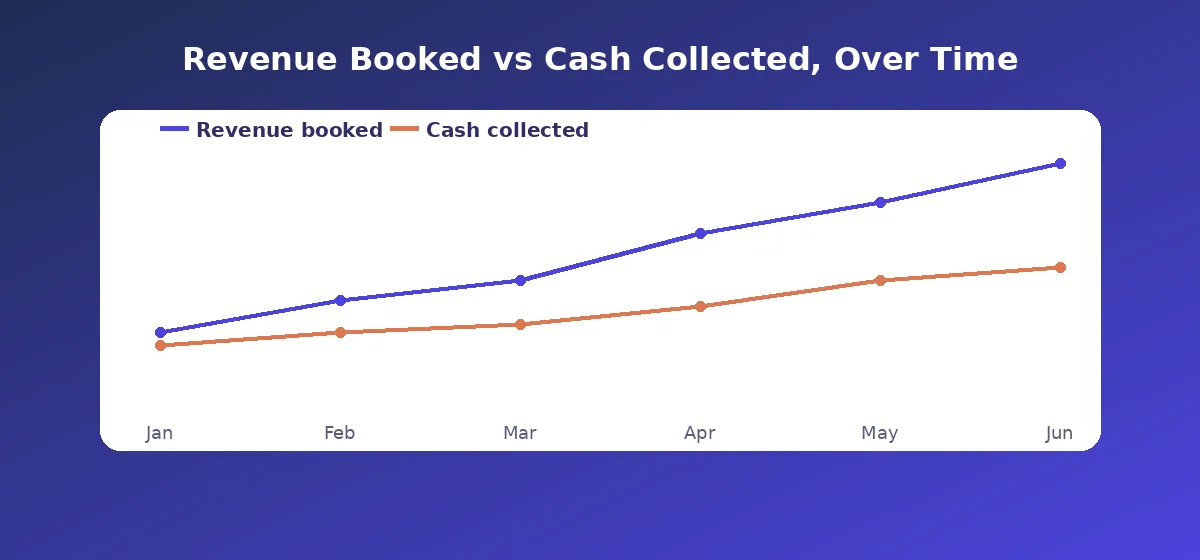
The chart above is the pattern to watch for: revenue climbing steadily while cash collected lags behind and the gap widens month over month. Growth alone will produce this pattern even in a healthy business - new invoices get raised faster than old ones get paid - which is exactly why it's dangerous to ignore. Growth makes the gap bigger, not smaller.
Why the Gap Exists
- Payment terms. A Net 30 or Net 45 invoice is legitimate revenue the day it's raised, but it's 30-45 days from being cash.
- Late payers. Even strong clients with good intentions slip past agreed terms regularly, and that slippage compounds across multiple clients.
- Growth itself. The faster you're signing new work, the faster new invoices pile up relative to old ones getting collected - a growing business almost always has a growing receivables gap, by default.
- Partial payments and disputes. Scope disagreements, partial sign-offs, and milestone-based billing all create invoices that sit in limbo longer than clean, simple ones.
Same Revenue, Different Reality
Here's what the same top-line number looks like in practice for two agencies with identical revenue but very different collections discipline:
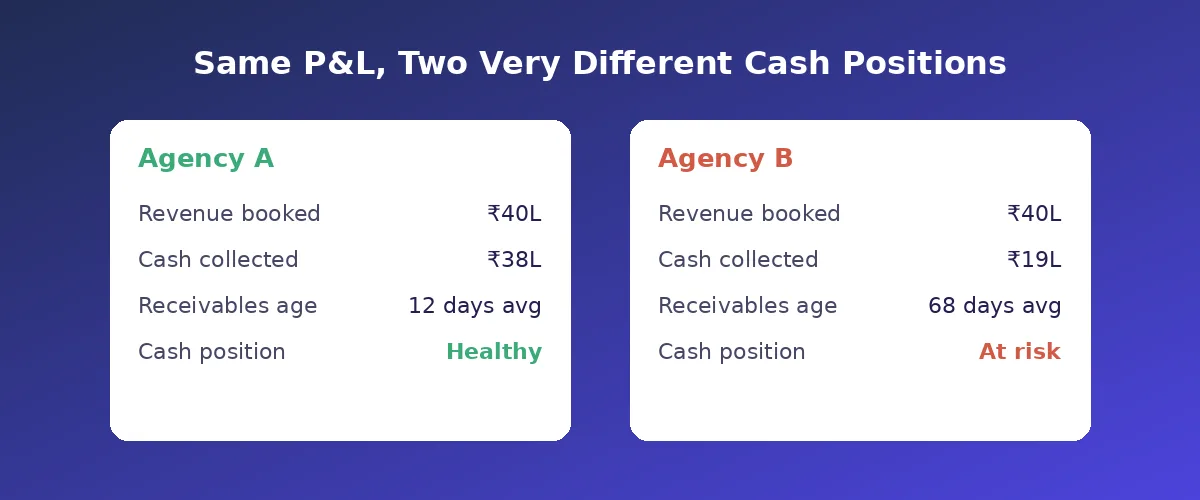
Both agencies booked ₹40L. One is sitting on ₹21L less cash than their P&L implies, with receivables averaging 68 days old. On paper, both look equally profitable. In the bank, they're not remotely the same business.
How to Track Both, Side by Side
- Put both numbers on the same report. Revenue booked and cash collected, same period, same page - not in two separate tools that nobody cross-checks.
- Watch the trend, not the snapshot. A gap that's stable month to month is normal and manageable. A gap that's widening is the thing to act on.
- Tie it back to receivables ageing. The gap between revenue and cash is, almost by definition, your outstanding receivables - so this connects directly to tracking what's owed and by whom.
- Review cash collected weekly, revenue monthly. Revenue moves slower and matters for planning; cash moves fast and matters for survival. Match your review cadence to each.
- Don't let "we're profitable" end the conversation. Treat it as the first half of the picture, not the whole answer, when someone asks how the business is doing.
Common Mistakes
- Treating revenue as a proxy for cash. They correlate, but not tightly enough to plan hiring, vendor payments, or expansion off revenue alone.
- Only noticing the gap when it's already a crisis. The pattern is visible months in advance if you're tracking both numbers regularly.
- Not connecting this to receivables tracking. Revenue vs cash collected and receivables ageing are two views of the same underlying problem - treating them as separate topics means solving half the puzzle.
- Assuming growth will fix it. Growth usually widens the gap before it narrows it, since new invoices keep outpacing old collections.
Frequently Asked Questions
Can a business be profitable and still run out of cash?
Yes, and it's one of the most common ways growing service businesses get into trouble. Profit is an accounting measure based on revenue earned; cash is what's actually available to pay bills, salaries, and vendors. A business can show a profit on its P&L while being cash-negative in reality if too much revenue is sitting uncollected.
Is this the same as the difference between cash and accrual accounting?
Related, but not identical. Cash vs accrual is about which accounting method you use for your books. Revenue vs cash collected is a practical tracking habit that applies regardless of which method your books use - even accrual-basis businesses need to watch actual cash separately for day-to-day survival.
How often should I compare revenue and cash collected?
Monthly at minimum for the trend, weekly for cash collected specifically if your business has tight margins or significant receivables outstanding.
What's a healthy gap between revenue and cash collected?
There's no universal number - it depends on your payment terms and client mix - but what matters most is whether the gap is stable or widening over consecutive months. A stable gap proportional to your payment terms is normal; a steadily widening one is the warning sign.
Explore More
Related guides:
How to Track Client Receivables,
How to Track Client-Wise Revenue,
How to Register a Private Limited Company in India
Official references
Need help staying Accounting compliant?
MoneyGence's AI Finance OS tracks your compliance, wallet share, and finances in one place, built for agencies and growing businesses.
Get started with MoneyGence