How to Register a Private Limited Company in India: A Step-by-Step Guide (2026)
A practical walkthrough of registering a Pvt Ltd company in India - the SPICe+ process, required documents, real costs, timelines, and the mistakes that actually delay incorporation.
CMS PASTE GUIDE - How to Register a Private Limited Company in India
Each block below is labeled with which editor button to click before pasting that chunk. Skip pasting a heading for the title itself - that's already in the "Guide title" field.
If you've spent an evening with five browser tabs open - one for the MCA portal, one for a "SPICe+ explained" video, one for a CA's WhatsApp number - you already know the problem. Registering a company in India isn't hard, exactly. It's just scattered across enough forms and acronyms that it's easy to lose an afternoon before you've even reserved a name. This guide puts the whole process in one place.
What a Private Limited Company Actually Is
A private limited company is a separate legal entity registered under Section 2(68) of the Companies Act, 2013. "Separate legal entity" is the part that matters practically: the company can own assets, sign contracts, sue and be sued, and survive a change in ownership - all independent of the individual founders. Your personal liability is limited to what you've invested in shares, which is the whole point if you're taking on vendor contracts, hiring staff, or raising capital.
It's not the only structure available, and it's worth being honest that it isn't always the right one.
| Structure | Minimum people | Liability | Compliance load | Best suited for |
| Private Limited Company | 2 directors + 2 shareholders | Limited | High (ROC filings, audit, AGM) | Startups raising funding, agencies scaling headcount |
| One Person Company (OPC) | 1 director + 1 nominee | Limited | Medium | Solo founders who still want limited liability |
| LLP | 2 designated partners | Limited | Low–Medium | Professional/services firms not chasing VC funding |
| Partnership | 2 partners | Unlimited | Low | Small, low-risk local businesses |
If you're a services or consulting business planning to bring on clients, employees, and eventually investors, Pvt Ltd is usually the default recommendation. If you're a solo consultant who wants limited liability without the compliance overhead, an OPC or LLP is worth a serious look before you default to Pvt Ltd out of habit.
Who's Eligible, and What You'll Need on Hand
Before you touch the MCA portal, get these ready - half the delays we see come from scrambling for documents mid-filing rather than the filing itself.
For each director/shareholder
- PAN card (mandatory for Indian nationals)
- Aadhaar card or passport/driving licence as address proof
- A recent utility bill or bank statement (not older than 2 months) as residential proof
- Passport-size photograph
- For NRI or foreign directors: documents notarised and apostilled in their country of residence
For the registered office
- Utility bill or property tax receipt (not older than 2 months)
- Rent agreement and a No Objection Certificate from the owner, if the premises are rented
Structural basics
- At least 2 directors (minimum 1 must be an Indian resident - someone who's stayed in India for 120+ days in the preceding financial year)
- At least 2 shareholders (directors and shareholders can be the same people)
- A registered office address (residential addresses are allowed)
The SPICe+ Process, Step by Step
Everything now runs through SPICe+ (Simplified Proforma for Incorporating Company Electronically Plus) on the MCA V3 portal - a single integrated form that replaced the five-to-eight separate filings founders had to juggle before 2020.
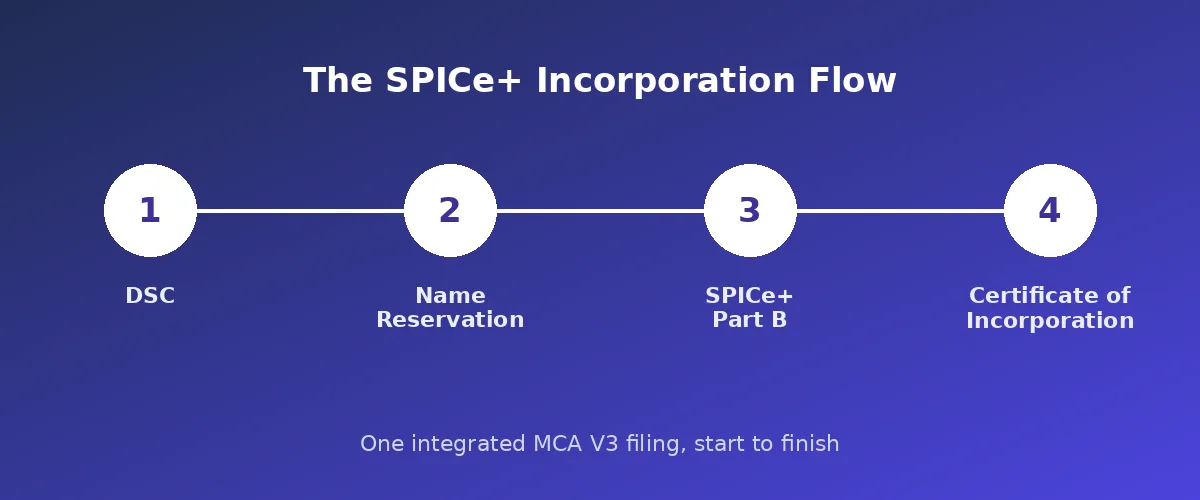
- Get Digital Signature Certificates (DSC). Every proposed director needs a Class 3 DSC to sign forms electronically. This involves a short video KYC with a licensed certifying authority and typically takes 1–2 days.
- Register on the MCA V3 portal. Each director and the professional handling your filing needs a business user account at mca.gov.in.
- Reserve your name (SPICe+ Part A). Submit up to two proposed names. The MCA checks these against existing companies, trademarks, and its own naming rules, typically responding within 1–3 working days.
- Draft your MOA and AOA. The Memorandum of Association and Articles of Association are auto-generated inside SPICe+ based on your inputs - you don't need to write these from scratch.
- Choose your NIC code. This classifies your business activity for regulatory purposes. Pick the code that actually reflects what you do.
- File SPICe+ Part B with AGILE-PRO-S. This captures your incorporation details, DIN allotment (up to 3 directors), registered office particulars, and the INC-9 declaration. AGILE-PRO-S simultaneously applies for your GSTIN, EPFO, ESIC registration, and a bank account.
- Get it certified and submit. A practicing CA, CS, or cost accountant certifies the forms before submission - this isn't optional.
- Receive your Certificate of Incorporation. Once the ROC approves, you get your Certificate of Incorporation along with your CIN, PAN, and TAN issued together.
Realistic Timeline
| Stage | Estimated time |
| DSC procurement | 1–2 days |
| Name reservation (SPICe+ Part A) | 1–3 days |
| MOA/AOA drafting and NIC code selection | 1–2 days |
| SPICe+ Part B filing and ROC scrutiny | 3–7 working days |
| Certificate of Incorporation | Issued on approval |
| Bank account activation | 3–5 days post-incorporation |
| Total | 7–15 working days |
What It Actually Costs
Most guides quote a single number, which is misleading - the real total depends heavily on your state and your declared authorised capital. Here's the honest breakdown for a standard 2-director Pvt Ltd with authorised capital up to ₹15 lakh:
| Component | Typical cost | Notes |
| Name reservation | ₹1,000 | Non-refundable per application |
| SPICe+ government filing fee | ₹0 | Nil up to ₹15 lakh authorised capital; rises in slabs above that |
| DIN allotment | Included | No separate fee within SPICe+ |
| PAN & TAN | ₹0 | Auto-allotted with the Certificate of Incorporation |
| Digital Signature Certificates | ₹1,500–₹2,500 per director | Class 3 DSC, 2-year validity recommended |
| Stamp duty (MOA + AOA) | ₹200–₹12,600 | The biggest swing factor — set by your state |
| Professional fees (CA/CS) | ₹5,000–₹15,000 | Drafting, filing, and compliance setup |
| Typical total | ₹7,000–₹25,000 | Mostly driven by state stamp duty and who you hire |
After Incorporation: What Actually Matters
Getting your Certificate of Incorporation isn't the finish line - it's the start of a recurring compliance calendar.
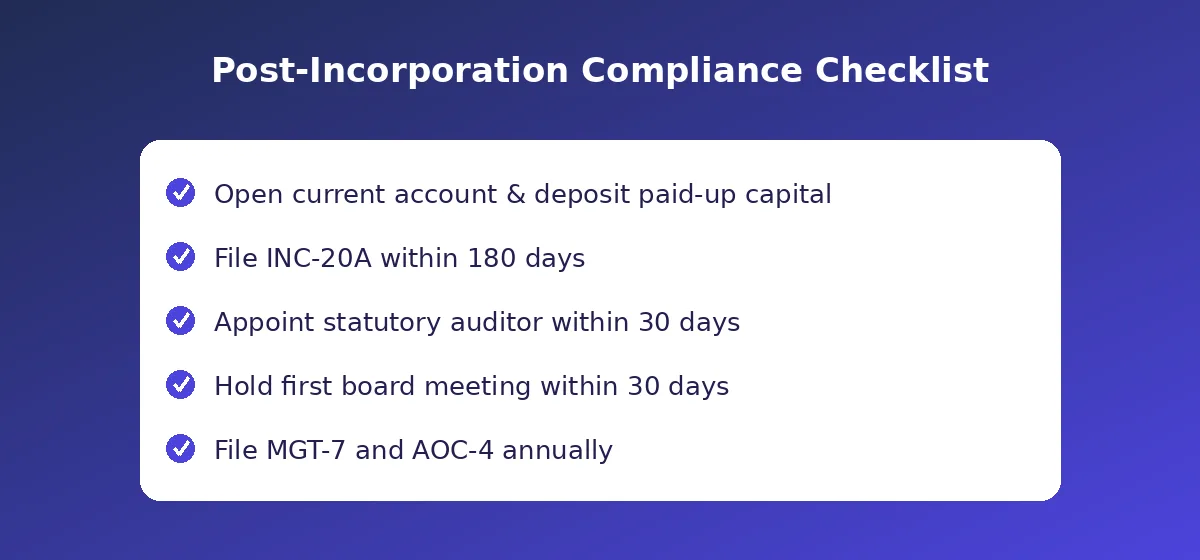
- Open your current account and deposit paid-up capital within the timeline specified in your MOA
- File INC-20A (Commencement of Business declaration) within 180 days of incorporation
- Appoint a statutory auditor within 30 days of incorporation
- Maintain statutory registers and hold your first board meeting within 30 days
- File annual returns (MGT-7) and financial statements (AOC-4) with the ROC every year
- Track GST, TDS, and client-wise receivables from day one
A lot of newly incorporated service businesses and agencies quietly lose money not from bad clients, but from not having client-wise visibility into what's been billed, collected, and left outstanding. It's a separate problem from incorporation, but it starts on day one, not month six.
Common Mistakes That Actually Delay Registration
- Proposing a name too similar to an existing trademark or company. Search the MCA and IP India trademark databases before you submit, not after rejection.
- Object clause that doesn't match the NIC code. If your business is consulting but your object clause reads like a trading company, expect a query from the ROC.
- Outdated address proof. Utility bills and bank statements older than 2 months get rejected outright.
- Skipping INC-20A. Penalties, plus you can't legally commence business.
- Choosing authorised capital carelessly. Most first-time founders are better off starting at ₹1 lakh and increasing it later if needed.
Frequently Asked Questions
How long does private limited company registration take in India?
Most straightforward applications with clean documents take 7–15 working days from DSC procurement to Certificate of Incorporation. Resubmissions due to document or naming issues are the main cause of delay beyond that window.
Can I register a company without a CA or CS?
The forms must be certified by a practicing professional, so you can't file entirely without one - but many founders handle document collection and name selection themselves and only bring in a professional for the certification and filing step.
Is there a minimum capital requirement for a private limited company?
No. The Companies Act, 2013 removed the minimum paid-up capital requirement, so you can incorporate with as little as ₹1, though most founders start with ₹1 lakh authorised capital for practical reasons.
Do I need a physical office to register?
No - a residential address can serve as your registered office, provided you have the required proof.
What happens if my proposed company name gets rejected?
You lose the ₹1,000 name reservation fee and need to reapply with a new name.
Can a foreigner or NRI be a director?
Yes, but at least one director must be an Indian resident. Foreign directors' documents need notarisation and apostille from their home country.
Official references
Need help staying Company Registration compliant?
MoneyGence's AI Finance OS tracks your compliance, wallet share, and finances in one place, built for agencies and growing businesses.
Get started with MoneyGence