Factory Compliance in India: Checklist & Key Rules (Factories Act 1948
This guide explains what factory compliance means in India, who must follow the Factories Act compliance checklist, the core provisions of the Factories Act, 1948, and practical checklist items and best practices for staying compliant. You will learn the threshold tests that determine whether an industrial unit must follow the Act, which central and state authorities administer it, the principal subject areas covered by the law (health, safety, hazardous processes, welfare, working hours, employment of young persons, leave and special provisions), and the routine obligations factories must keep up with, such as record-keeping, display of statutory notices, and safety arrangements. Understanding these elements matters because compliance protects worker health and safety, reduces legal and operational risk for employers, and helps ensure continuity of operations by keeping licences and approvals in order. The guide is aimed at factory managers, owners, compliance officers and HR/operations professionals who need a concise, actionable reference to the Act’s scope and the practical steps commonly included in factory audits and inspections.
What is Factory Compliance?
Factory compliance refers to the actions and systems a factory implements to meet its legal and operational obligations under the Factories Act, 1948 and related labour and safety expectations. At its core, compliance covers worker rights, health, safety, hygiene, welfare, and terms of work that the law requires factories to safeguard.
Practically, this means maintaining appropriate working conditions, securing machinery, managing hazardous processes, providing welfare facilities such as rest rooms, canteens and first aid, and keeping contemporaneous records and statutory notices. These measures not only fulfil legal obligations but also reduce workplace risk and support worker wellbeing.
Because obligations under the Act are ongoing, compliance is a continuous management task: systems must be sustained, records maintained and production processes periodically reviewed to ensure that the protections intended by the law remain effective over time.
Who Must Follow the Factory Act Compliance Checklist?
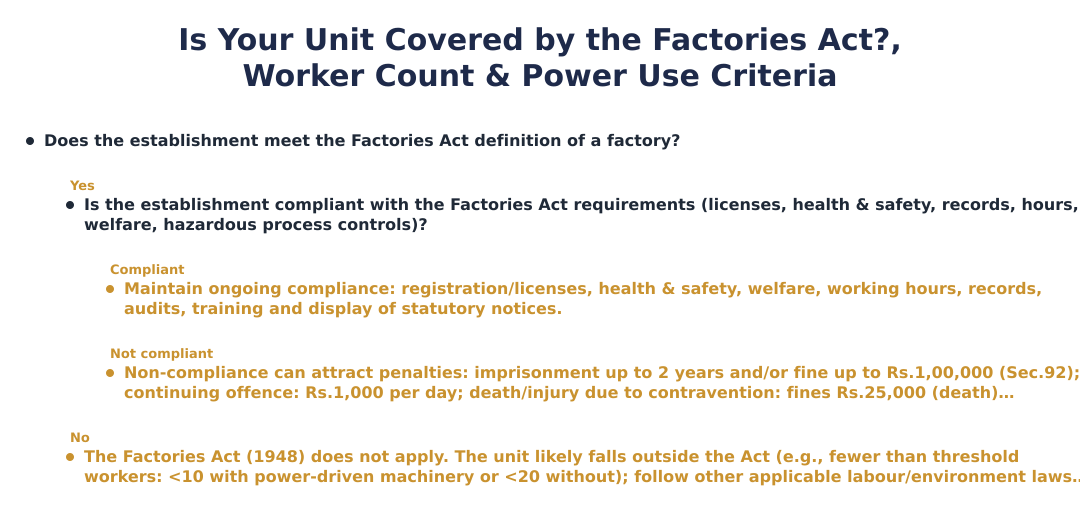
The Act applies to industrial units based on the nature of operations and the number of workers. Specifically, a factory that uses tools or machinery running on electricity/power in any part of its operations and has a headcount of 10 or more workers on any day during the last 12 months must follow the Factories Act compliance checklist.
Similarly, a factory that does not use tools or machinery running on electricity/power in any part of its operations and has a headcount of 20 or more workers on any day during the last 12 months must follow the Factories Act compliance checklist.
These threshold tests are important for managers to determine whether the Act’s obligations apply. Where the thresholds are met, the unit must adopt the procedural and record-keeping practices required under the Act and be prepared for inspections by the administering authorities.
What is the Factories Act, 1948?
The Factories Act, 1948 is legislation governing worker rights, safety, health, hygiene and wellbeing in factories in India. It sets out a statutory framework of chapters that address specific aspects of factory operations and worker protection.
Notable subject chapters of the Act include Health (Chapter III), Safety (Chapter IV), Provisions relating to Hazardous processes (Chapter IVA), Welfare & Grievance (Chapter V), Working hours of adults (Chapter VI), Employment of young persons (Chapter VII), Annual leave with wages (Chapter VIII) and Special provisions (Chapter IX). These chapters collectively define core obligations employers must meet.
The Act has been amended since enactment; for example, it was amended by the Factories (Amendment) Act, 1987. At the administrative level, the Ministry of Labour and Employment administers the Act centrally through the Directorate General, Factory Advice Service & Labour Institutes (DGFASLI), while state governments administer provisions through their respective labour or welfare ministries.
Factory Compliance Rules & Requirements in India
Compliance obligations under the Act include a mix of facility-level measures, workforce protections and documentation duties. Facility measures encompass securing machinery and guarding moving parts, implementing safeguards around hazardous processes, and providing on-premise welfare facilities such as rest rooms, canteens and first-aid equipment.
Workforce protections cover health, safety and working-time rules, employment conditions for young persons, and provisions for leave with wages. Employers are expected to manage exposure to hazardous materials and control related risks to workers as part of the safety framework.
Documentation and transparency are central: factories must maintain records and display statutory notices and abstracts of the Act so that workers and inspectors can verify compliance. Failure to maintain proper records may have incriminating consequences for management, so record-keeping is both a legal and practical control.
Factory Compliance Checklist in India
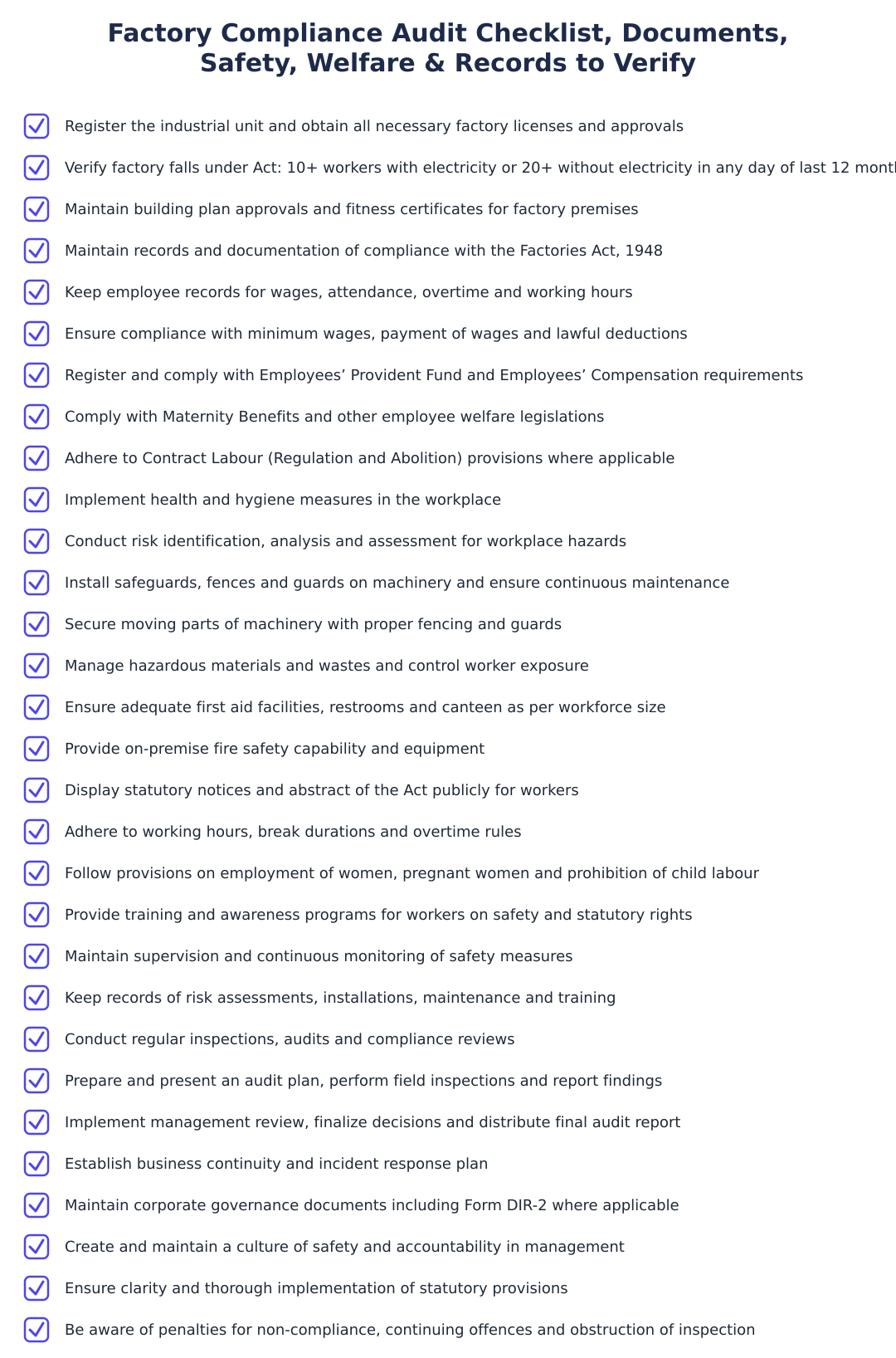
A practical compliance checklist typically covers registration and licences, health and hygiene arrangements, workplace safety measures, wage and working-hours compliance, welfare facilities and documentation. Core items to check include whether the unit is appropriately registered and whether required licences and permissions are in place and current.
Health and safety items include securing machinery and guards, assessing and controlling hazardous processes, continuous monitoring and maintenance of safeguards, and maintaining first-aid capability. Welfare checks include adequate rest rooms, canteen facilities and other worker amenities appropriate to the workforce size.
Administrative checklist items focus on maintaining accurate records of wages, hours and overtime, displaying statutory notices and abstracts of the Act, and ensuring workers are informed about their rights and responsibilities. Regular internal inspections, audits and supervision are part of a robust checklist to confirm that procedures are actually implemented on the ground.
Best Practices for Ensuring Factory Compliance
Adopt a culture of safety and accountability where management and workers understand roles and statutory duties. Clear communication of rules, routine training and awareness-building for employees help ensure that safety measures and welfare provisions are followed consistently.
Implement comprehensive documentation and record-keeping systems so that licences, registers and statutory notices are up to date and evidence of compliance is available for inspections. Regular internal inspections and audits, together with proactive risk assessment and maintenance schedules for machinery and guards, reduce the likelihood of incidents.
Combine technical safeguards (fencing, guarding, engineering controls) with organisational measures (supervision, training, emergency preparedness and incident response). Continuous review and improvement, rather than one-time fixes, will help a factory meet ongoing obligations under the Act.
Frequently Asked Questions
Q: Who administers the Factories Act? A: The Ministry of Labour and Employment administers the Act centrally through DGFASLI, while state governments implement provisions through their labour/welfare ministries.
Q: Which parts of factory operations does the Act cover? A: The Act covers health, safety, hazardous processes, welfare and grievance procedures, working hours of adults, employment of young persons, annual leave with wages and special provisions as organised in its chapters.
Q: What records should factory owners keep? A: Owners should maintain records and notices required to substantiate compliance; the content implies ongoing obligations such as maintaining records, displaying statutory notices, securing machinery, providing first aid, canteen and rest rooms, and following working hours and overtime rules under the Act.
Staying compliant under the Factories Act, 1948 requires knowing whether the Act applies to your unit, implementing health and safety controls, providing welfare facilities, keeping accurate records and remaining prepared for inspections by central and state authorities. Use the checklist and best practices above as a foundation; continuous monitoring, training and documentation are the practical steps that convert legal requirements into safer workplaces.
Frequently asked questions
What are the basic registration and licensing steps to start a factory in India?
You must register the industrial unit with the state factory inspector and obtain required licences and fitness certificates before starting operations. This typically includes approval of building plans, a fitness certificate after construction, factory registration under the Factories Act, and any environment or local municipal permissions depending on the process and waste discharge. Keep copies of all licences and renewals accessible on-site and ensure any changes in machinery, product mix or workforce size are notified to the inspector. Failure to register or obtain required permits can attract penalties under the Act and stop-work orders from authorities.
Who must follow the factory compliance checklist under the Factories Act?
Any industrial unit that uses power-driven machinery with 10 or more workers, or any unit without power-driven machinery with 20 or more workers, must follow the factory compliance checklist. The headcount test applies to any day in the previous 12 months, so existing and newly starting units meeting these thresholds fall within the Act. State rules may prescribe additional local requirements, so management should confirm thresholds and registration processes with the local inspecting authority. Smaller establishments may still be subject to other labour laws and local safety norms.
What are the main health and safety obligations under the Factories Act, 1948?
The Factories Act requires employers to provide health, safety and welfare measures such as proper ventilation, cleanliness, guarding of machinery, first-aid facilities, canteens and restrooms according to workforce size. The Act is divided into chapters covering Health (III), Safety (IV), Hazardous Processes (IVA), Welfare (V) and Working Hours (VI), and it mandates risk assessment, guarding of moving parts, worker training, and maintenance of safety devices. For hazardous processes additional controls, notifications and safety audits are required under Chapter IVA. Records of inspections, risk assessments, and safety training must be maintained for inspection by authorities.
What documents and records must a factory maintain for compliance audits?
Factories must maintain registration and licence documents, wage and attendance records, health and safety records (risk assessments, inspection reports), welfare facility records, and statutory forms and returns required under the Act. Corporate governance documents, business continuity and incident response plans, and any Form DIR-2 or similar declarations should be available during inspections. Documentation should be continuous and up to date because failure to produce records can be incriminating in the event of an accident or legal scrutiny. Proper filing and periodic internal audits help ensure readiness for statutory inspections and third-party audits.
What are the penalties for non-compliance with the Factories Act?
Penalties for contravening the Factories Act include imprisonment up to two years, a fine up to Rs.1,00,000, or both for general offences under Section 92, with continuing offences attracting Rs.1,000 per day. More serious outcomes like death or injury due to contravention carry fines ranging from Rs.5,000 (serious injury) to Rs.25,000 (death) under Section 94. Obstructing inspection (Section 95) or wrongfully disclosing factory information (Section 96) can lead to imprisonment up to six months, fines up to Rs.10,000, or both, while workers violating provisions may be fined up to Rs.500 (Section 97). These penalties apply in addition to administrative actions such as closure orders or suspension of licences by state authorities.
How should a factory manage hazardous materials and processes to remain compliant?
A factory must identify hazardous processes, notify the inspector, implement engineering controls such as safeguards and fences, maintain guards, and conduct regular monitoring and safety audits as required under Chapter IVA. Management must maintain records of risk identification, mitigation measures, continuous monitoring, worker training and supervision specific to hazardous operations. Emergency response plans, proper storage and waste disposal procedures, and restrictions on exposure must be documented and periodically tested. Non-compliance in hazardous processes attracts stricter enforcement and higher penalties under the Act.
What does a typical factory compliance audit checklist include?
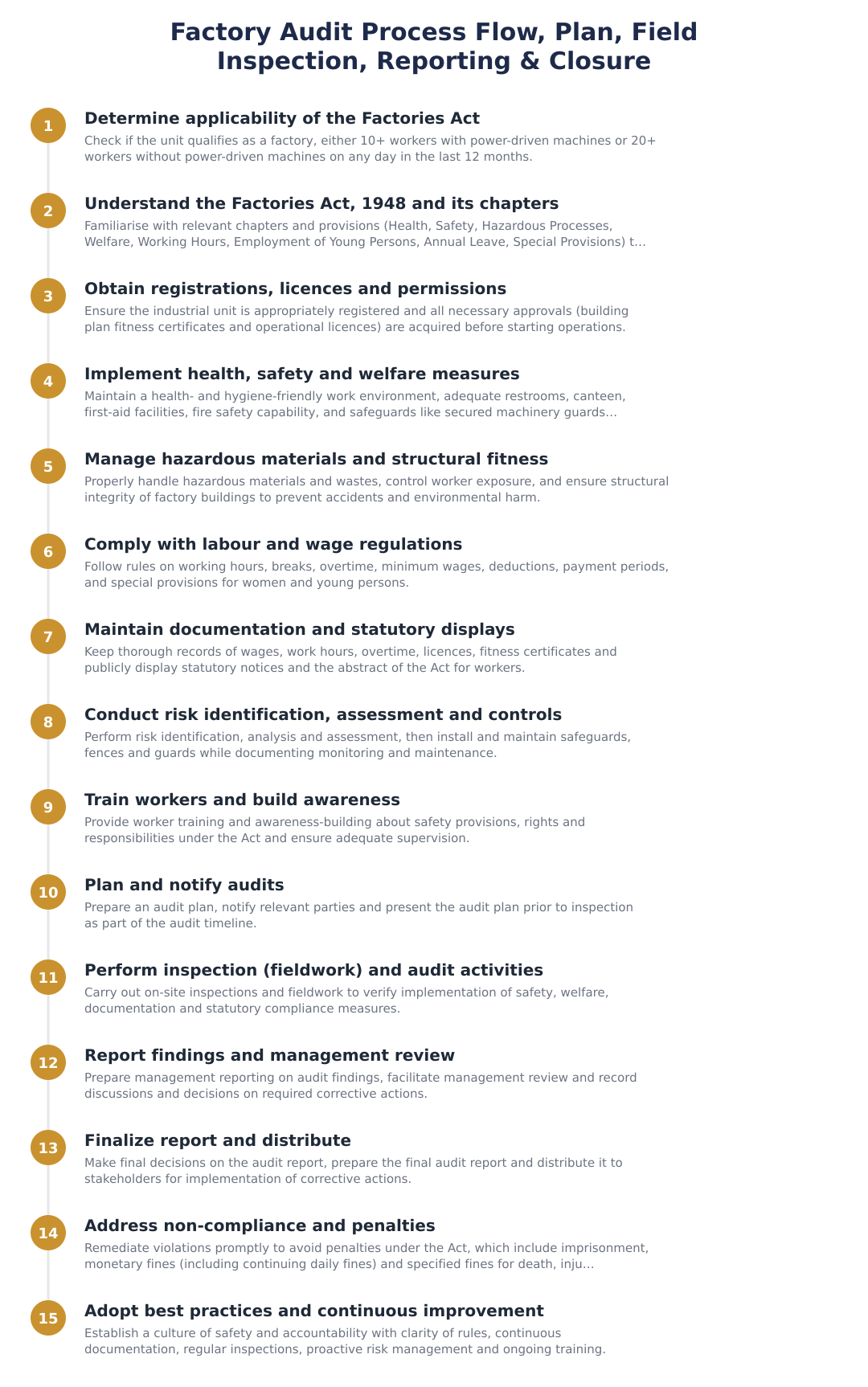
A typical audit checklist covers registration and licences, health and safety infrastructure (guards, ventilation, first aid), welfare facilities (canteen, restrooms), working hours and wage compliance, documentation and recordkeeping, hazardous material management, and statutory displays such as abstracts of the Act. Audit steps normally follow planning, notification, field inspection, management reporting, review, final decisions and distribution of the final audit report. The audit should also verify training records, maintenance of guards and fences, and the existence of business continuity and incident response plans. Regular internal audits and corrective action tracking are recommended to close gaps before statutory inspections.
What are the best practices for ensuring continuous factory compliance?
Best practices include establishing a culture of safety and accountability, clear understanding and thorough implementation of statutory provisions, continuous documentation of compliance procedures, regular training and awareness programmes, and proactive risk management. Regular inspections, routine maintenance of safety guards and equipment, and periodic independent audits help identify gaps and prevent incidents. Management should also maintain updated licences, engage with the local inspectorate, and ensure transparent communication of statutory notices and worker rights on the shop floor. These measures reduce legal risk and improve worker wellbeing and operational continuity.
Are there special rules for employing women and young persons under the Factories Act?
Yes, the Act contains specific provisions regulating employment of women and young persons, including restrictions on working hours, mandated rest breaks, and separate welfare facilities; employment of young persons (children) is tightly controlled by special provisions and annual leave rules. Chapter VII deals with employment of young persons and the Act prohibits child labour in factories except as permitted by law, and requires notification of working hours for young workers where allowed. Employers must also ensure adequate facilities for women, adhere to maternity-related benefits under other statutes, and maintain records proving compliance. Violations concerning women and young persons attract penal consequences and closer scrutiny by inspectors.
Need help staying Compliance compliant?
MoneyGence's AI Finance OS tracks your compliance, wallet share, and finances in one place, built for agencies and growing businesses.
Get started with MoneyGence