Annual Compliance Checklist for a Private Limited Company in India (2026)
Starting a company is easy. Staying compliant is where founders slip. Here are the ROC, board and tax filings a private limited company handles each year, and when each is due.
Starting a private limited company is the easy part. The filings that follow, year after year, are what catch founders out. Nobody sends a reminder, the dates move with your AGM, and a missed form usually costs a late fee for every day of delay.
This checklist covers the filings a standard private limited company deals with in a year, in the order they tend to fall. Your CA or company secretary should confirm what applies to your company, but this gives you the full picture so nothing arrives as a surprise.
Who has to file
Every registered company has to file its annual forms, including a company with no revenue, no staff and no transactions. A dormant company still files AOC-4 (with nil financials) and MGT-7 each year. "We did nothing this year" is not a reason to skip them.
The AGM and the filings that follow it
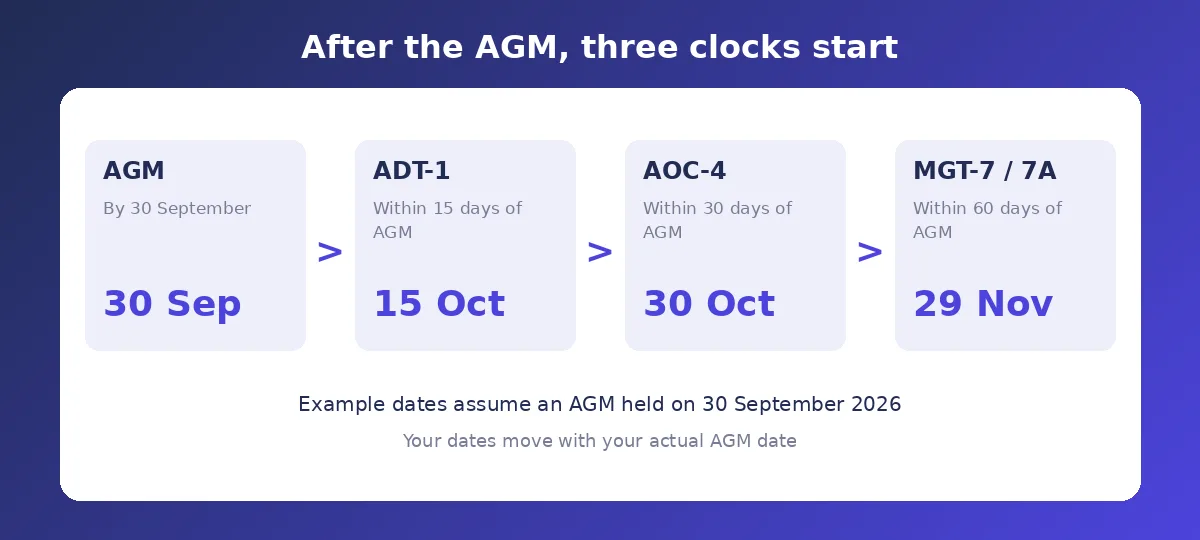
The Annual General Meeting is the starting gun. A private company (other than a one person company) holds it within six months of the end of the financial year, which means by 30 September for the year ending 31 March. Three filings then run off the AGM date, so their deadlines move if your AGM moves.
Rebuild with the Table button, 3 columns:
| Form | What it is | Due |
| ADT-1 | Notice of the auditor's appointment | Within 15 days of the AGM |
| AOC-4 | Financial statements filed with the ROC | Within 30 days of the AGM |
| MGT-7 or MGT-7A | Annual return | Within 60 days of the AGM |
Other ROC filings
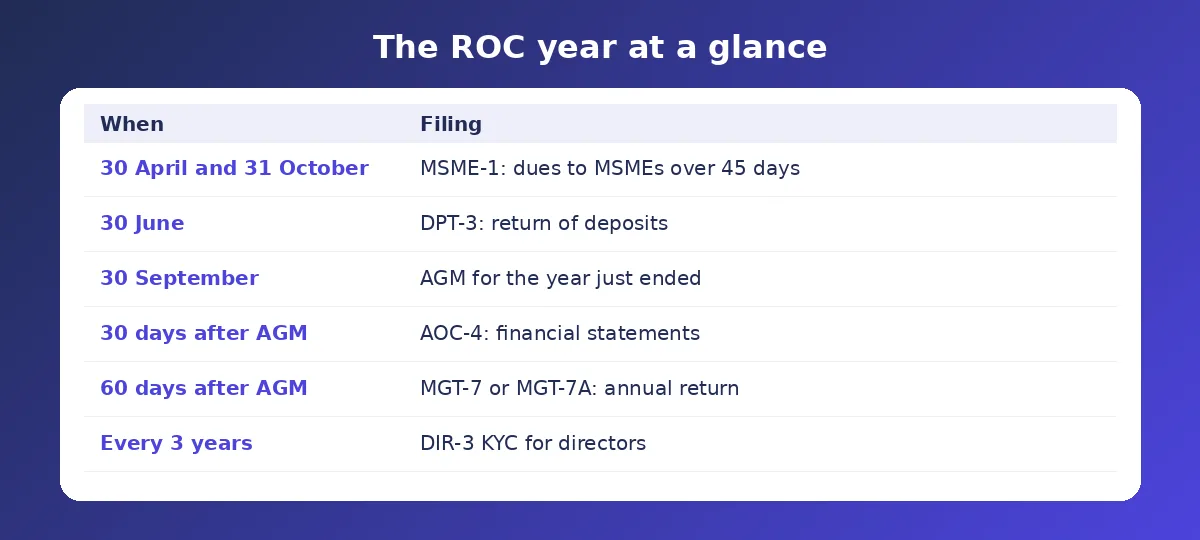
- DPT-3: a return of deposits and certain loans, due by 30 June. Many companies are surprised to learn that it applies to them even if they never took public deposits.
- MSME-1: a half-yearly report of payments pending to micro and small suppliers for more than 45 days, due by 30 April and 31 October.
- DIR-3 KYC: the director KYC. This used to be an annual filing due on 30 September, but recent sources say it moved to a three-year cycle from 31 March 2026. Because older articles still say "annual", confirm your director's cycle with your CA.
Board and secretarial basics
- Hold at least four board meetings a year, with no more than 120 days between two meetings.
- Keep minutes of every board and general meeting.
- Maintain the statutory registers, such as the register of members and register of directors.
- Keep your registered office details current and file the form for any change in directors, address or share capital within the time allowed.
Tax filings that sit alongside
These are separate from ROC filings but belong on the same calendar. Dates below are the usual ones. Your CA will confirm them for your year, especially because the Income-tax Act, 2025 now applies and uses "tax year" instead of "assessment year".
- Income tax return, generally due 31 October if your accounts need an audit, and later if transfer pricing applies.
- Advance tax, paid in instalments through the year if your tax liability crosses the threshold.
- TDS returns, filed every quarter if you deduct TDS. We cover the rates in [Internal link -> TDS on Payments to Freelancers and Professionals].
- GST returns, monthly or quarterly as applicable, and the annual GST return where it applies.
What late filing costs
Most ROC forms attract an additional fee for every day of delay, and for several forms there is no upper limit on the amount. The commonly quoted figure is Rs 100 per day. Directors can also face penalties, and persistent default can lead to the company being struck off. Cheaper by far to file on time than to clean up later.
Common Mistakes
- Assuming a company with no revenue does not need to file.
- Counting from the financial year end instead of the AGM date.
- Forgetting DPT-3 and MSME-1 because they are not "main" annual forms.
- Relying on an older checklist that still says director KYC is yearly.
- Not holding four board meetings, or not minuting them.
- Mixing up MGT-7 and MGT-7A.
- Leaving accounts unreconciled until the audit.
Frequently Asked Questions
What is the annual compliance checklist for a private limited company?
AGM, ADT-1, AOC-4, MGT-7 or MGT-7A, DPT-3, MSME-1 where applicable, director KYC on its cycle, at least four board meetings, statutory registers, and the income tax, TDS and GST filings that apply.
What is the due date for AOC-4?
Within 30 days of the AGM. If the AGM is held on 30 September, that is 30 October.
What is the due date for MGT-7?
Within 60 days of the AGM. If the AGM is on 30 September, that is 29 November.
Do I have to file if my company had no business this year?
Yes. AOC-4 and MGT-7 are still due, with nil figures where relevant.
Is DIR-3 KYC still annual?
Recent sources say it moved to a three-year cycle from 31 March 2026. Check your own due date with your CA, since older guides still say annual.
Related guides:
How to Register a Private Limited Company in India
MSME 45-Day Payment Rule for Service Businesses
Bookkeeping in Excel: Step-by-Step System for Small Businesses
Official references
Run a service business? See every client's money on one screen.
MoneyGence shows who has paid, who is overdue and by how many days, with GST-ready invoices, bank reconciliation and renewal alerts alongside your Compliance work. Free for up to 2 clients, no credit card needed.
Start free with 2 clients See how it works →