MSME 45-Day Payment Rule: What Service Businesses Must Know (Section 43B(h))
Paying a registered micro or small vendor late has two costs: interest at three times the RBI bank rate and a delayed tax deduction. Here is how to stay inside the limit.
Category: MSME | Slug: msme-45-day-payment-rule-service-businesses Do not paste the title or the Direct answer. Start from the opening below.
Most agencies and consultancies think of late payment as something that happens to them. A client sits on an invoice for 70 days and you chase it. Fair enough.
But there is a second side to it. You also buy things: printing, freelancers' tools, cloud hosting, studio rentals, production crews. Some of those vendors are registered micro or small enterprises, and for them the law sets a payment deadline that is a lot shorter than the 60 or 90 days many of us put in a PO. Miss it, and it costs you real money.
What the rule actually says
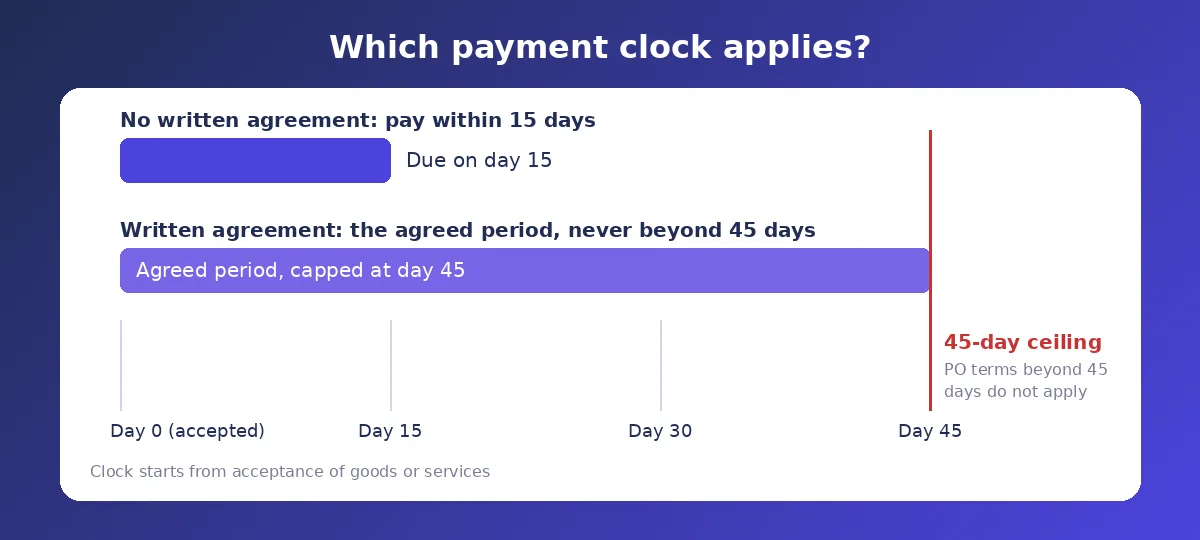
The 45-day figure comes from Section 15 of the MSMED Act, 2006. The Income Tax Act then added a tax consequence on top of it. Two clocks exist, and which one applies depends on whether you have a written agreement.
Rebuild with the Table button, 3 columns:
| Situation | Payment deadline | Counted from |
| No written agreement with the supplier | 15 days | Day of acceptance (or deemed acceptance) of goods or services |
| Written agreement | The agreed period, but never more than 45 days | Day of acceptance (or deemed acceptance) |
Who is covered
The rule protects suppliers that are registered as micro or small enterprises under the MSMED Act, which in practice means they hold a Udyam registration. Medium enterprises are not covered by the 45-day rule. A vendor that is not registered gets no protection, however small it is.
This is why the first practical step is boring: ask every vendor whether they are Udyam registered, and keep a copy of the certificate.
What happens if you pay late
Two separate things happen, and people often mix them up.
- Interest to the supplier. Under Section 16, you owe compound interest with monthly rests at three times the bank rate notified by the RBI, from the day the payment was due until you pay.
- Tax deduction deferred. Under Section 43B(h) of the Income Tax Act, if you pay beyond the limit, the expense is allowed as a deduction only in the year you actually pay it, not the year you booked it.
Here is a rough feel for the interest. As an illustration only, suppose the bank rate were 6.5%. Three times that is 19.5% a year, which works out to roughly 1.6% a month. On a Rs 1,00,000 bill that is two months late, you would owe about Rs 3,300 on top. Check the current RBI bank rate before working out a real figure.
Why service businesses should care
- You buy from small vendors all the time. Production crews, print shops, equipment rental, software resellers, local agencies you subcontract to.
- Your payment terms are probably longer than the law allows. A habit of paying vendors "after the client pays us" will cross the limit for any registered micro or small supplier.
- The year-end matters. A bill that has gone past its limit and is still unpaid on 31 March is the one that gets caught for the tax deferral.
- It works in your favour too. If your own business is a registered micro or small enterprise, large clients are bound by the same limit when they pay you. Put your Udyam number on your invoices.
A simple way to keep track
You do not need new software. You need one extra column.
- Make a list of vendors and mark which are Udyam registered micro or small enterprises.
- For each vendor bill, note the date you accepted the goods or services.
- Check whether you have a written agreement. If not, the limit is 15 days. If yes, it is the agreed period, capped at 45.
- Calculate the "pay by" date and sort the sheet by it.
- Review it weekly, and again in the second week of March.
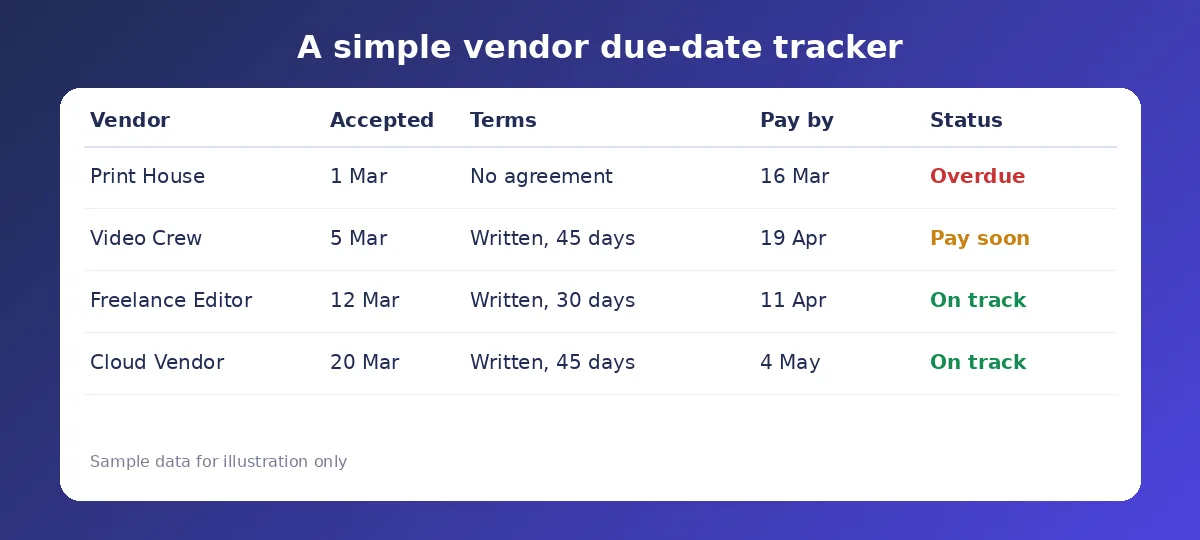
If you already track vendor costs in a tool, check that it can store a due date per bill. Do not assume it works out the MSME limit for you. MoneyGence tracks vendor purchase orders against the client they belong to, which helps you see what each client job has cost you, but the MSME deadline is something you should still verify with your own due date column and your CA.
Common Mistakes
- Assuming every payment term is 45 days. With no written agreement it is 15.
- Counting from the invoice date when the law counts from acceptance.
- Never asking vendors whether they are registered.
- Relying on a 60 or 90 day PO term that the law does not recognise for covered suppliers.
- Ignoring the 31 March position until the CA asks about it.
- Treating the interest as deductible.
Frequently Asked Questions
Does the 45-day rule apply to services as well as goods?
Yes. The limit applies to goods supplied or services rendered by a covered micro or small enterprise.
What if there is no written agreement?
Then the payment limit is 15 days from acceptance or deemed acceptance, not 45.
Does it apply to medium enterprises?
No. The 45-day rule and the tax clause cover micro and small enterprises only.
Will I lose the expense permanently if I pay late?
No. The deduction is deferred, not cancelled. You claim it in the year you actually pay. The interest, however, is never deductible.
Do I need to report overdue MSME dues anywhere?
Companies with outstanding dues to micro and small suppliers beyond the limit generally have reporting duties, including a half-yearly MSME return, and the tax audit report asks about it too. The exact forms and dates depend on your entity, so confirm with your CA.
Official references
Need help staying MSME compliant?
MoneyGence's AI Finance OS tracks your compliance, wallet share, and finances in one place, built for agencies and growing businesses.
Get started with MoneyGence