Form MSME-1: Compliance Guide for Timely Payments to MSMEs
This guide explains how businesses should approach compliance with Form MSME-1 and, more importantly, practical steps to ensure timely payments to micro, small and medium enterprises (MSMEs). Timely payments to MSMEs are both a legal compliance matter and a sound commercial practice: suppliers that are paid on time remain viable, maintain supply continuity, and preserve negotiating relationships. In this article you will learn what internal controls a buyer should implement, how to prepare and maintain documentation that supports timely settlement, how to build dispute-resolution workflows that prevent payment delays, and how monitoring and reporting mechanisms can be used to demonstrate compliance. While this guide does not substitute for professional advice tailored to your company, it provides actionable best practices that finance, procurement and legal teams can adopt right away. Finally, we note a related government update on currency in circulation which can influence payment processes: the Reserve Bank of India announced the withdrawal of Rs 2,000 banknotes from circulation (news item dated around May 2023 on the site), a development buyers and sellers should consider when assessing cash-based settlement risks.
Why Form MSME-1 and timely payments matter
Form MSME-1 is part of broader compliance and disclosure frameworks that aim to protect the interests of micro, small and medium enterprises. From a business perspective, adhering to the form and related payment obligations reduces legal exposure, improves supplier confidence and supports the availability of goods and services from smaller vendors.
Timely payment is not only a statutory expectation in many jurisdictions but also a cornerstone of good supplier management. Delays can strain cash flows for MSMEs, increase costs through interest or penalty claims, and damage long-term supplier relationships. For buyers, consistent on-time settlement enhances procurement resilience and often leads to better commercial terms.
Designing internal controls to prevent delays
Start with clear ownership: designate accountable roles for invoice receipt, verification, approval and payment. Well-defined responsibilities reduce handoffs and avoid bottlenecks that cause delays. Map the approval workflow and remove unnecessary sign-offs while preserving necessary checks.
Implement cut-off and processing timelines inside your accounting and procurement policies. Use automated reminders and dashboards to flag invoices approaching their due date. By combining manual review with automation you can catch exceptions early and route disputes before a payment deadline is missed.
Documentation and record-keeping best practices
Maintain a centralised repository for all MSME-related contracts, purchase orders, invoices, delivery receipts and any correspondence about payment terms or disputes. Clear, easily retrievable documentation is essential when preparing statutory forms and responding to supplier queries or audits.
Reconcile supplier statements regularly and resolve mismatches promptly. Regular reconciliation reduces surprises and shortens the time required to clear payments. Retain evidence of attempts to settle disputes, approvals for partial payments, and records of any extensions or agreed timelines.
Dispute resolution and escalation to avoid payment blocks
Establish a simple, time-bound dispute-resolution process that includes initial review, supplier communication, and a defined escalation path. The faster disputes are triaged and assigned, the less likely they are to hold up settlement.
Create a cross-functional escalation committee for complex disputes, including representatives from procurement, finance, operations and legal. This reduces the risk of unilateral holds and ensures a commercial perspective is applied when deciding interim or final resolution.
Monitoring, reporting and continuous improvement
Track key metrics such as average payment turnaround, percentage of invoices paid within contractual terms, and number of disputes outstanding. Use these metrics in monthly management reports to highlight trends and trigger corrective actions.
Conduct periodic reviews of your payment process and supplier feedback. Where recurring problems appear, perform root-cause analysis and update policies or systems. Continuous improvement reduces compliance risk and usually lowers overall procurement cost by stabilising supplier relationships.
Ensuring compliance with Form MSME-1 and maintaining timely payments to MSMEs requires a mix of clear policies, efficient workflows, good documentation and active monitoring. Adopt practical controls, resolve disputes quickly and keep suppliers informed, these steps protect both the supplier ecosystem and your organisation. Also keep an eye on related government updates, such as the Reserve Bank of India’s announcement to withdraw Rs 2,000 banknotes from circulation (news item dated around May 2023 on the site), which can affect cash settlement practices and operational planning.
Frequently asked questions
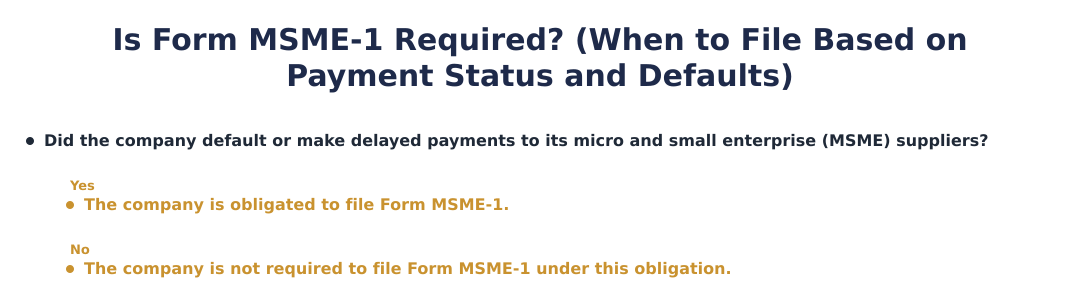
Who has to file Form MSME-1 when payments to suppliers are late?
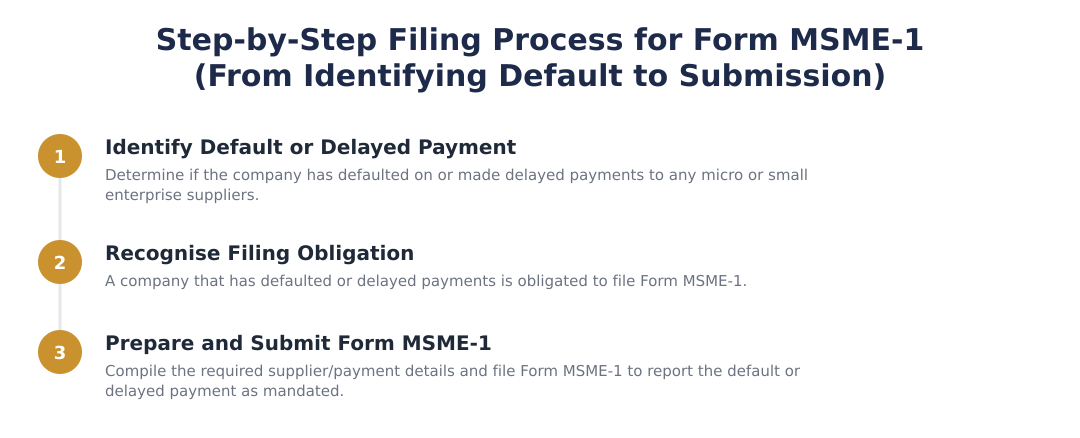
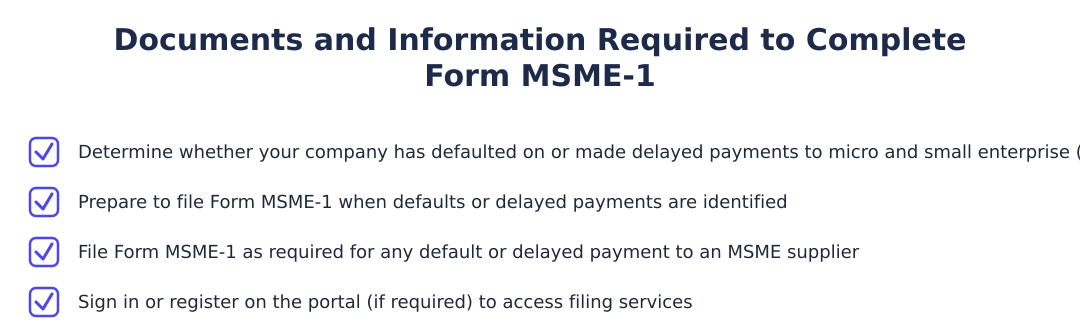
Any company that defaults or makes delayed payments to its micro and small enterprise (MSME) suppliers is required to file Form MSME-1. The obligation attaches whenever an overdue payment arises to an MSME supplier, irrespective of the amount or supplier size within the micro and small category. Filing is the company’s responsibility even if the delay was caused by administrative error or dispute; the form functions as an official intimation of the default/delay to the relevant authorities.
What is the purpose of Form MSME-1?
Form MSME-1 serves as an official intimation by a company that it has defaulted on or delayed payment to a micro or small enterprise supplier. The form notifies the relevant authority and records core details about the overdue payment so the situation is on record rather than hidden. It helps policymakers and regulators monitor payment defaults to MSMEs and may trigger follow-up action or compliance checks where necessary.
What information do companies need to include in Form MSME-1?
Companies must provide details that identify the supplier and the overdue transaction, typically including the MSME supplier’s name, invoice or supply reference, outstanding amount and the period for which payment is overdue. The form also usually requires a brief explanation for the delay or default so the authorities have context for the intimation. Accurate figures and correct supplier identification are important because the filing creates an official record of the outstanding payment.
Does filing Form MSME-1 mean the company will be penalised?
Filing Form MSME-1 itself is an intimation and does not automatically impose a penalty on the company. The purpose is to notify authorities of the default/delay; however, repeated non-compliance or unjustified defaults could invite regulatory scrutiny or enforcement measures under applicable laws. Prompt, accurate filing and efforts to clear the outstanding payment or document a valid dispute reduce the risk of adverse consequences.
When should a company file Form MSME-1 after a payment becomes overdue?
A company should file Form MSME-1 as soon as it recognizes a payment to an MSME supplier is delayed or in default so that the intimation accurately reflects the outstanding position. Prompt filing ensures transparency and demonstrates the company’s compliance with reporting obligations even if the delay is temporary or being resolved. Delaying the intimation can worsen the compliance record and potentially attract scrutiny if regulators discover the overdue payments through other channels.
Who in the company is responsible for filing Form MSME-1?
The company’s management is ultimately responsible for ensuring Form MSME-1 is filed, and typically the finance or accounts department handles preparation and submission of the intimation. The board or authorised officers should ensure accurate reporting and timely filing as part of the company’s compliance obligations. Assigning a clear internal owner and documenting the reasons for any delay helps maintain compliance records and supports any subsequent explanations to stakeholders or authorities.
How should a company handle disputed claims when filing Form MSME-1?
If a payment is disputed, the company should still file Form MSME-1 if the amount remains unpaid, but clearly indicate in the form that the sum is under dispute and provide a concise explanation. Documenting the nature of the dispute (for example, quality, quantity or billing discrepancies) in the intimation helps authorities understand the context and prevents the filing from being treated as an outright admission of liability. At the same time, companies should maintain records of communications and remedial steps taken while pursuing resolution.
Can a company file Form MSME-1 retrospectively if it missed reporting an earlier delayed payment?
A company should file Form MSME-1 retrospectively if it failed to report an earlier delayed payment as soon as the omission is discovered, to correct the compliance record. Making a retrospective filing with an explanation of the oversight demonstrates good faith and helps regularise the company’s reporting history. Companies should also review internal controls to prevent future misses and be prepared to answer any queries from authorities about the delayed intimation.
Where can I get help preparing and filing Form MSME-1?
Companies can seek assistance from their finance team, company secretary, statutory auditors or external compliance consultants who are familiar with MSME reporting requirements and the filing process. Professional advisors can help ensure accurate details, appropriate explanations for delays or disputes and timely submission to avoid compliance gaps. Keeping documentation and using a standard internal workflow for MSME payments and reporting will make future filings simpler and more reliable.
Need help staying MSME compliant?
MoneyGence's AI Finance OS tracks your compliance, wallet share, and finances in one place, built for agencies and growing businesses.
Get started with MoneyGence