MSME Samadhaan: File Delayed Payment Claims & Check Status Online
This guide explains what MSME Samadhaan is, who it is meant for, and how it fits into India’s framework for protecting small businesses from delayed payments. You will learn the broad purpose of the scheme, the kinds of enterprises that typically use it, the usual stages of making and pursuing a claim, and practical tips for following up on an application. Understanding these aspects matters because delayed receivables can strain cash flow, hinder growth and increase financing costs for micro and small enterprises. Knowing the available remedy and the broad steps involved helps suppliers preserve working capital, make informed business decisions about credit terms and dispute escalation, and use institutional channels effectively rather than relying solely on ad hoc negotiation or expensive litigation. This guide focuses on the conceptual process and practical considerations around bringing a delayed-payment grievance through the MSME Samadhaan mechanism, situating it within the legal backdrop provided by the MSME Act, 2006, which governs provisions related to delayed payment to micro and small enterprises. Where appropriate, the guide highlights realistic expectations, for example, that institutional routes typically involve a defined filing step, an initial review, and then a process for settlement, adjudication or follow-up, without prescribing fixed timelines or monetary thresholds, which vary by scheme rules and may be updated by authorities.
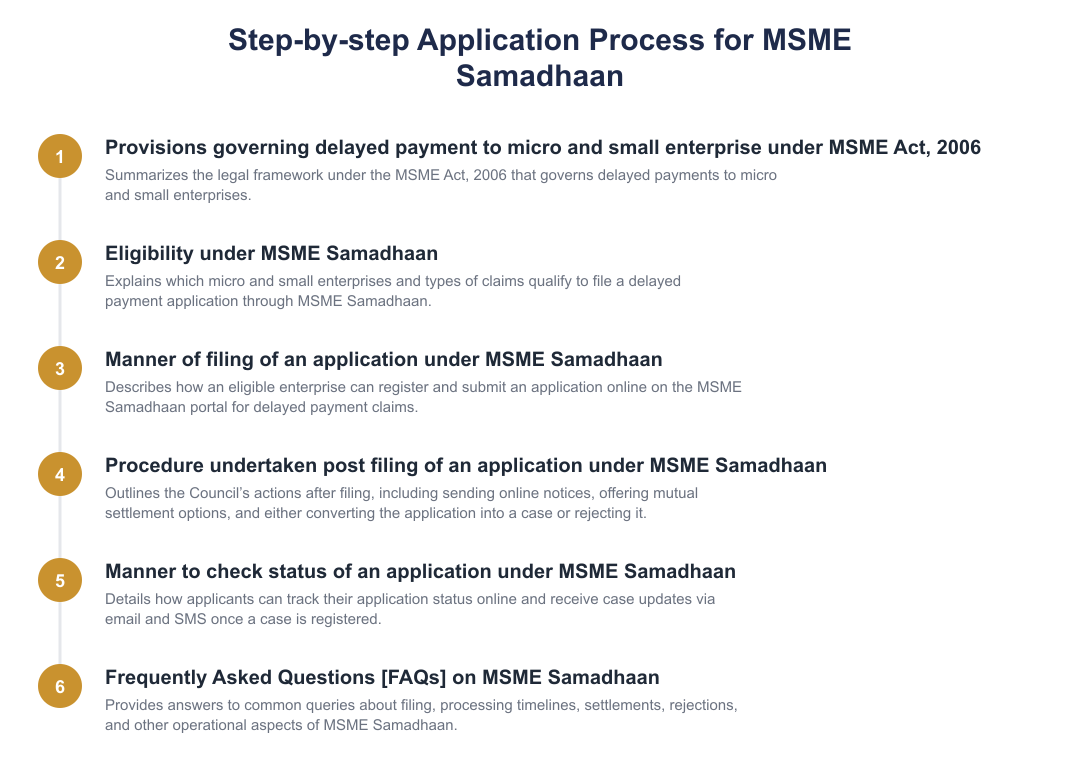
Provisions governing delayed payment to micro and small enterprise under MSME Act, 2006 –
The legal foundation for addressing delayed payments to small suppliers in India is created by the MSME Act, 2006. That Act provides the policy and statutory framework under which remedies and processes for late payment are framed. In practice, this means there are dedicated mechanisms and institutional channels designed to help micro and small enterprises recover outstanding dues without immediately resorting to ordinary civil suits.
Having a statute focused on micro and small enterprises recognises the asymmetric bargaining power between small suppliers and larger buyers. The statutory framework aims to promote timely payments, reduce the risk of defaults, and provide faster, less costly relief than traditional litigation. For business owners, the presence of such a framework is an important protection for working capital and business continuity.
Eligibility under MSME Samadhaan
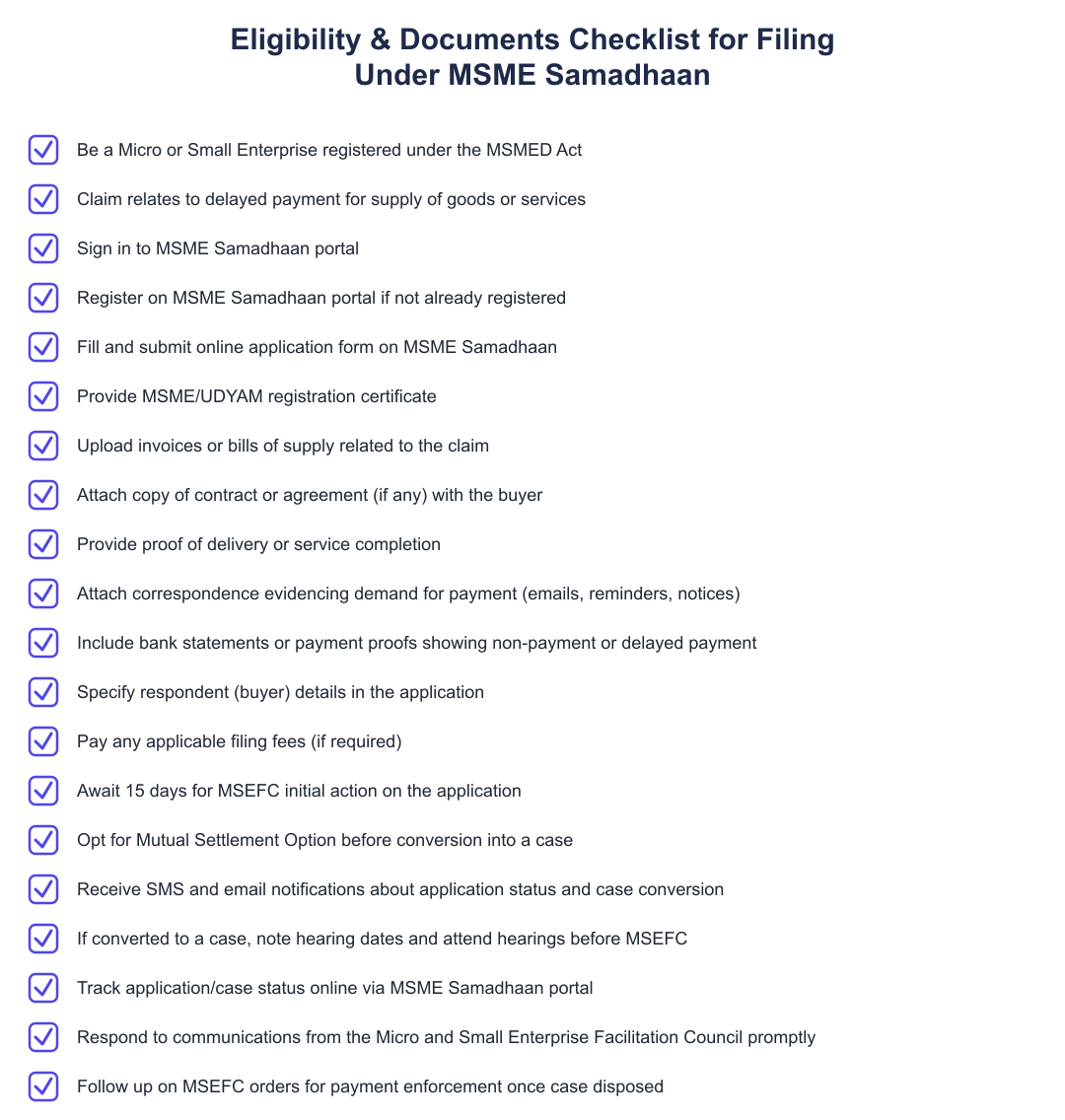
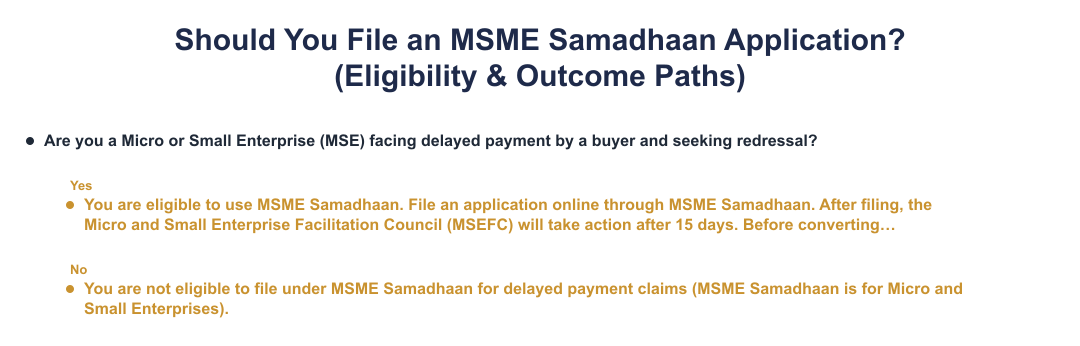
MSME Samadhaan is intended for enterprises that qualify as micro or small units under the statutory definitions and whose commercial transactions have resulted in delayed payment for supplied goods or rendered services. Eligibility is therefore tied to the enterprise’s classification and the nature of the dispute, specifically, a claim arising from unpaid invoices or breach of agreed payment terms.
Before approaching any formal grievance mechanism, businesses should confirm their status as a micro or small enterprise and ensure their claim relates to a transaction covered by the remedy route. It is also useful to have documentary proof of supply or service, invoices and any communications about the payment schedule, since these documents form the basis of any institutional review or adjudication.
Manner of filing of an application under MSME Samadhaan
Collect invoices, contracts or purchase orders and any correspondence showing the agreed payment terms and the default in payment.
Summarise the facts of the transaction, amount due, due date and steps already taken to obtain payment; attach supporting documents.
File the application through the designated filing channel for the scheme, typically an online portal or registry, following any form and fee requirements.
After submission expect an acknowledgement or reference number; keep this for subsequent tracking and communication.
Procedure undertaken post filing of an application under MSME Samadhaan
Once an application is filed, institutional processes generally include an initial review to determine the admissibility of the claim. This review assesses whether the applicant qualifies as a micro or small enterprise and whether the dispute falls within the scope of the remedy mechanism.
If the application is accepted for consideration, the mechanism commonly provides stages for conciliatory resolution (such as mutual settlement discussions), followed by formal adjudication if settlement is not achieved. Outcomes can include negotiated payment plans, orders directing payment, or other remedies permitted by the scheme. The exact procedural steps, notices, hearings and options for settlement, depend on the specific rules and operational practices of the administering body.
Manner to check status of an application under MSME Samadhaan
After filing, applicants should monitor the status of their case using the reference number or acknowledgement received at filing. Most administrative schemes provide a way to view the case status online, and may also send updates by e-mail or SMS. Regularly checking status helps ensure you do not miss hearing dates or requests for additional information.
If online status information is insufficient or unclear, applicants can typically contact the administering authority by the official contact channels listed on the scheme’s website. Maintaining a clear record of all communications and submissions will make follow-up easier and strengthen your ability to respond to queries promptly.
Frequently Asked Questions [FAQs] on MSME Samadhaan
Q: Who can use MSME Samadhaan? A: The mechanism is aimed at enterprises that are recognised as micro or small units and have genuine disputes arising from delayed payments for goods or services supplied to buyers. Specific eligibility criteria are set out in the scheme’s rules.
Q: Is settlement encouraged? A: Yes. Institutional dispute-resolution channels commonly prioritise settlement and mutual resolution as an efficient first step. Successful settlements conserve time and cost for both parties compared with lengthy adjudication. However, when settlement is not possible, the mechanism usually enables formal determination or orders to secure dues.
MSME Samadhaan provides an institutional avenue for micro and small enterprises to address delayed payments within the policy framework established by the MSME Act, 2006. Using this route effectively requires clear documentation, timely filing, active follow-up and preparedness to engage in settlement or adjudication steps. Businesses that understand the process and keep records of their transactions are better positioned to recover dues and protect working capital.
Frequently asked questions
What is MSME Samadhaan and how does it help small businesses with delayed payments?
MSME Samadhaan is an online platform that helps micro and small enterprises file claims for delayed payments and track the status of those claims. It lets eligible MSEs register and submit an application against buyers who have not paid within the agreed time, provides a mutual settlement option before formal conversion to a case, and notifies parties by email and SMS about application and case updates. The Micro and Small Enterprise Facilitation Council (MSEFC) processes the application and either rejects it or converts it into a case for hearing; the council takes action on applications after 15 days of filing. The portal also displays case hearing dates and allows stakeholders to monitor progress online.
Who is eligible to file a delayed payment application on MSME Samadhaan?
Only micro and small enterprises as defined under the MSME Act, 2006 are eligible to file a delayed payment application on MSME Samadhaan. The claim must relate to a delay in payment for goods or services supplied to a buyer, and the enterprise should be able to furnish supporting documents and details of the transaction when filing online. Public and private buyers can be respondents, but the applicant must be a registered MSE and provide valid contact information so the council can communicate by email and SMS. If an agreement exists between the parties, the application process follows specific timelines and settlement options under the portal's procedure.
How do I file an application on MSME Samadhaan step by step?
To file an application on MSME Samadhaan you must first register or sign in on the portal, complete the online application form with transaction and respondent details, and upload supporting documents. After submission the portal sends online information via email to both the applicant and the respondent, and the MSEFC provides a mutual settlement option before formally converting the application into a case. If the council approves, the application is converted into a case and the applicant and respondent are informed by SMS and email; if rejected, the applicant is likewise notified. Keep copies of acknowledgements and the application reference number to track status and for future follow-up.
What happens after I file an application on MSME Samadhaan?
After filing, the Micro and Small Enterprise Facilitation Council reviews the application and takes action after 15 days, during which mutual settlement options are offered to the parties. The council will either approve the application and convert it into a formal case for hearing or reject it; the status change is communicated by email and SMS to both the applicant and the respondent. Once converted into a case, the MSEFC updates case hearing dates and disposes of matters through hearings or settlements; the portal records outcomes such as mutual settlements and rejections. The national data shows large volumes of filings, 2,06,496 applications filed, with 40,518 cases disposed and 50,883 pending review, so timelines may vary by council workload.
How can I check the status of my MSME Samadhaan application online?
You can check the status of your MSME Samadhaan application online by signing into the portal and using your application reference or case number to view current progress and hearing dates. The portal also sends email and SMS updates to the applicant and respondent when the application is received, converted to a case, or when hearings are scheduled, so you can rely on those communications as well. If the application is pending review, it will appear under sections like 'pending to be viewed by MSEFC Council' until acted upon; national figures show 50,883 applications pending to be viewed at one point. Keep your registered contact details updated to ensure timely receipt of notifications and follow-up actions.
What are the possible outcomes after the MSEFC reviews my application?
After review, the MSEFC may approve and convert the application into a formal case, reject the application, or the parties may reach a mutual settlement before conversion. If converted into a case, the council schedules hearings and eventually disposes of the matter; records show 19,101 applications were mutually settled and 56,165 were rejected in the reported dataset. All outcomes are communicated to applicant and respondent by email and SMS, and the portal updates the case status so parties can follow further proceedings. Rejection reasons typically relate to ineligibility or insufficient documentation, so ensure your application is complete when filing.
What timelines should I expect when pursuing a delayed payment claim through MSME Samadhaan?
You should expect the Micro and Small Enterprise Facilitation Council to take initial action on an application after 15 days of filing, with subsequent hearing dates and disposal timelines varying by council workload and case complexity. The portal offers mutual settlement options before conversion to a case, which can shorten resolution time if both parties agree; otherwise, formal hearings are scheduled and the council proceeds to dispose of the case. Aggregate data indicates substantial caseloads, over 2 lakh applications filed and more than 40,000 cases disposed, so actual resolution time depends on the specific MSEFC’s calendar and whether the respondent cooperates. Keep track of email and SMS notifications and the online dashboard for real-time updates on your case progression.
Where can I find statistics on applications and case outcomes on MSME Samadhaan?
The portal and related reports publish summary statistics such as total applications filed, applications rejected, mutually settled cases, cases pending review, and cases disposed by MSEFC councils. For example, reported figures show 2,06,496 applications filed by MSEs, 56,165 rejected, 19,101 mutually settled, 50,883 pending to be viewed, 40,518 cases disposed, and 39,829 cases under consideration. These numbers give an overview of system usage and council performance, and individual councils may also publish their own performance metrics and disposal rates. Monitoring these statistics can help applicants set realistic expectations about timelines and likelihood of settlement or disposal.
Need help staying MSME compliant?
MoneyGence's AI Finance OS tracks your compliance, wallet share, and finances in one place, built for agencies and growing businesses.
Get started with MoneyGence