MSME Registration: Eligibility, Benefits & Process
This guide explains who qualifies as an MSME in India, the practical benefits such enterprises commonly access, and how to complete Udyam registration. Small and medium businesses are a backbone of the economy, understanding the eligibility thresholds, the government preferences available to MSMEs, and the simplified registration mechanics helps proprietors, partners and directors plan compliance, access schemes and bid for contracts with confidence. In the sections that follow you will find a clear comparison of micro, small and medium enterprise thresholds; a concise summary of notable benefits MSMEs typically receive; stepwise guidance on how Udyam registration works (what is required and what to expect after filing); and an author note with suggested next steps. This article focuses on verifiable, practical points, the statutory investment and turnover limits that define classification, the preferential treatment in government procurement, and the streamlined features of Udyam registration such as Aadhaar-based filing, one registration per enterprise, no requirement for renewal, and issuance of a permanent identity number after successful filing. Use this guide as a quick reference when determining whether your business falls within MSME limits and to understand what the registration process will entail in practice.
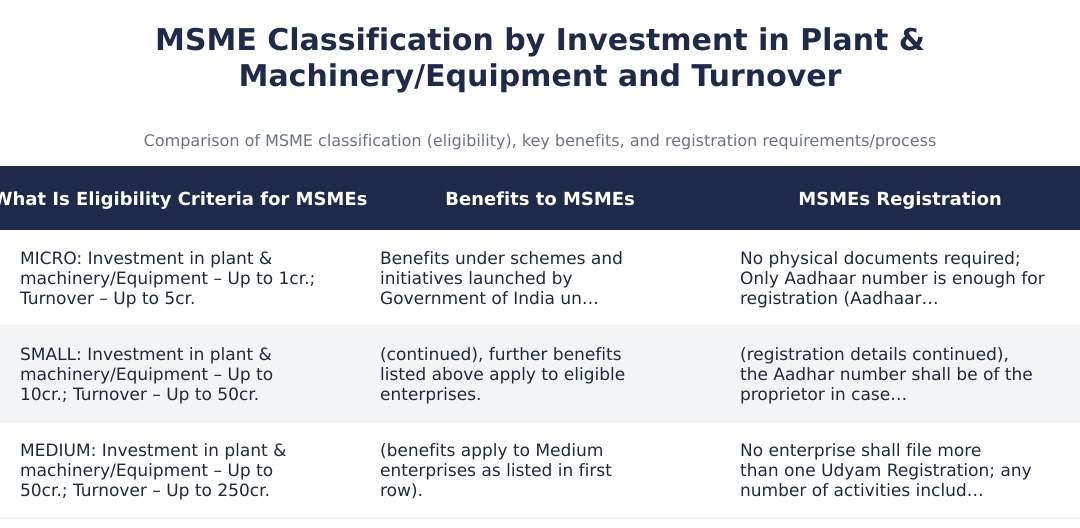
MSME Eligibility, Investment and Turnover Thresholds
| Enterprise | Investment in plant & machinery/Equipment | Turnover |
|---|---|---|
| Micro | Up to 1 crore | Up to 5 crore |
| Small | Up to 10 crore | Up to 50 crore |
| Medium | Up to 50 crore | Up to 250 crore |
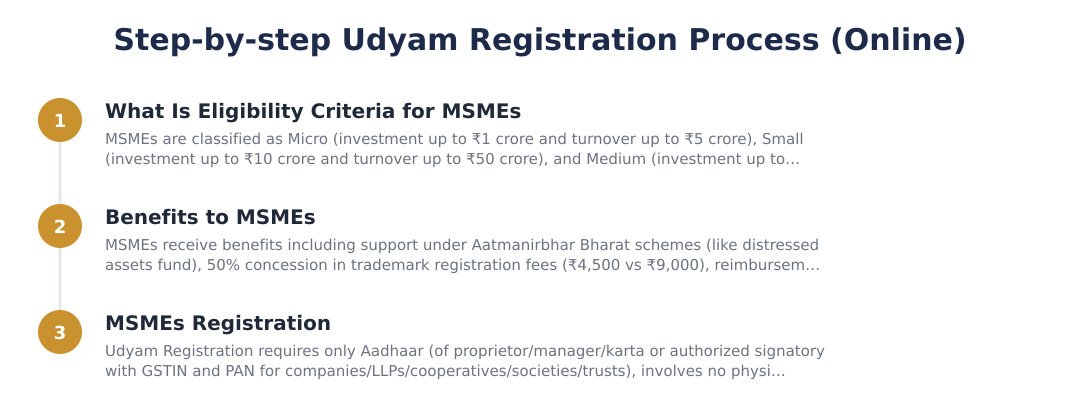
What Is Eligibility Criteria for MSMEs
MSME classification in India is determined by two objective metrics: investment in plant and machinery or equipment, and annual turnover. An enterprise is treated as micro, small or medium depending on where it falls against the prescribed thresholds for both investment and turnover. These thresholds are used by policymakers and programme administrators to determine eligibility for various supports, benefits and priorities.
Practically, businesses should compute their investment and turnover on an annual basis and compare the figures against the limits for micro, small and medium enterprises. Classification affects access to preferential procurement treatment, loan facilitation programmes and certain regulatory relaxations. Accurate classification also matters when applying for schemes that rely on MSME status as an eligibility condition.
Benefits to MSMEs
One of the concrete benefits for enterprises recognised as MSMEs is preference in government tenders and contracts. This preferential treatment aims to increase market access for smaller businesses, enabling them to compete effectively for public procurement opportunities that might otherwise be dominated by larger firms.
Beyond procurement preference, MSME recognition is commonly the gateway to a range of policy supports and targeted schemes offered by central and state agencies. Being formally classified as an MSME can make it easier for a business to be considered for financial assistance, concessions and other institutional supports designed specifically to strengthen smaller enterprises.
MSMEs Registration (Udyam), Key Points and Steps
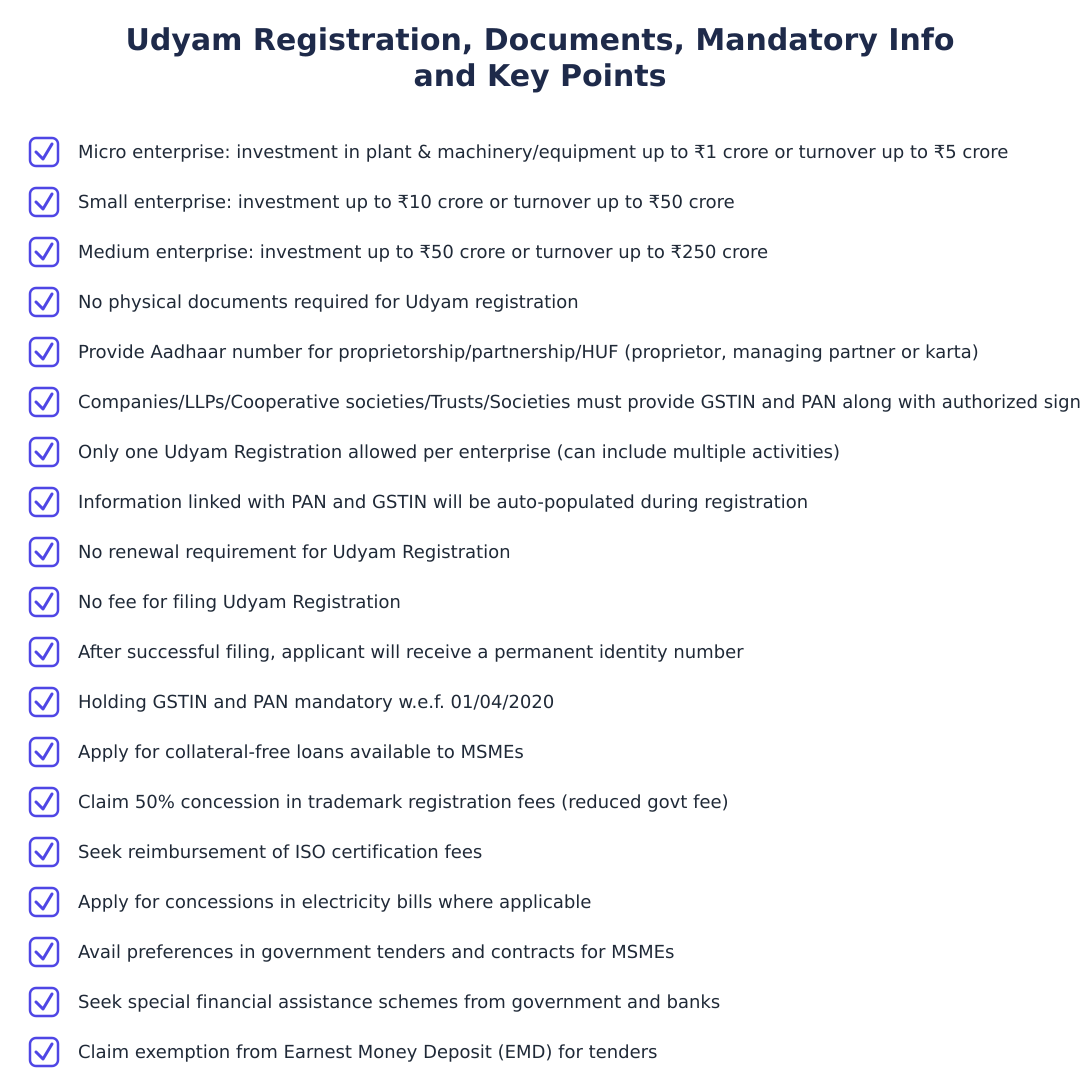
Udyam registration requires only an Aadhaar number for filing; ensure the Aadhaar belongs to the proprietor (for proprietorships), the managing partner (for partnerships) or the karta (for HUFs).
For companies, LLPs, cooperative societies, societies or trusts, the organisation or its authorised signatory should provide GSTIN and PAN along with the Aadhaar number during registration.
An enterprise must not file more than one Udyam Registration; however, any number of manufacturing or service activities may be included within the single registration.
The registration process does not require physical documents, and once registered there is no renewal requirement, the Udyam registration remains valid without periodic re-filing.
After successful filing of the Udyam registration form, the applicant receives a permanent identity number that serves as the enterprise’s MSME identifier.
Practical implications for businesses
Small business owners and financial officers should maintain records that allow clear computation of investment and turnover for classification purposes. While the registration process itself is simplified under Udyam, accurate internal records ensure the enterprise benefits from schemes or procurement preferences without dispute.
Because only one Udyam registration is permitted per enterprise and multiple activities can be covered in that one filing, businesses with diverse operations should plan their registration details carefully so that all relevant activities are captured under the single identifier.
Author Info
This guide summarises official thresholds and the core features of Udyam registration to help MSME owners and advisers make informed decisions. It is intended as a factual reference covering classification limits and the simplified registration mechanics that affect most small and medium enterprises.
For specific scheme applications, tender participation or accounting treatment linked to MSME status, businesses should consult the relevant scheme guidelines or seek professional advice to ensure compliance with procedural and documentary requirements beyond the registration basics covered here.
Correctly classifying a business as micro, small or medium is the first step to accessing procurement preferences and other MSME supports. Use the thresholds in this guide to check eligibility, complete a single Aadhaar-based Udyam registration to get your permanent identity number, and ensure your enterprise details and activities are accurately recorded to make the most of available benefits.
Frequently asked questions
What is the eligibility criteria for an enterprise to be classified as an MSME in India?
An enterprise is classified as Micro, Small or Medium based on its investment in plant & machinery/equipment and its annual turnover. For Micro enterprises the investment limit is up to Rs.1 crore and turnover up to Rs.5 crore; for Small enterprises the investment limit is up to Rs.10 crore and turnover up to Rs.50 crore; for Medium enterprises the investment limit is up to Rs.50 crore and turnover up to Rs.250 crore. Both investment and turnover thresholds are used together to determine the category, so an enterprise meeting the Micro limits is treated as Micro even if it performs multiple activities. These limits apply for registration and scheme eligibility under current MSME rules.
What are the main benefits available to MSMEs under government schemes?
MSMEs get several financial and non-financial benefits such as preference in government tenders, collateral-free loans, reimbursement of ISO certification fees, and a 50% concession in trademark registration fees (government fee reduced from Rs.9,000 to Rs.4,500 for MSMEs). Other supports include exemption from EMD (earnest money deposit) for tenders, concessions in electricity bills, special financial assistance schemes, and access to funds launched under Aatmanirbhar Bharat like the Distressed Assets Fund for MSMEs. These benefits are designed to lower compliance and operational costs and improve access to credit and market opportunities for registered MSMEs.
How do I register an enterprise as an MSME (Udyam Registration)?
You register as an MSME through the Udyam Registration portal by submitting required details (Aadhaar, PAN, GSTIN where applicable) and there is no registration fee. No physical documents are required; the Aadhaar number of the proprietor/ managing partner/ karta (for HUF) is sufficient, while companies/LLPs/cooperatives/societies/trusts must provide GSTIN and PAN plus the authorized signatory’s Aadhaar. Registration information is auto-populated from PAN and GSTIN, a permanent Udyam number is issued after successful filing, there is no renewal requirement, and an enterprise cannot file more than one Udyam Registration though multiple activities may be specified in a single registration. Note: having GST and PAN became mandatory w.e.f. 01/04/2020.
Do I need to upload physical documents for Udyam Registration?
No physical documents are required for Udyam Registration; the process is fully online and Aadhaar is sufficient for proprietors, partners or karta, while entities must provide GSTIN and PAN along with the authorized signatory's Aadhaar. The portal auto-populates information linked with PAN and GSTIN to reduce manual uploads and errors, and there is no fee for filing the registration. After successful submission a permanent Udyam identity number is issued and there is no renewal requirement, simplifying ongoing compliance for MSMEs.
Is GST and PAN mandatory for MSME registration?
Yes, GST and PAN are mandatory for Udyam Registration w.e.f. 01/04/2020. Companies, LLPs, cooperatives, societies and trusts must provide their GSTIN and PAN along with the authorized signatory’s Aadhaar during registration, while proprietorships, partnerships and HUFs rely primarily on the proprietor/partner/karta’s Aadhaar and PAN details where applicable. If an enterprise does not have GSTIN or PAN where required, it must obtain them before completing Udyam Registration to be eligible for scheme benefits.
Are there any fees or renewal requirements for Udyam Registration?
There are no fees for filing Udyam Registration and there is no renewal requirement, registration is intended to be permanent once issued. After successful filing the applicant receives a permanent identity number and can claim MSME benefits without periodic renewal formalities. However, enterprises should ensure their PAN/GST details remain accurate and update any business changes as needed within the portal.
Can one enterprise file multiple Udyam registrations?
No, an enterprise cannot file more than one Udyam Registration; a single Udyam Registration can specify any number of activities including manufacturing and services. The rule prevents duplicate registrations for the same enterprise, but allows listing multiple business lines within the one permanent registration. If separate business entities (with distinct PAN/GST) exist, each entity must register separately; incorrect duplicate filings can lead to compliance issues.
What specific concessions help MSMEs reduce costs and access markets?
Concessions that help MSMEs reduce costs and access markets include a 50% reduction in government trademark registration fees (from Rs.9,000 to Rs.4,500), reimbursement of ISO certification fees, exemption from paying Earnest Money Deposits (EMD) for tenders, and preferential treatment in government procurement and tenders. Additional cost relief comes from concessions in electricity bills and special financial assistance schemes from the government and banks, while collateral-free loan schemes improve access to credit for small enterprises. These targeted supports are intended to lower entry barriers and operating expenses for MSMEs.
What government initiatives and schemes are available specifically for MSMEs?
Government initiatives for MSMEs include programs launched under the Aatmanirbhar Bharat Mission such as the Distressed Assets Fund for MSMEs, the Companies Fresh Start Scheme (CFSS) 2020, and administrative support like expedited Import-Export Code (IEC) services; these aim to support liquidity, compliance relief and market access. There are also state and central schemes offering financial assistance, collateral-free loans, and concessions in statutory fees (for trademarks, ISO, etc.) to promote MSME growth and formalization. Eligibility for most schemes requires Udyam Registration and compliance with PAN/GST norms introduced in 2020.
Need help staying MSME compliant?
MoneyGence's AI Finance OS tracks your compliance, wallet share, and finances in one place, built for agencies and growing businesses.
Get started with MoneyGence