MSME Registration Process & Benefits | How to Register Today
This guide explains MSME registration in India and how to determine your enterprise category under the MSME classification. You will learn why classification matters, how micro, small and medium enterprises are defined for policy and scheme purposes, and practical steps to classify your business correctly. Understanding the MSME category helps owners evaluate eligibility for targeted support, plan finance and growth, and ensure their applications for government schemes are aligned with official thresholds. This article focuses on the classification thresholds for investment and turnover that determine whether an enterprise is micro, small or medium. It also outlines the practical implications of those thresholds and a straightforward, actionable checklist to help you classify your business and proceed with registration or compliance-related tasks. Whether you are starting a new venture or assessing an existing business, this guide will help you establish the correct MSME category so you can pursue relevant benefits and programmes effectively.
What the MSME classification means
The MSME classification groups enterprises into micro, small and medium categories based on two financial measures: investment in plant and machinery (or equipment) and annual turnover. This dual-criteria approach ensures that both capital intensity and scale of business activity are considered when determining an enterprise’s size.
Classification matters because many policy instruments, incentives and support programmes target enterprises of different sizes. Accurately identifying your enterprise category helps you decide which schemes to pursue and how to present your business when applying for finance, procurement opportunities, or capacity-building support.
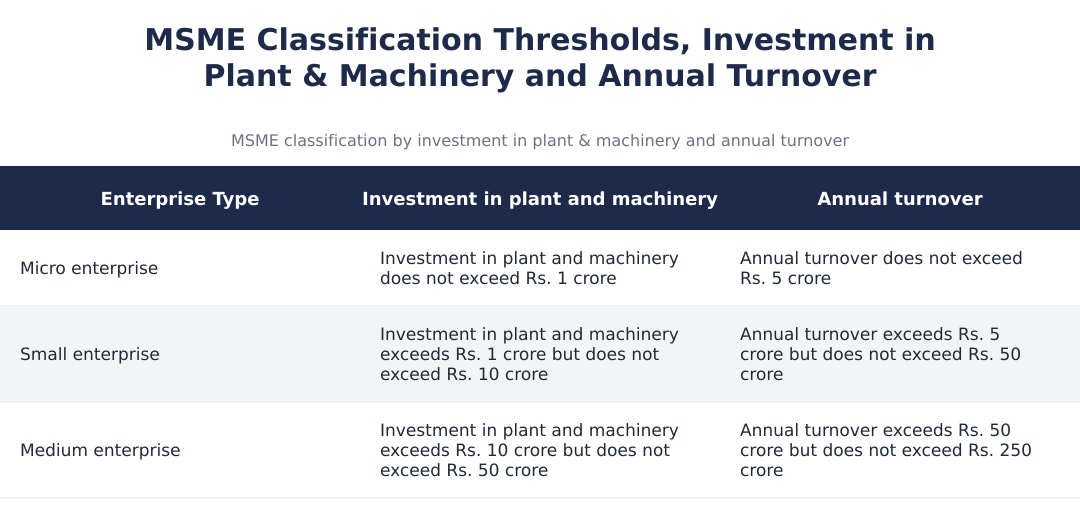
MSME classification: investment and turnover thresholds
| Enterprise category | Investment in plant & machinery/equipment | Annual turnover |
|---|---|---|
| Micro enterprise | Investment in plant and machinery does not exceed Rs. 1 crore | Annual turnover does not exceed Rs. 5 crore |
| Small enterprise | Investment in plant and machinery exceeds Rs. 1 crore but does not exceed Rs. 10 crore | Annual turnover exceeds Rs. 5 crore but does not exceed Rs. 50 crore |
| Medium enterprise | Investment in plant and machinery exceeds Rs. 10 crore but does not exceed Rs. 50 crore | Annual turnover exceeds Rs. 50 crore but does not exceed Rs. 250 crore |
How to use these thresholds in practice
To find your category, compare your enterprise’s latest figures for investment in plant and machinery and annual turnover against the thresholds. Both criteria are considered together; an enterprise falls into the category for which both its investment and turnover meet the stated range.
If your investment and turnover fall into different categories, determine which policy or scheme you are applying for and check whether that programme specifies which metric takes precedence. For routine classification, use the category where both thresholds are satisfied, and keep contemporaneous financial records to support the numbers you report.
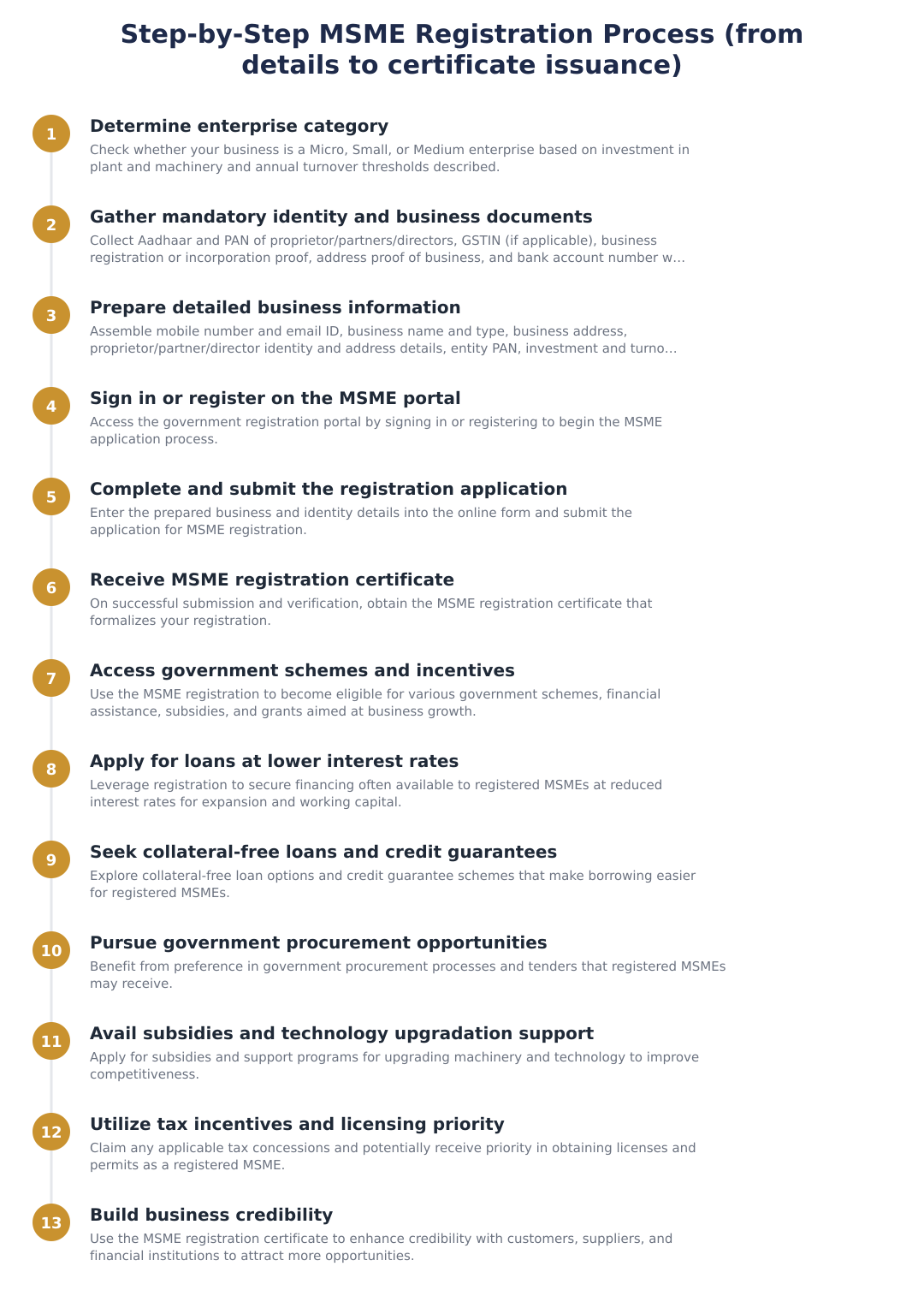
Simple steps to classify your business and proceed with registration
Gather your latest audited or internally prepared figures for investment in plant and machinery (or equipment) and for annual turnover.
Match your figures to the investment and turnover ranges for micro, small and medium enterprises shown above to determine the appropriate category.
Select the category that corresponds to both measures and retain supporting documentation for future verification or applications.
Use the chosen category when applying for registration or benefits, and ensure the information you submit matches your supporting records.
Practical tips and record-keeping
Maintain clear records of how you calculated investment in plant and machinery and how you computed annual turnover. Consistent bookkeeping makes it easier to demonstrate eligibility when required by banks or government agencies.
Reassess your classification periodically as investment or turnover change. Growing enterprises may move from one category to another, and timely reassessment ensures continued alignment with applicable programmes and compliance requirements.
Knowing where your enterprise sits among the micro, small and medium categories is the first step to accessing tailored support and complying with programme rules. Use the thresholds provided here to classify your business, keep accurate records, and update your classification as your investment or turnover change. Accurate classification makes applications smoother and positions your business to benefit from schemes designed for enterprises of your size.
Frequently asked questions
What is MSME registration and who can apply for it?
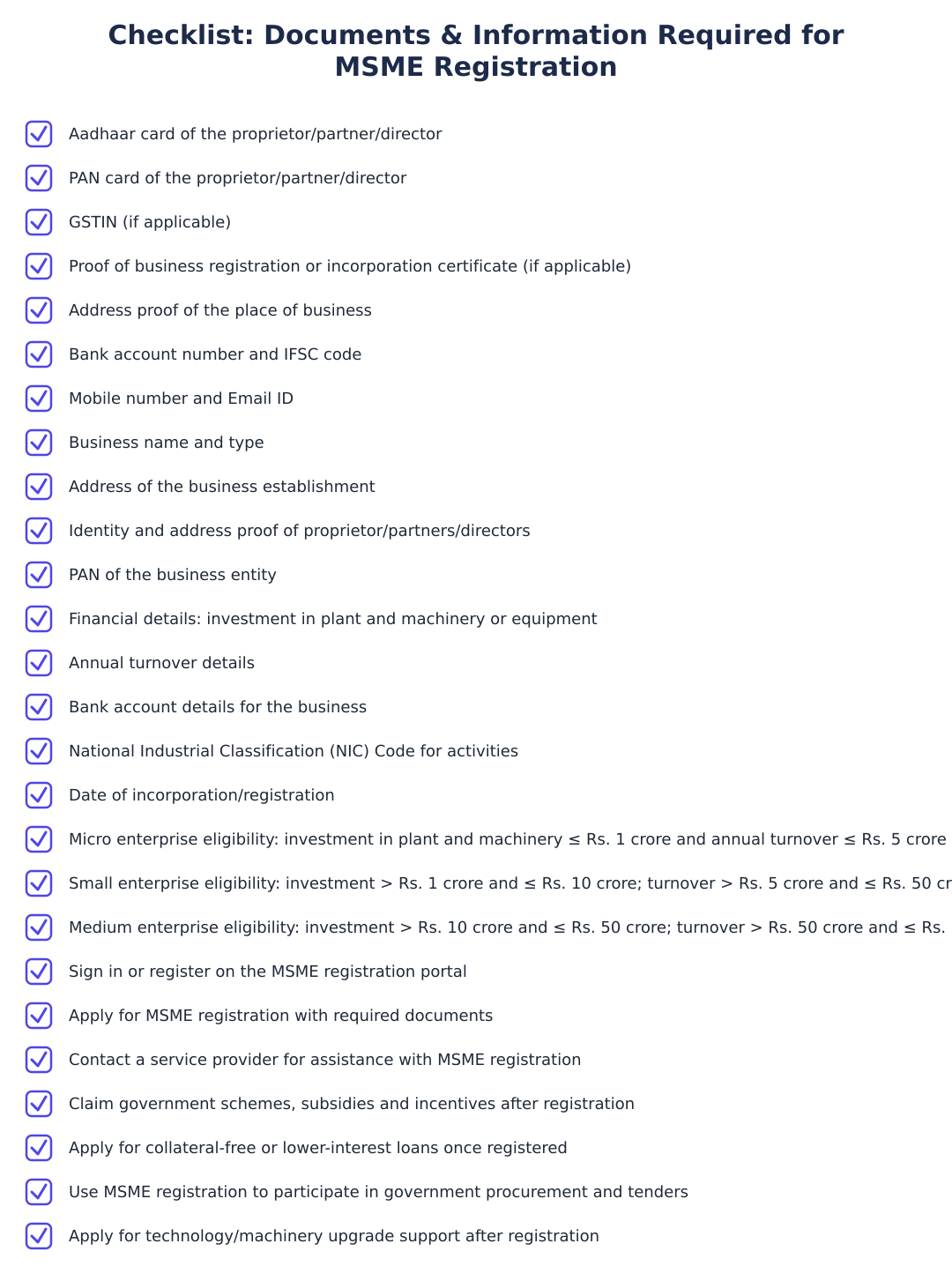
MSME registration (now commonly done as Udyam registration) is a government-recognised registration for Micro, Small and Medium Enterprises that helps businesses access schemes, finance and benefits. Any proprietorship, partnership, LLP, private limited company or other entity engaged in manufacturing or service activity can apply, provided they meet the investment and turnover criteria: Micro – investment in plant & machinery ≤ Rs.1 crore and turnover ≤ Rs.5 crore; Small – investment > Rs.1 crore and ≤ Rs.10 crore and turnover > Rs.5 crore and ≤ Rs.50 crore; Medium – investment > Rs.10 crore and ≤ Rs.50 crore and turnover > Rs.50 crore and ≤ Rs.250 crore. Applicants need basic identity and business details (Aadhaar, PAN, bank account) and must declare investment and turnover figures to determine classification.
How do I apply for MSME registration online?
You can apply for MSME registration online through the government Udyam registration portal by submitting Aadhaar, PAN and business details and completing the online form. The process requires your mobile number and email, business name and address, PAN of the entity or proprietor, bank account number and IFSC, NIC code for your activity, date of incorporation/registration (if any), and declared investment and turnover; once submitted the system generates a provisional certificate and the registration is processed further by the portal. Typically the online submission is quick (minutes) but government verification or updates may take longer depending on document checks or clarifications.
What documents are required for MSME registration?
To register as an MSME you will need Aadhaar card of the proprietor/partner/director, PAN card of the proprietor/partner/director and/or the business entity, GSTIN if applicable, proof of business registration or incorporation certificate (if applicable), address proof of the place of business, and bank account number with IFSC. Additional information commonly required includes mobile number and email ID, details of the proprietors/partners/directors with identity and address proofs, investment in plant and machinery/equipment and annual turnover figures, NIC code for activities, and date of incorporation or registration. These documents and details are used to verify identity, bank linkage and the financial thresholds that determine your MSME category.
What are the main benefits of registering as an MSME?
Registering as an MSME gives you access to government schemes, financial assistance, subsidies and grants designed to promote business growth and development. Registered MSMEs often get loans at lower interest rates, access to collateral-free loan schemes and support from credit guarantee programmes that make banks more willing to lend; they also receive preference in government procurement and tenders, and eligibility for subsidies for technology upgradation and other capacity-building support. Additional advantages include improved credibility with customers and suppliers, potential tax incentives or concessions where available, and faster processing for certain licences or permits in some cases.
Will MSME registration help me get collateral-free loans?
Yes, MSME registration improves your eligibility for collateral-free loans because many financial institutions and government-backed credit guarantee schemes prioritise registered MSMEs. Banks and NBFCs offer specific schemes for MSMEs that allow lending without traditional property collateral, subject to the lender’s eligibility criteria and the credit guarantee cover limits. While registration strengthens your case, loan approval still depends on creditworthiness, business financials and the specific scheme parameters such as maximum loan amount and guarantee coverage.
Does MSME registration affect my taxes or provide tax benefits?
MSME registration can make your business eligible for certain tax incentives or concessions under central or state schemes, but it does not automatically change your statutory tax liabilities like GST or Income Tax. Specific tax benefits, exemptions or rebates depend on prevailing government policies and schemes for registered MSMEs, so eligibility varies by scheme and state; businesses should check the scheme rules or consult a tax advisor to confirm applicable tax treatment. Registered status is primarily supportive for subsidies, credit access and procurement preference rather than blanket tax exemption.
How long does MSME registration remain valid and can I update details later?
MSME (Udyam) registration generally continues to be valid unless there is a change in enterprise details that affects its classification, and you can update or modify details on the portal when investment or turnover figures change. Enterprises are required to keep their information accurate, if investment or turnover increases beyond the current category thresholds you should update the registration to reflect the new classification and maintain compliance with scheme eligibility. The portal allows modifications and reclassification as needed, but specific procedures and timelines for updates depend on the government portal rules at the time of change.
Is there a fee to register as an MSME and how long does the registration take?
MSME (Udyam) registration is generally a simple online process on the government portal and does not require a fee for basic registration; submission is immediate but verification may take additional time. On successful submission with Aadhaar, PAN and bank details the portal typically generates a provisional registration number or certificate quickly, though formal verification and any follow-up from authorities can extend the timeline depending on the case. If third-party facilitators are used, they may charge service fees, but the official government registration itself is intended to be free.
How does MSME registration help with government tenders and procurement?
MSME registration helps by giving registered enterprises preferential treatment in many government procurement processes, including reservation of certain tenders or relaxation in eligibility criteria for small suppliers. Governments often reserve a percentage of procurement or give price and qualification advantages to MSMEs, improving chances to win contracts and access consistent business; however, reservation and preference rules depend on the procuring authority and tender terms. To gain these benefits, a valid MSME certificate/registration must be quoted in tender documents and procurement portals as required by the issuing agency.
Need help staying MSME compliant?
MoneyGence's AI Finance OS tracks your compliance, wallet share, and finances in one place, built for agencies and growing businesses.
Get started with MoneyGence