Shop and Establishment Act Registration: Guide & Process
This guide explains what Shop and Establishment Act registration is, who must register, what the Acts regulate, the typical documents and information required, and the common online process to obtain the registration. Registration under these Acts is mandatory for every shop or commercial establishment; the laws are framed and enforced by the State Labour Departments, and the exact rules vary from state to state. Understanding the core requirements and the step-by-step path to registration helps business owners, from small retail shop proprietors to owners of service premises, warehouses, restaurants and residential hotels, avoid compliance gaps and operate legally. You will learn which establishments are typically covered, the kinds of employer obligations the Acts impose (such as limits on working hours, leave, and record keeping), the usual set of documents and information you will need, and the general online process used in most states. The guide focuses on practical compliance realities: what inspectors look for, what details the registration captures about your establishment and employer, and why maintaining accurate records matters for both daily operations and inspections by enforcement authorities.
Shop and Establishment Act
The Shop and Establishment Acts are state-level labour laws that govern the functioning of shops and commercial establishments. Because each state frames and implements its own rules, the Act’s provisions and administrative procedures differ from state to state and are regulated by the respective State Labour Department.
At a high level, these Acts set the framework for employer–employee relations in non-factory commercial settings. They combine workplace standards with administrative obligations, creating both rights for employees (for example, around work hours and leave) and duties for employers (for example, record keeping and compliance with inspections).
Shop and Establishment Act Applicability
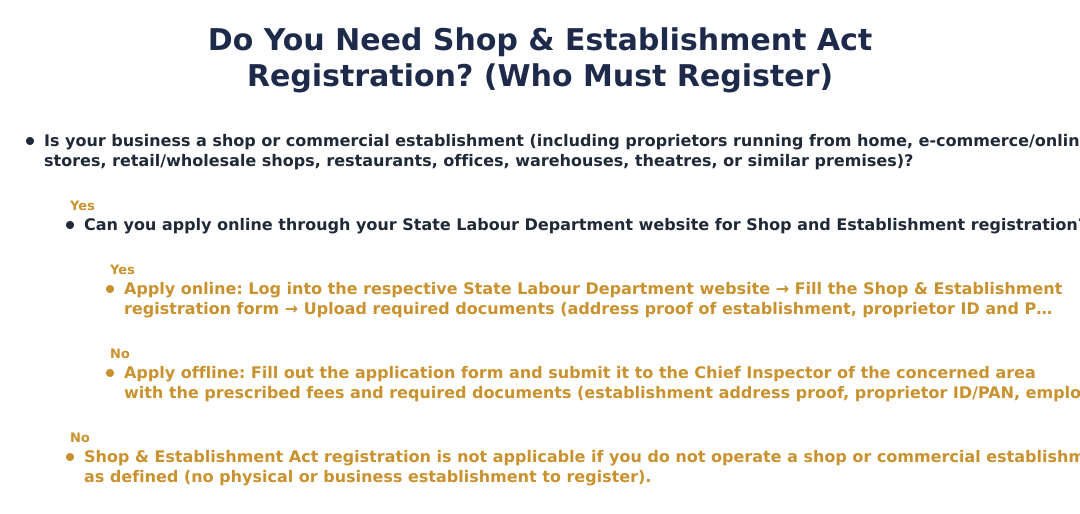
Every shop or commercial establishment must obtain registration under the Shop and Establishment Act. Typical examples of establishments that fall within the Acts include retail and wholesale shops; premises where services are rendered to customers including offices; workshops or workplaces used for trade or business; theatres or places of public entertainment; commercial establishments; storerooms, warehouses or godowns; restaurants or eating houses; and residential hotels.
The Acts cover proprietors or owners of shops and establishments, including people working from home, owners running businesses without a physical store, and proprietors of e-commerce or online businesses. Because the Acts are state-specific, proprietors should check the rules that apply in the state where the establishment is located to confirm applicability and any state-specific inclusions or exclusions.
Regulations Under The Shop and Establishment Act
The Acts cover a range of workplace matters intended to protect employees and set standards for commercial operations. They regulate working hours, annual leave and weekly holidays, and include provisions on intervals for rest (breaks) and opening and closing hours. These rules define basic time-and-leave entitlements and the timing of work in covered establishments.
Beyond time-related rules, the Acts regulate payment of wages and compensation, contain provisions prohibiting employment of children, and require employers to maintain records. The Acts also include enforcement and inspection powers for authorities, so employers should be prepared for periodic checks by the labour department or inspectors.
Shop and Establishment Certificate
On successful completion of the registration process with the relevant State Labour Department, the proprietor or owner receives a registration certificate or licence under the state Shop and Establishment Act. The certificate is the official acknowledgement that the establishment is registered and has provided the required information to the authority.
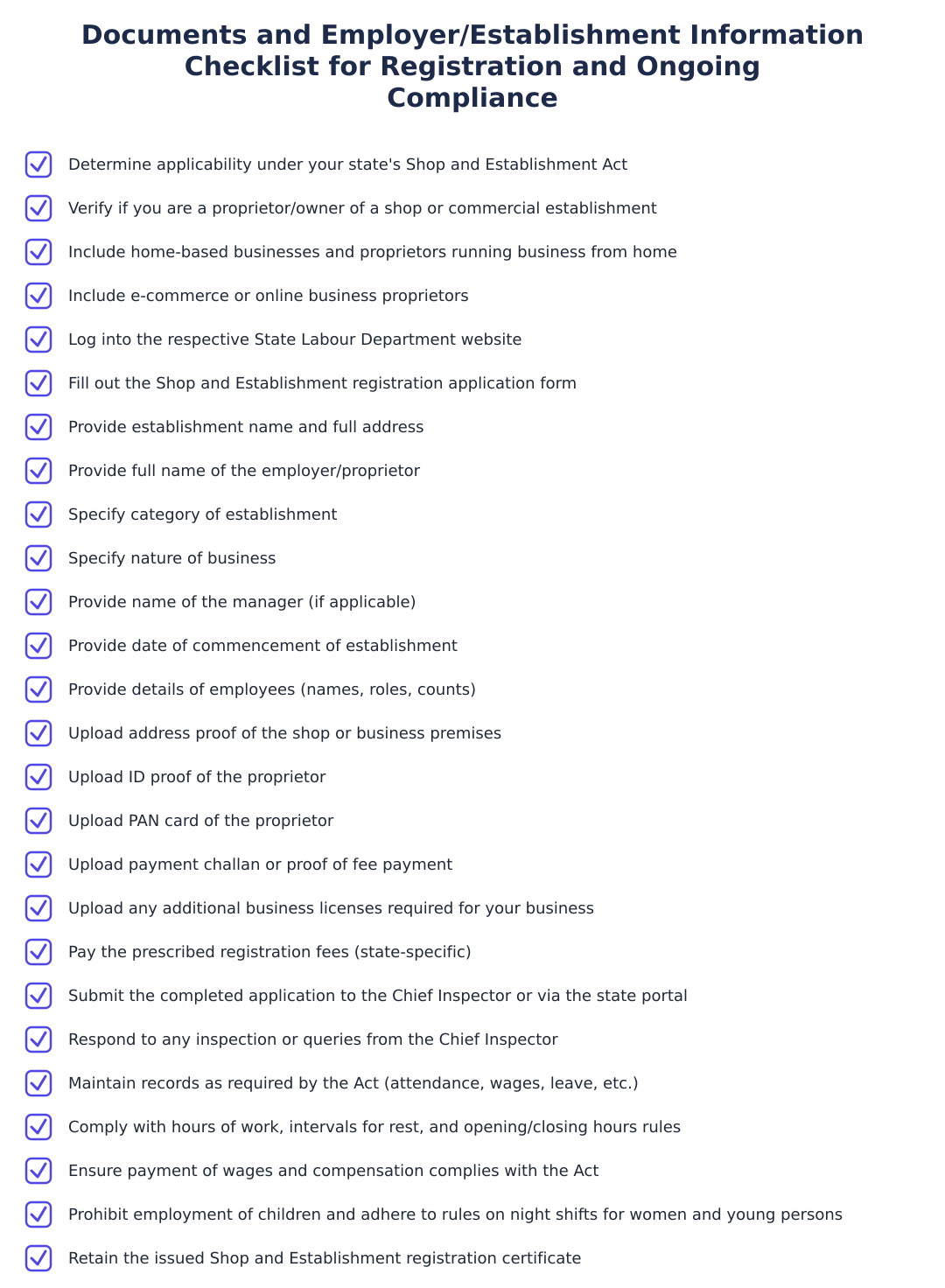
The certificate records typical information required at registration such as the name and address of the establishment, full name of the employer, category of establishment, nature of business, name of the manager, date of commencement of the establishment, and employee details. Employers should keep this certificate and the underlying records available for inspections and statutory compliance.
Process For Obtaining Shop and Establishment Registration
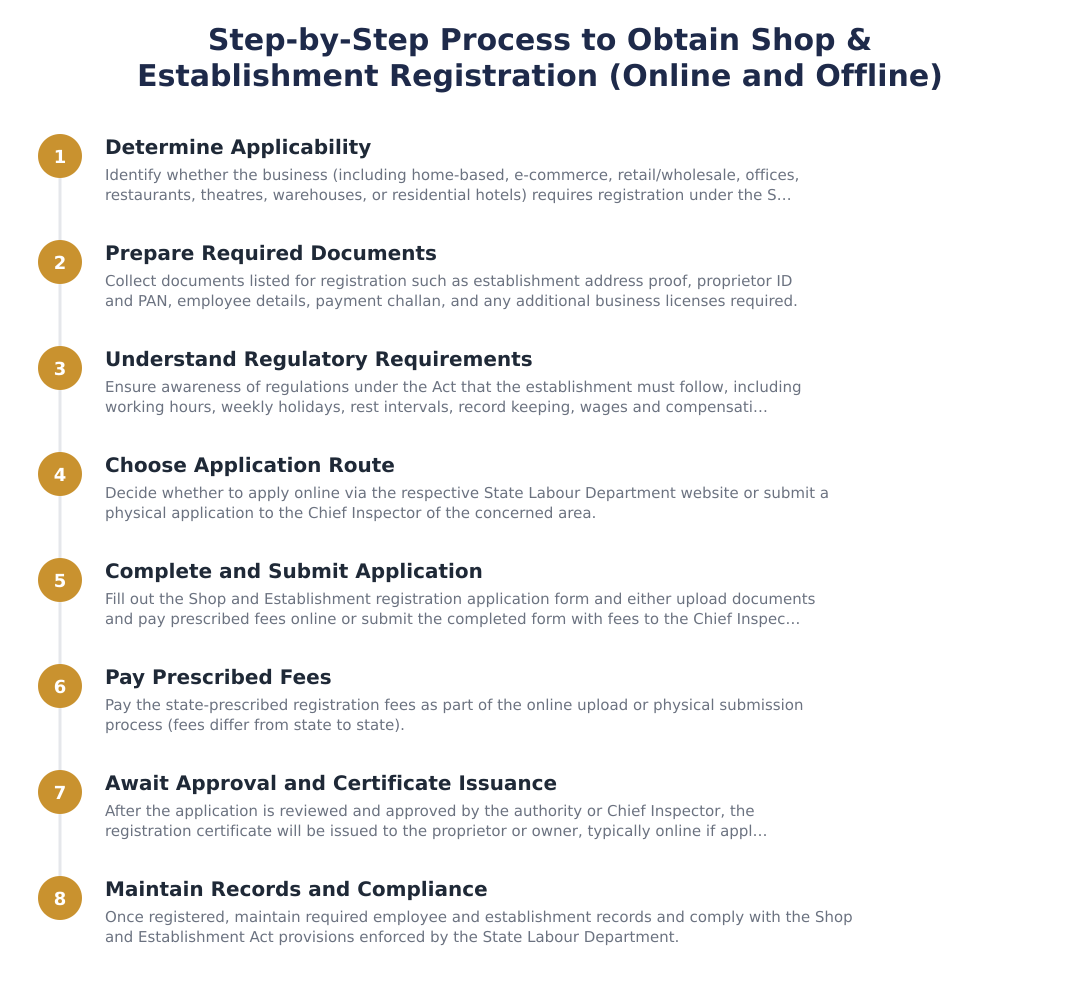
Log into the respective State Labour Department website for the state where your establishment is located; the Acts and procedures differ by state.
Complete the application form for registration under the Shop and Establishment Act and submit it online as required by the state portal.
Upload the required documents and pay the prescribed registration fees. Prescribed fees differ from state to state.
Once the application is processed and approved by the authority, the registration certificate will be issued to the proprietor or owner, often online.
Documents Required For Shop And Establishment Registration
| Document |
|---|
| Shop or business establishment address proof |
| ID proof of the proprietor |
| PAN card of the proprietor |
| Details of the employees |
| Payment challan |
| Any additional business licences necessary for starting the business |
Validity of Shop And Establishment Registration
The Shop and Establishment Acts are implemented by the State Labour Departments, and administrative details such as validity periods, renewal timelines and fees are determined by the state. As a result, validity and renewal procedures can differ across states.
Proprietors should consult their state’s labour department portal or local inspector to find the exact validity period and renewal process applicable to their establishment and ensure timely renewals to remain compliant.
Frequently Asked Questions
Q, Is registration mandatory for every shop and commercial establishment? A, Yes. Every shop or commercial establishment must obtain registration under the Shop and Establishment Act.
Q, Who regulates these Acts? A, The Shop and Establishment Act differs from state to state and is regulated by the State Labour Department; therefore, procedural details and fees vary by state.
Q, What does registration typically record? A, Registration normally captures the name and address of the establishment, full name of the employer, category of establishment, nature of business, name of the manager, date of commencement, and employee details.
Q, What are some employer obligations under the Acts? A, The Acts regulate working hours, annual leave and weekly holidays, payment of wages and compensation, prohibit employment of children, require record keeping, and include provisions on rest intervals and opening/closing hours, along with enforcement powers for inspection.
Registering under the Shop and Establishment Act is a mandatory and foundational compliance step for commercial enterprises. Because the Acts and procedures are state-specific, business owners should use their State Labour Department portal as the primary source for application forms, fees, validity, and renewal details. Maintaining the required documents and records, and understanding the workplace regulations set out in the Act, will help you remain compliant and prepared for inspections.
Frequently asked questions
What is Shop and Establishment Act registration and why do I need it?
Shop and Establishment Act registration is a mandatory licence issued by the State Labour Department that registers every shop or commercial establishment in the state. It ensures compliance with state-specific labour laws such as hours of work, weekly holidays, rest intervals, payment of wages, record-keeping, and prohibitions on child labour and night shifts for women and young persons. The registration provides legal recognition to the business, is often required to obtain other licences or open business bank accounts, and protects both employer and employee rights under the respective state rules. Non-compliance can invite inspections and penalties from labour authorities of the state.
Who must register under the Shop and Establishment Act?
All proprietors or owners of shops and commercial establishments, including businesses run from home and e-commerce or online stores, must register under the Shop and Establishment Act as required by their state law. This covers retail and wholesale shops, offices and service premises, workplaces used for trade, theatres, restaurants, warehouses, and residential hotels as listed in most state rules. Even proprietors operating solely online or from home without a physical storefront are typically required to register, though specific state rules may vary. Registration applicability and thresholds differ across states, so businesses should check the rules of the State Labour Department where they operate.
What documents do I need to apply for Shop and Establishment registration?
You need proof of the shop or business establishment address, the proprietor's ID proof, PAN card of the proprietor, employee details, the payment challan, and any additional business licences if applicable. These documents demonstrate the existence and ownership of the business, identity of the employer, and details of workforce which the labour department uses for record-keeping and compliance checks. Some states may require additional documents or different file formats when applying online, so check the specific document checklist on your State Labour Department website before uploading. Accurate employee details are important because they form part of statutory records maintained under the Act.
How do I apply for Shop and Establishment registration online?
You apply online by logging into your State Labour Department website, filling the Shop and Establishment registration form, uploading the required documents and paying the prescribed fees. Once the application and documents are verified by the department, the registration certificate is issued online to the proprietor; the fee amount and specific online steps differ from state to state. Keep digital copies of the certificate and the application acknowledgement for future inspections or licence renewals. If the state does not have an online system, you must follow the offline submission process to the Chief Inspector as prescribed locally.
What is the offline process to obtain Shop and Establishment registration?
For offline registration you must fill the application form, submit it to the Chief Inspector of the concerned area along with the prescribed fees, and the Chief Inspector will issue the registration certificate after verifying the application. This process typically requires physical copies of the establishment address proof, proprietor's ID, PAN, employee details and the fee challan. Timelines and inspection requirements before issuance vary by state, and some states may still allow or encourage online filing instead. Retain a stamped copy of the certificate and submission receipt as proof of registration for compliance inspections.
How long is the Shop and Establishment registration valid and do I need to renew it?
Validity of Shop and Establishment registration varies by state and in many states the certificate is either permanent or requires periodic renewal at intervals specified by the State Labour Department. Some states issue a registration that remains valid until changes occur in ownership or premise, while others mandate renewals annually or every few years; check your state rules for exact validity and renewal timelines. If your business changes address, employer name, manager, or employee strength, you must notify the authority and seek amendment or re-registration as required. Failure to renew or update the certificate when mandated can attract penalties during inspections.
What information appears on the Shop and Establishment certificate?
The Shop and Establishment certificate typically contains the establishment name and address, full name of the employer, category and nature of the establishment, name of the manager, date of commencement, and employee details. These details serve as the official record for labour inspectors and other government agencies to verify compliance with working hours, holidays, wages and record-keeping obligations. Ensure the certificate accurately reflects current facts because discrepancies may trigger notices or inspections from the labour department. If any detail changes, the proprietor must apply for amendment as per state procedures.
What regulations does the Shop and Establishment Act enforce on businesses?
The Act enforces regulations on hours of work, weekly and annual leave, payment of wages and compensation, prohibition of child employment, restrictions on night shifts for women and young persons, enforcement and inspection powers, rest intervals, opening and closing hours, record keeping, and dismissal provisions. These rules are framed and administered by the State Labour Department and can vary from state to state, but they collectively protect employee welfare and define employer obligations. Employers must maintain statutory registers and produce them during inspections to show compliance with wage payments, holidays, and other labour conditions. Non-compliance with these regulations can lead to penalties and corrective orders from labour authorities.
Does an e-commerce or home-based business need to register under the Shop and Establishment Act?
Yes, proprietors who run a business from home and proprietors of e-commerce or online businesses are generally required to register under the Shop and Establishment Act in their state. The Act covers establishments irrespective of physical storefronts, so online-only businesses and home-based operations fall within its scope unless a specific state exemption applies. Registration ensures the business follows labour rules, maintains employee records and obtains legal recognition; check the State Labour Department guidelines for any state-specific thresholds or simplified procedures for home and online enterprises. Failure to register may lead to fines or compliance notices during inspections even for online businesses.
Need help staying Compliance compliant?
MoneyGence's AI Finance OS tracks your compliance, wallet share, and finances in one place, built for agencies and growing businesses.
Get started with MoneyGence