
On this page 7 sections
Imagine opening a GST notice for ₹1.25 crore. A few weeks later, a different tax office summons your director and asks for the same records again.
It feels like double jeopardy. In August 2025 the Supreme Court looked at exactly this situation in Armour Security (India) Ltd. v. Commissioner, CGST, Delhi East, and the answer is more precise than most business owners expect.
What happened in the case
The petitioner is a public limited company that provides security services. The facts were short:
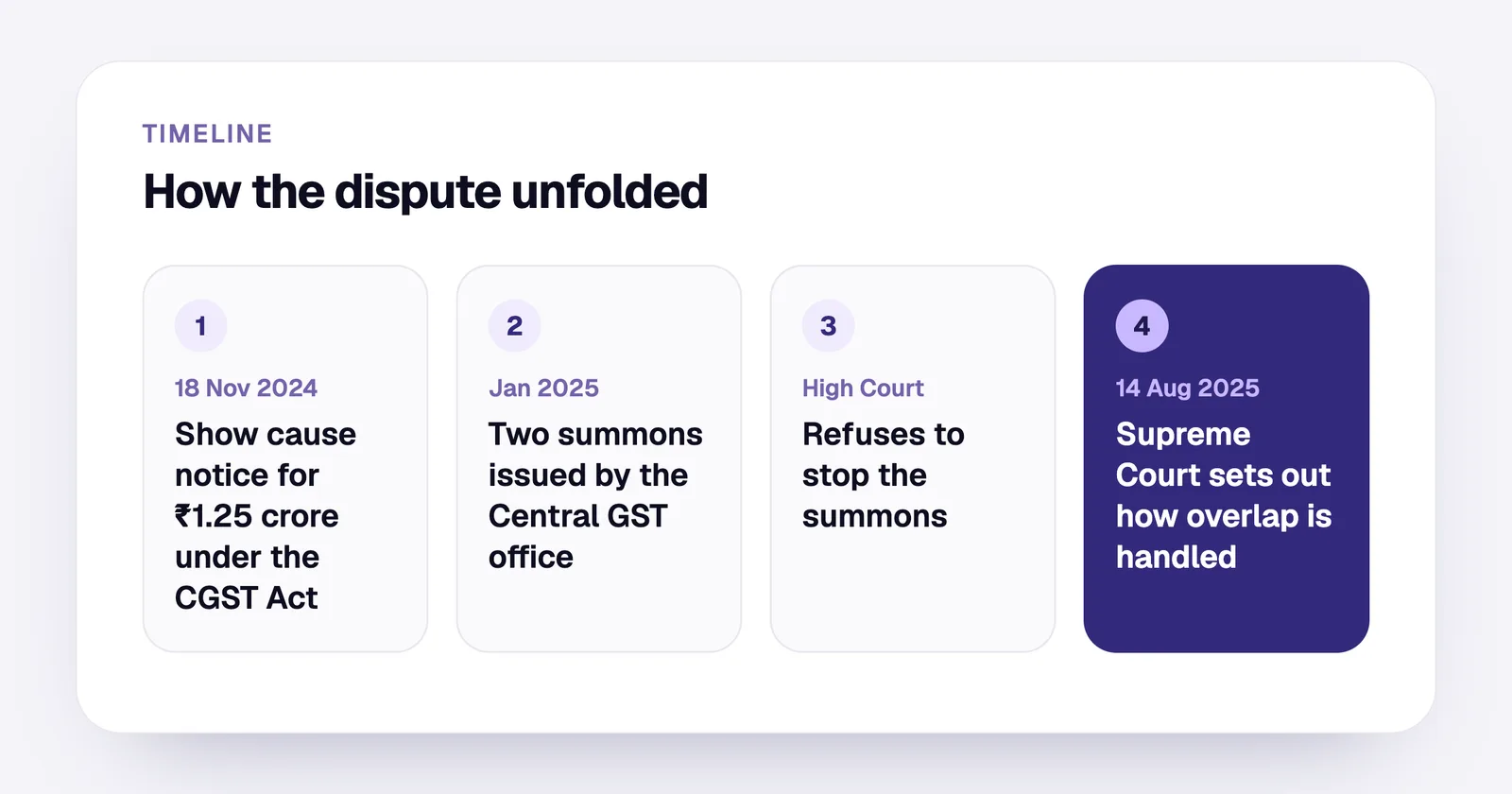
- On 18 November 2024 it received a show cause notice under section 73 of the CGST Act, with a demand of ₹1,24,92,162 under sections 50 and 74.
- In January 2025 the Commissioner of CGST, Delhi East, issued two summons under section 70 asking a director to produce documents.
- The company argued that section 6(2)(b) stopped the second office from acting. The High Court refused to interfere, and the company went to the Supreme Court.
What section 6(2)(b) actually says
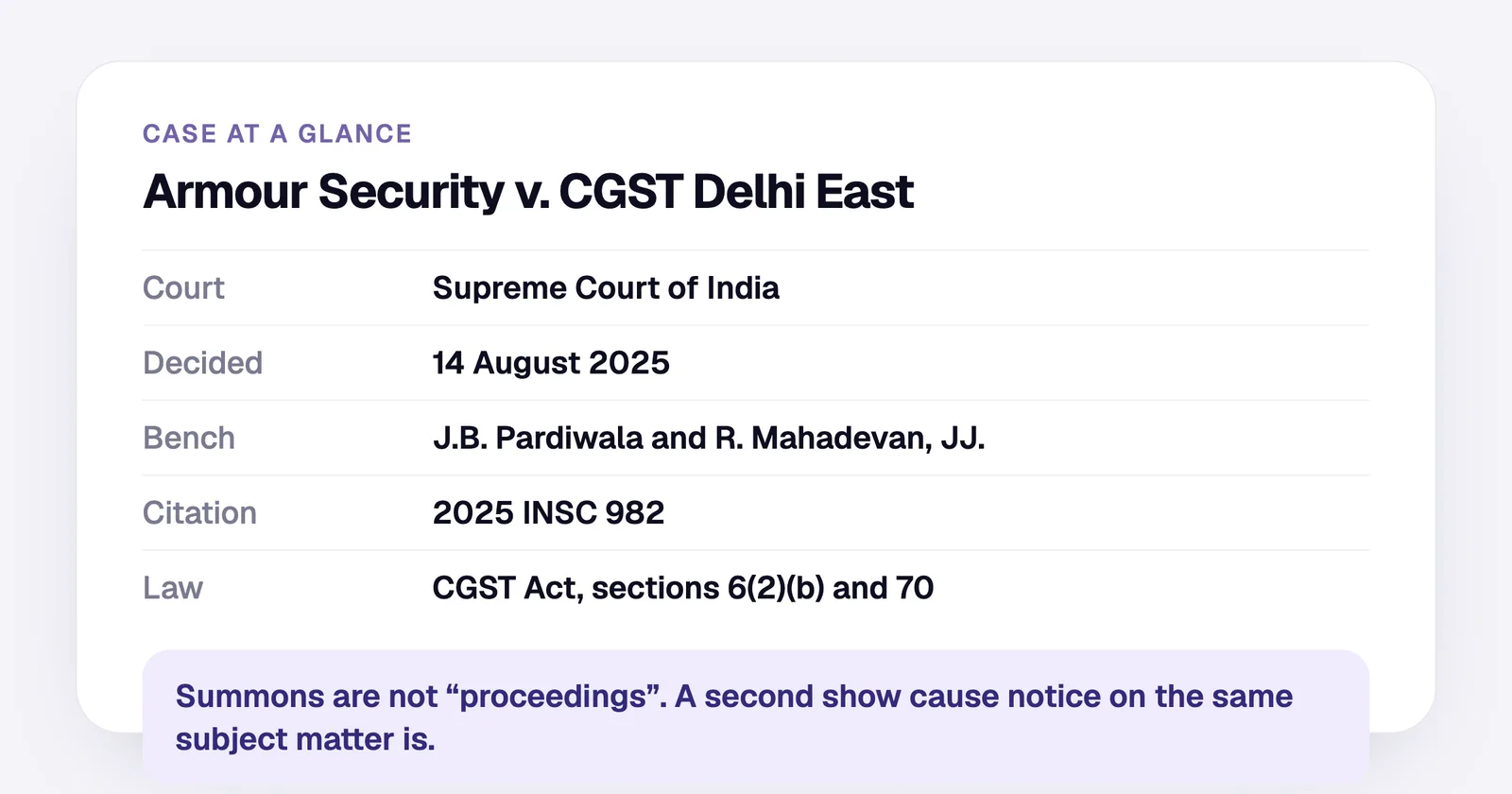
Section 6(2)(b) of the CGST Act stops a tax officer from initiating any proceedings on a subject matter when an officer of the other administration (Central or State) has already done so. Everything turns on two phrases, and the Court explained both.
| Phrase | What the Court said it means |
|---|---|
| "Initiation of proceedings" | The formal start of adjudication, which means a show cause notice. Summons, searches and seizure do not count. |
| "Same subject matter" | A tax liability or obligation arising from a particular contravention that the Department wants to assess or recover. |
| Overlap | If two proceedings seek an identical or partly overlapping liability, the bar applies immediately. If they cover distinct infractions, it does not, even when the amount is similar. |
The rules the Court laid down for overlapping inquiries
- Either the Central or the State administration can start intelligence-based enforcement, even for a taxpayer assigned to the other.
- Once one has started, the other should not launch a parallel action.
- If both are looking at the same matter, they decide between themselves who continues, and the other passes on all material.
- If they cannot agree, the authority that started first carries on.
- A show cause notice for a liability already covered by an existing one is to be quashed.
- If the authorities do not follow this, the taxpayer can file a writ petition before the High Court.
What this means for a service business
- Respond to every summons. Do not ignore one because you think another office is already handling the issue. Reply and raise the overlap in writing.
- Keep a notice register. Log each notice or summons with the date, issuing office, period and issue. Overlap arguments depend on showing the same subject matter.
- Be ready to produce records fast. Invoices, contracts and payment proofs for the period should be easy to pull for any one client.
Common mistakes
- Treating a summons as optional because a show cause notice already exists.
- Arguing overlap without a clear list of what each office is asking about.
- Replying to one office and forgetting the deadline from the other.
- Scrambling for records after the notice arrives instead of before.
Keep the paper trail ready
When a summons asks for documents, the hard part is usually finding every invoice and payment for one client across a period. A tidy record makes the reply faster and the overlap easier to show.
MoneyGence shows, client by client, what you have billed, what has been paid and what is still pending, and keeps the invoice and payment history in one place. It is a client profitability tool, not a tax-filing or legal service, so your advisor still decides how a ruling applies to you.
Frequently Asked Questions
Can the Central and State GST offices both act on the same issue?
Not through duplicate formal proceedings. Section 6(2)(b) bars a second show cause notice on the same subject matter. They can still investigate until it is clear both are examining the identical liability.
Does a summons count as "initiating proceedings"?
No. The Court held that proceedings begin with a show cause notice. Summons under section 70 are a way of gathering information.
Can I refuse a summons because another office already issued a notice?
No. The Court said taxpayers must appear and reply. You can object to the overlap in writing, and you can approach the High Court if the authorities do not follow the process.
What if the two inquiries are about different issues?
Then the bar does not apply, even when the tax amount is the same or similar. Distinct infractions are different subject matters.
What happens to a duplicate show cause notice?
A show cause notice issued for a liability already covered by an existing show cause notice is to be quashed.
Official references
Run a service business? See every client's money on one screen.
MoneyGence shows who has paid, who is overdue and by how many days, with GST-ready invoices, bank reconciliation and renewal alerts alongside your GST work. Free for up to 2 clients, no credit card needed.
Start free with 2 clients See how it works →