New MSME Threshold Limit 2025: Classification & Rules
Micro, Small, and Medium Enterprises (MSMEs) form the backbone of the Indian economy, acting as key drivers of industrial growth, innovation, and employment generation. To keep pace with economic changes, inflation, and the growing scale of business operations, the regulatory frameworks governing these enterprises undergo periodic updates. Navigating these updates is essential for business owners, financial advisors, and tax professionals to ensure compliance and maximize government-backed benefits. This guide provides a detailed overview of the significant regulatory shift in MSME categorization. Specifically, we examine the updated threshold limits that come into force on the 1st of April, 2025. By understanding these revised definitions, businesses can accurately assess their classification status and plan their strategic investments and expansion plans without the risk of prematurely losing their crucial MSME status and the associated legal safeguards. In this article, you will learn about the governing legislation, the exact revised investment and turnover thresholds for Micro, Small, and Medium enterprises, and how these changes facilitate a more conducive business environment in India. Keeping your business aligned with these standards ensures seamless access to credit, statutory protections, and various promotional schemes designed to nurture enterprise growth.
The Legislative Foundation: The MSMED Act
The structured growth and development of the MSME sector in India are legally anchored by a comprehensive statutory framework. All MSME classifications, registrations, and regulatory compliances are strictly governed under the MSMED Act. This Act provides the legal definitions and mechanisms necessary to support small-scale industries, offering them a robust shield against market vulnerabilities and ensuring they receive target-oriented assistance from financial institutions and government bodies.
Under the provisions of this governing legislation, enterprises are classified based on specific financial metrics. Registration under the MSMED Act opens up multiple avenues for businesses, including easier access to formal credit, protection against delayed payments, and eligibility for various subsidy schemes. Therefore, staying updated with any modifications made under this Act is paramount for sustaining operational compliance and maintaining eligibility for statutory benefits.
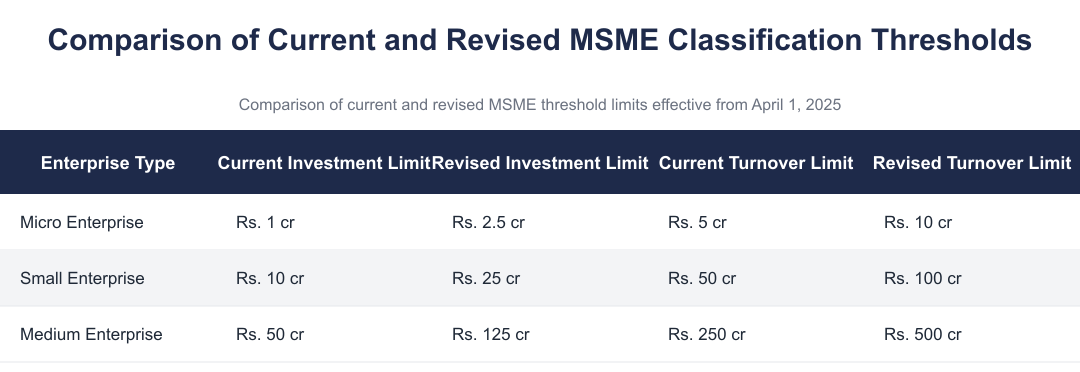
The Revised MSME Threshold Limits
| Enterprise Class | Investment Threshold | Turnover Threshold |
|---|---|---|
| Micro Enterprise | Rs. 2.5 cr | Rs. 10 cr |
| Small Enterprise | Rs. 25 cr | Rs. 100 cr |
| Medium Enterprise | Rs. 125 cr | Rs. 500 cr |
Strategic Implications of the Revised Thresholds
The introduction of the revised thresholds starting from April 1, 2025, marks a progressive shift in how the government views and supports enterprise scaling. By significantly raising the limits for both investment and turnover across all three tiers, the policy ensures that growing businesses do not get penalized by losing their MSME status too early. Previously, businesses often hesitated to expand their infrastructure or increase sales out of fear that exceeding the old limits would strip them of their micro, small, or medium status and the corresponding financial benefits.
With these generous new limits, businesses have substantial room to modernize their plant and machinery, invest in advanced technology, and aggressively scale up their market reach and revenue. It facilitates smoother business operations and encourages entities to formalize their setups, knowing they can enjoy the statutory protections of the MSMED Act even at a much larger scale of operations.
Determining Your Classification Under the New Rules
Calculate the total net investment value of your enterprise assets to see if it aligns with the updated limits.
Assess your financial statements to verify that your annual turnover does not exceed the newly specified boundaries.
Apply the joint criteria under the MSMED Act to classify your business as a Micro, Small, or Medium enterprise.
The revised MSME classification thresholds effective from April 1, 2025, represent a major milestone in fostering industrial growth and ease of doing business in India. By aligning your business with these updated definitions governed under the MSMED Act, you can secure continuous operational benefits, compliance, and growth, and developmental opportunities.
Frequently asked questions
What are the new MSME classification limits from April 1, 2025?
Effective from April 1, 2025, MSMEs are classified based on revised investment and turnover thresholds, where Micro enterprises have limits up to Rs. 2.5 crore investment and Rs. 10 crore turnover, Small enterprises up to Rs. 25 crore investment and Rs. 100 crore turnover, and Medium enterprises up to Rs. 125 crore investment and Rs. 500 crore turnover. This revision marks a significant increase from previous limits to help growing businesses retain their MSME benefits while scaling up. To qualify for a specific category, an enterprise must satisfy both the investment and turnover criteria specified for that tier.
What is the revised limit for a Micro enterprise under the new MSME definition?
Under the revised rules taking effect on April 1, 2025, a Micro enterprise is defined as a business where the investment in plant and machinery or equipment does not exceed Rs. 2.5 crore and its annual turnover does not exceed Rs. 10 crore. Previously, these thresholds were set at Rs. 1 crore for investment and Rs. 5 crore for turnover. This upward revision allows smaller businesses to expand their operations and revenues without losing the regulatory benefits and subsidies associated with Micro-level status.
How is a Small enterprise classified under the new MSME rules starting April 2025?
A Small enterprise is classified as a business with an investment in plant and machinery or equipment of up to Rs. 25 crore and an annual turnover not exceeding Rs. 100 crore, effective from April 1, 2025. This is a substantial increase from the earlier thresholds of Rs. 10 crore for investment and Rs. 50 crore for turnover. Both conditions must be satisfied to fall under this category, and if a business exceeds either of these limits, it will automatically transition into the Medium enterprise category.
What are the investment and turnover limits for a Medium enterprise from April 1, 2025?
Effective from April 1, 2025, an enterprise is classified as Medium if its investment in plant and machinery or equipment does not exceed Rs. 125 crore and its annual turnover is not more than Rs. 500 crore. These limits have been raised significantly from the earlier thresholds of Rs. 50 crore for investment and Rs. 250 crore for turnover. The expansion aims to support mid-sized corporate entities by allowing them to scale up operations globally while continuing to enjoy MSME-specific policy support and schemes.
Who is eligible to register as an MSME in India?
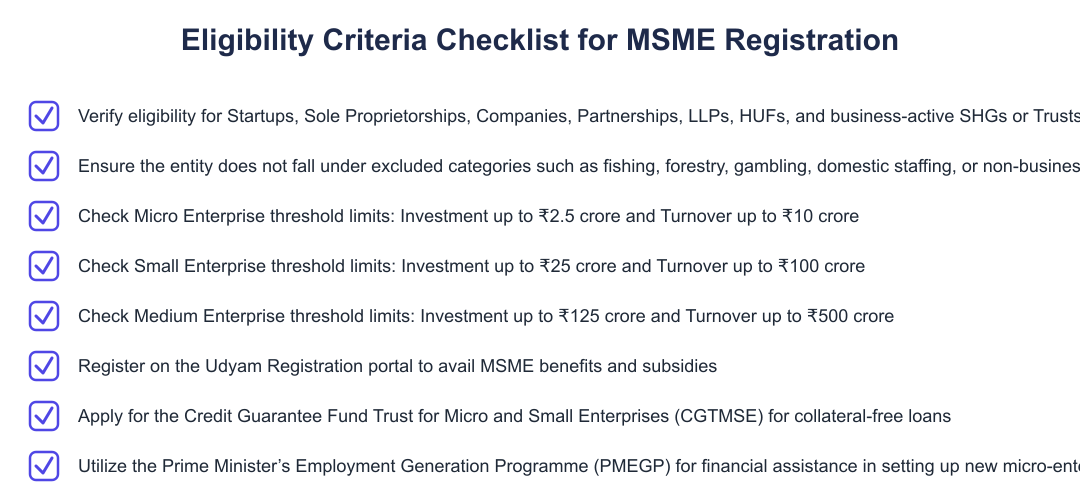
MSME registration is open to various business structures engaged in manufacturing or service activities, including sole proprietorships, partnership firms, Limited Liability Partnerships (LLPs), Hindu Undivided Families (HUF), public and private limited companies, co-operative societies, and self-help groups. Startups, entrepreneurs, and trusts that are actively engaged in commercial business operations can also apply for MSME registration. To register, these eligible entities must obtain an online Udyam Registration, which is a simplified, self-declaration-based process.
Which business activities are excluded from registering as an MSME?
Business activities such as fishing and aquaculture, forestry and wood harvesting, gambling and related ventures, and domestic household staffing services are strictly excluded from MSME registration. Additionally, non-business entities like charitable trusts, NGOs, clubs, or societies that are not actively engaged in manufacturing or service operations cannot register under the MSME category. Extraterritorial organizations and bodies are also completely ineligible for any benefits or registrations under the MSMED Act.
What government benefits can a registered MSME avail?
Registered MSMEs can access several government support initiatives, such as the Credit Guarantee Fund Trust for Micro and Small Enterprises (CGTMSE) which provides collateral-free business loans, and the Prime Minister’s Employment Generation Programme (PMEGP) for setting up new micro-enterprises. Businesses can also leverage national skill development and training programs to upgrade their workforce. To access these subsidies, financial assistance, and simplified compliance benefits, enterprises must complete their registration on the official Udyam portal.
What is Udyam Registration and why is it important for MSMEs?
Udyam Registration is a simplified online registration process launched by the government that acts as the official recognition for MSMEs in India. Obtaining this registration is essential because it serves as the gateway to access all government subsidies, priority sector lending from banks, collateral-free loans, and protection against delayed payments. The process is completely digital, paperless, and based on self-declaration, integrating investment and turnover details automatically through Income Tax and GST portals.
Need help staying MSME compliant?
MoneyGence's AI Finance OS tracks your compliance, wallet share, and finances in one place, built for agencies and growing businesses.
Get started with MoneyGence