How to Track Client Profitability
Revenue tells you what a client paid you. Profitability tells you what's actually left after the cost of serving them. Most agencies only track the first one - here's how to calculate the second, and why the gap between them matters more th
How to Track Client Profitability
Ask an agency founder which client is their best one, and most will name whoever bills the most. It's an understandable answer and often the wrong one. Revenue tells you what a client paid you. It says nothing about what it cost you to earn that money - the hours your team spent, the vendors you paid on their behalf, the scope creep nobody billed for. Profitability is the number that actually answers "is this a good client," and most agencies never calculate it.
Revenue Is Not Profitability
These get used interchangeably in casual conversation, and that's exactly the problem. Client-wise revenue tracking (covered in our earlier guide) tells you what each client bills and pays. Profitability goes one step further and asks what's actually left after the real cost of serving them.
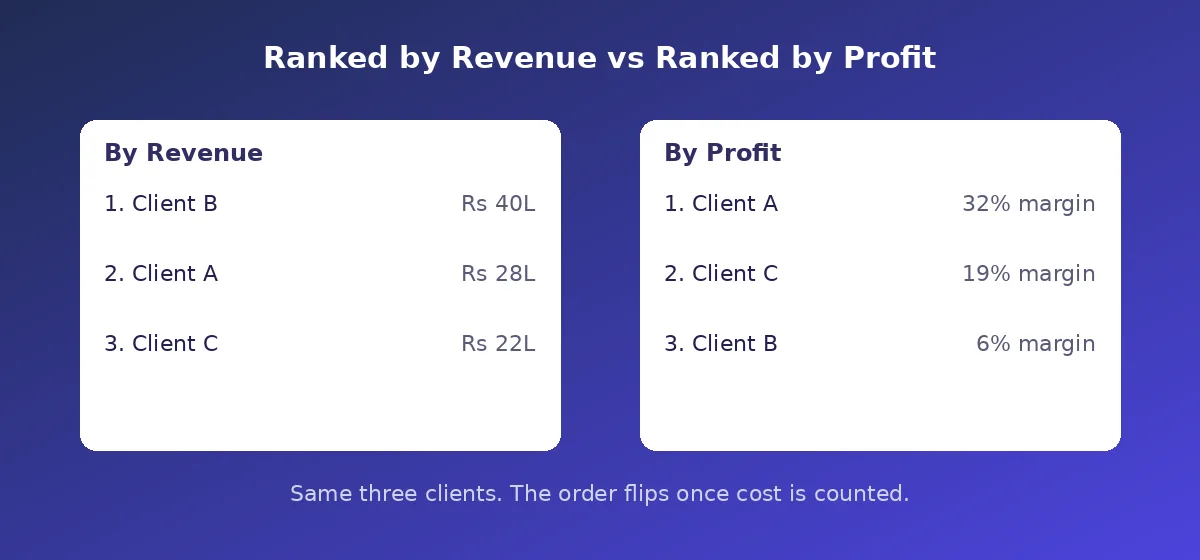
The pattern above is common enough to be the rule rather than the exception: your biggest client by revenue is often not your most profitable one, once you account for how much team time, vendor cost, and scope creep that account actually absorbs. A high-touch client who negotiated a discount, needs constant revisions, or has a complex vendor chain can bill a lot and keep very little of it.
The Client Profitability Formula
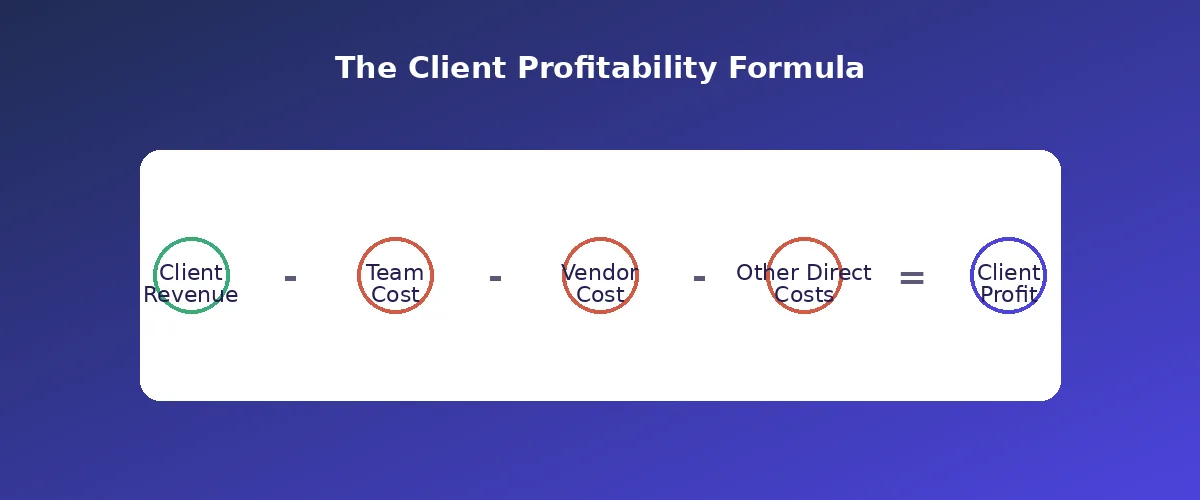
The calculation itself isn't complicated:
The difficulty isn't the formula. It's getting accurate numbers into each side of it - specifically, knowing how much team time and which vendor costs actually belong to each client.
What Goes Into the Cost Side
Team cost
This is usually the biggest and hardest piece. You need some way of attributing a portion of salary cost to each client based on time spent - timesheets, project-tracking tools, or even a rough weekly estimate from team leads if that's all you have. Precision matters less than consistency: a rough-but-consistent allocation beats a precise one-time estimate that never gets updated.
Vendor and subcontractor cost
Any external spend done specifically for a client - freelancers, specialist agencies, production costs, software licensed per-project - should be tagged to that client at the point of purchase, not reconstructed later. This is also the exact kind of PO-to-client mapping that gets genuinely messy without some system to enforce it.
Other direct costs
Travel for client meetings, servicing costs, anything incurred specifically because of that relationship. Smaller than the first two usually, but it adds up across a large client base and shouldn't be ignored entirely.
A Practical Way to Start (Without a Full Costing System)
- Start with your top 10-15 clients by revenue, not your whole roster. Full coverage can come later; the biggest relationships matter most first.
- Get a rough team-time allocation - even a monthly estimate from team leads ("I spend roughly 30% of my time on Client X") is far better than nothing.
- Tag vendor costs to clients at the point of purchase, not reconstructed from memory at quarter-end.
- Calculate margin quarterly to start. Monthly is better once the process is running smoothly, but don't let "we need monthly data" stop you from starting at all.
- Look at the trend per client, not just a single snapshot - a client whose margin is shrinking quarter over quarter is a different conversation than one that's always been thin but stable.
A Note on Tools (Including Ours)
It's worth being direct about where the tooling landscape actually stands, because this is an area where it's easy to oversell. General accounting software (Tally, Zoho Books) tracks entity-level books, not client-level cost allocation - you'd be building this manually regardless of which accounting system you use. Client-wise revenue and cash visibility tools, including MoneyGence, are a meaningfully different layer: they show you what each client bills, pays, and owes, which is the essential foundation this calculation sits on top of.
Common Mistakes
- Ranking clients by revenue alone. It's the easiest number to grab and the least complete picture.
- Allocating team cost once and never updating it. Client workload shifts; a cost allocation from eight months ago is probably wrong now.
- Including overhead in client-level numbers. It dilutes the signal and makes every client look equally mediocre.
- Treating low-margin as automatically bad. Some low-margin clients are strategic (a logo client, a foot in a new industry) - profitability should inform decisions, not make them automatically.
- Waiting for a perfect system before starting. The rough version, done consistently, beats the precise version that never gets built.
Frequently Asked Questions
What's the difference between client revenue and client profitability?
Client revenue is what a client bills and pays you, full stop. Client profitability subtracts the cost of serving that client (team time, vendor spend, other direct costs) from revenue to show what's actually left. A client can be high on one measure and low on the other.
How accurate does team-time allocation need to be?
Less accurate than you'd think, as long as it's consistent. A rough monthly estimate reviewed regularly is more useful operationally than a precise one-time time-tracking exercise that never gets repeated.
Should I fire a client with negative profitability?
Not automatically. Some negative-margin relationships are intentional (strategic accounts, new-industry entry points), but it should be a conscious decision rather than something you discover a year later with no plan for it.
Can MoneyGence calculate client profitability for me?
Not yet, as of this writing. MoneyGence currently shows client-wise revenue, receivables, and cash position; a full cost-and-margin engine is in active development. Today, this calculation needs to be done manually using the method in this guide, typically with timesheet data and vendor costs tagged by client.
Official references
Need help staying Accounting compliant?
MoneyGence's AI Finance OS tracks your compliance, wallet share, and finances in one place, built for agencies and growing businesses.
Get started with MoneyGence