Quotation Format: Templates & Samples for Indian Businesses
Quotations are the first formal step in turning interest into a sale. This guide explains how to choose and use different quotation formats and templates so your business presents prices, scope and terms clearly and professionally. You will learn how to match a template to your business size and customer type, what elements a useful quotation should include, and practical tips for keeping templates consistent and easy to reuse. Whether you send quotations by email, download them from cloud tools, or print them for customers, a well‑structured format reduces back‑and‑forth, speeds decision making, and protects both parties by documenting expectations. The advice here focuses on format and presentation rather than pricing strategy, so you can pick or design templates that support your sales process and administrative workflow. By the end of this guide you will be able to select or build quotation templates that are clear for customers, easy for your team to populate, and adaptable as your business grows.
Deciding which quotation format or template best suits your business
Start by considering how you sell and who you sell to. A one‑page, concise quotation often works better for straightforward product sales, while services or complex projects benefit from a more detailed format that separates scope, deliverables, timelines and assumptions. Think about the typical questions customers ask and ensure the template answers those questions up front.
Also evaluate how your team prepares quotations. If several people create quotes, choose a template that enforces consistency and reduces manual formatting. Cloud‑based editable templates help maintain a single source of truth and make version control easier, while simple offline files may be sufficient for very small operations.
Finally, plan for reuse and adaptation. A good template is modular: common fields such as contact details, itemised pricing and payment terms are standard across all quotes, while sections for optional services, discounts or special notes can be toggled on or off depending on the opportunity. This balance keeps quotes professional without forcing unnecessary detail on every customer.
Quotation templates widely used in India
Businesses commonly use a handful of template types tailored to different selling scenarios. Simple sales quotations focus on item description, unit price, quantity and total, presented clearly so customers can compare offers quickly. For services, templates typically include a description of work, deliverables, time estimates and assumptions that limit liability or clarify scope.
For project work, longer proposal‑style quotations combine commercial details with a short commercial narrative, milestones and acceptance criteria. Some templates include optional annexes for detailed specifications, terms and any technical drawings. Companies that deal with repeat orders may use master quote templates with fields for recurring items and predefined terms to accelerate issuance.
Many sellers also maintain a compact ‘estimate’ template used early in discussions, and a more formal ‘quotation’ template used once terms are agreed. The distinction between these templates helps manage customer expectations: estimates communicate a preliminary price range while formal quotations present a firm offer subject to the stated terms.
How to create a practical quotation template
Decide the core information every quotation must show, such as seller and buyer contact details, itemised pricing and total amount, and validity period or expiration of the quote.
Organise content so the price and next steps are prominent; use headings and simple tables for line items so customers can scan details quickly.
Add brief but clear payment, delivery and cancellation terms so there is no ambiguity about obligations and timelines.
Ask colleagues or a few customers to review the template for clarity and completeness and refine fields based on their feedback.
Advantages of using quotation formats or templates
Templates save time by pre‑populating repeated fields and enforcing a consistent structure across the sales organisation. Consistency reduces errors and makes it easier for customers to compare multiple quotes or past correspondence.
A well‑designed template also protects your business by documenting the scope and terms under which the price is offered. Clear presentation of exclusions and assumptions reduces later disputes and speeds contract finalisation.
Finally, using templates supports process efficiency. Templates that integrate with customer records or order management tools let teams turn accepted quotations into invoices or work orders with minimal rekeying, improving accuracy and shortening the sales cycle.
Choosing the right quotation format is a practical exercise in clarity, efficiency and risk management. By aligning template complexity with the nature of your offerings and how your team works, you make it easier for prospects to say yes and for your business to deliver. Start with a clear, reusable structure, iterate based on feedback, and integrate templates into your sales workflow for the best results.
Frequently asked questions
What is a quotation template and why should my business use one?
A quotation template is a pre-formatted document that lists prices, product or service details, terms and validity and is used to send price proposals to customers. Using a template saves time, ensures consistency across quotes, and reduces errors because you don’t recreate the layout for every customer; it also helps maintain records for future deals. Templates can be simple Word or Excel files or cloud-based formats, and they make it easier to include required information such as tax details and product breakdowns. For businesses concerned about compliance, a well-designed template ensures tax and terms are consistently communicated to clients.
How do I decide which quotation format or template best suits my business?
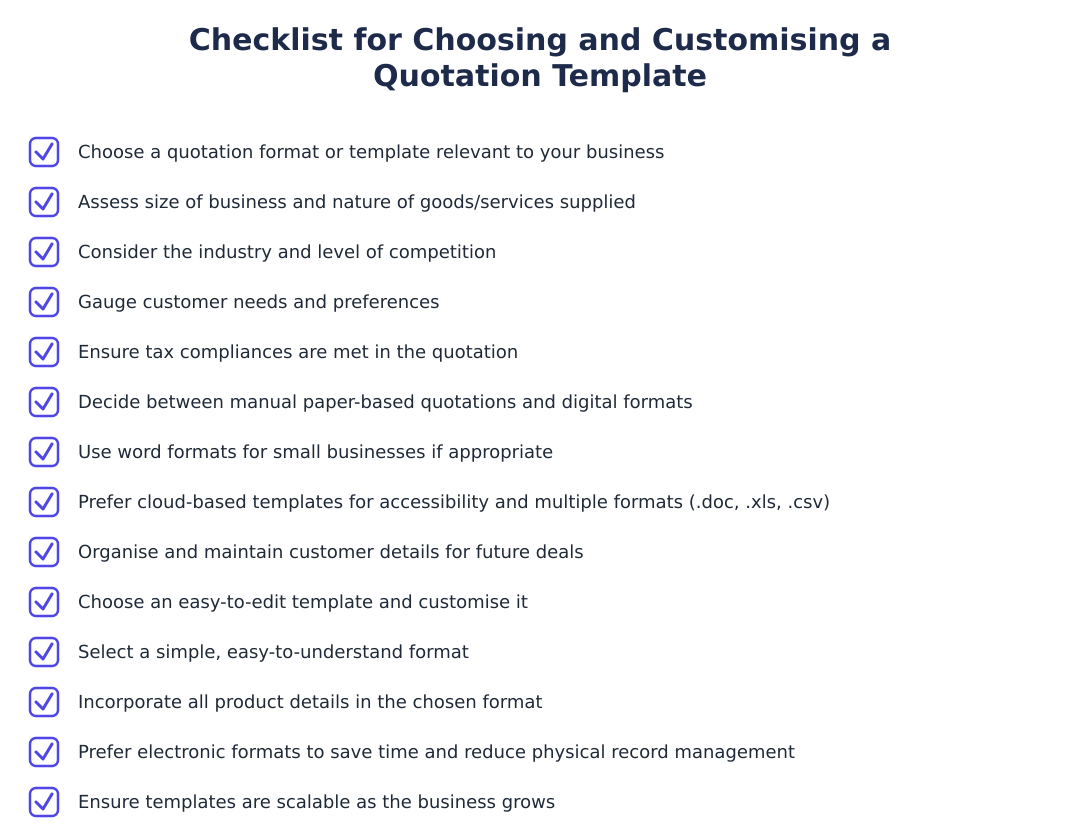
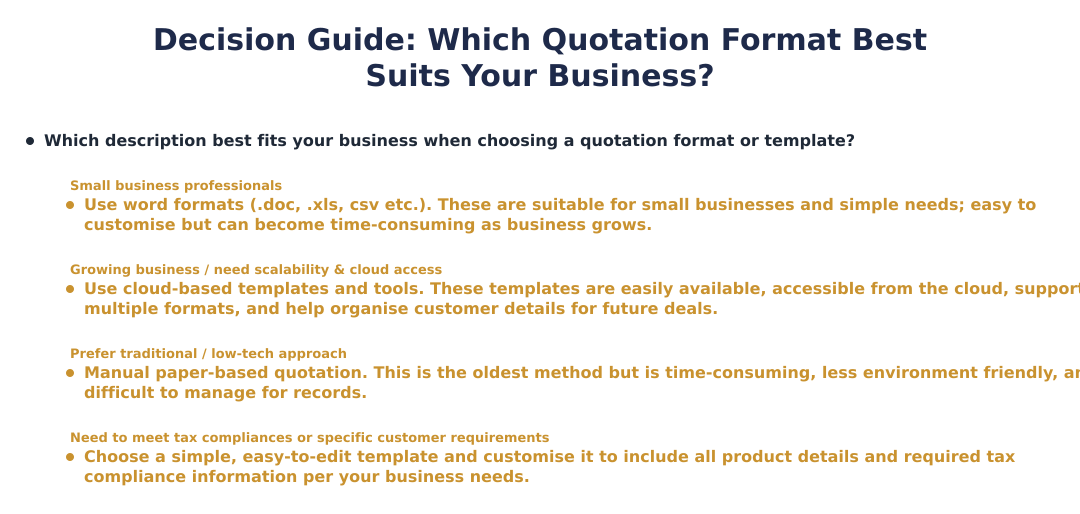
Choose a quotation format based on your business size, the nature of goods or services, industry competition, customer preferences and tax compliance needs. Small businesses with few SKUs may prefer simple Word or Excel templates for ease of use, while larger businesses should opt for cloud-based or software-generated templates to handle volume and automate calculations. Also consider whether customers expect formal-looking PDFs, editable formats, or emailed links, and ensure the chosen format makes it easy to include mandatory tax and product details. Finally, pick a format that is easy to edit and standardise so your team can use it consistently.
What are the common quotation templates widely used in India?
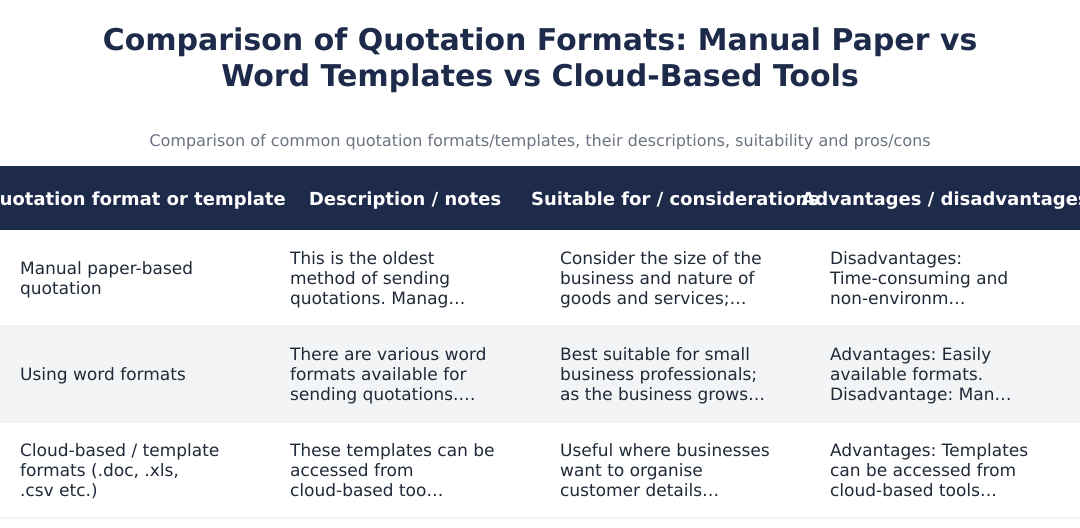
Common quotation templates in India include manual paper-based quotations, Word document formats, Excel spreadsheets and cloud-based templates that can export to .doc, .xls and .csv files. Manual paper quotations are traditional but slow and hard to manage; Word templates suit small professionals who need simple, printable quotes; Excel is useful when you need calculations and itemised pricing; cloud-based templates offer easy access, versioning and integration with customer records. Many businesses prefer cloud templates because they allow organising customer details for future deals and support multiple file formats and sharing options.
Are manual paper-based quotations still a good idea?
Manual paper-based quotations are outdated for most businesses because they are time-consuming, non-environment friendly and difficult to manage for record-keeping. They might be appropriate for very small local businesses or in situations where customers require a physical signed copy, but they become impractical as transaction volume grows. Digital formats offer faster generation, easy edits, and better compliance tracking, so consider paper only when legally or contractually necessary. Also factor in storage and retrieval costs when using physical records long-term.
What are the advantages of using quotation templates or formats?
Quotation templates increase efficiency, ensure consistency, reduce manual errors and make it easier to include tax and product details consistently across all quotes. They speed up response times to customers, help maintain an organised database of customer details for repeat business, and often integrate with other systems when cloud-based. Templates also make it simpler to comply with tax requirements and standard terms because you don’t omit crucial fields repeatedly. Finally, standardised templates improve professionalism and help with internal tracking of which offers were sent and accepted.
What file formats should I use for quotations (.doc, .xls, .csv)?
Use the file format that matches your needs: .doc (Word) for printable, well-formatted text quotes; .xls (Excel) when you need itemised lists and automatic calculations; and .csv for bulk data export or system import. Cloud-based tools often let you export to multiple formats so you can send a PDF to the customer while keeping editable .xls or .doc masters. Choose formats that your customers can open and that support any required numeric precision for pricing and taxes. Also ensure exported files preserve required fields like GST details to meet tax compliances.
How should I customise a quotation template for my business needs?
Customise a template by choosing an easy-to-edit layout, adding your company logo and contact details, including clear product/service descriptions, rates, tax breakdowns and payment terms, and tailoring validity periods and delivery terms to your operations. Make the format simple to understand so customers can quickly see total prices and tax components; incorporate product codes or service categories if you have many items. For compliance, ensure fields for GST, HSN/SAC codes and invoice terms are present when required. Test the template with a few sample quotes to confirm calculations and clarity before rolling it out to the team.
Can cloud-based quotation templates help manage customer data for future deals?
Yes, cloud-based quotation templates let you organise and store customer details centrally so you can quickly reuse past quotes, personalise offers and track negotiation history for future deals. They support formats like .doc, .xls and .csv and often integrate with CRMs or accounting software to maintain a single source of truth. This reduces manual entry, speeds up quote generation, and helps maintain compliance by reusing approved templates that include tax and legal terms. Ensure you manage access controls and data privacy when storing customer information in the cloud.
What simple best-practices should I follow when choosing or creating a quotation format?
Choose an easy-to-edit, simple format that includes all necessary product details, tax fields and payment and delivery terms, and then customise it consistently to your business needs. Keep the layout clear so customers can quickly understand prices and taxes, and use standard codes (like HSN/SAC) where applicable for compliance. Prefer cloud or digital formats for scalability and record-keeping, but keep printable versions if customers request them. Finally, maintain a master template and version control to ensure the whole team uses the same up-to-date format.
Need help staying Finance Templates compliant?
MoneyGence's AI Finance OS tracks your compliance, wallet share, and finances in one place, built for agencies and growing businesses.
Get started with MoneyGence