

On this page 9 sections
Most small businesses do not think about PF and ESI until the day the headcount reaches a certain number. Then the questions come quickly. Do we have to register? Who counts as an employee? What do we deduct from salaries, and what do we pay on top?
The answers are mostly simple. What has changed recently is the definition of "wages", which affects who is covered and how much is paid. This guide covers the basics first, then the change.
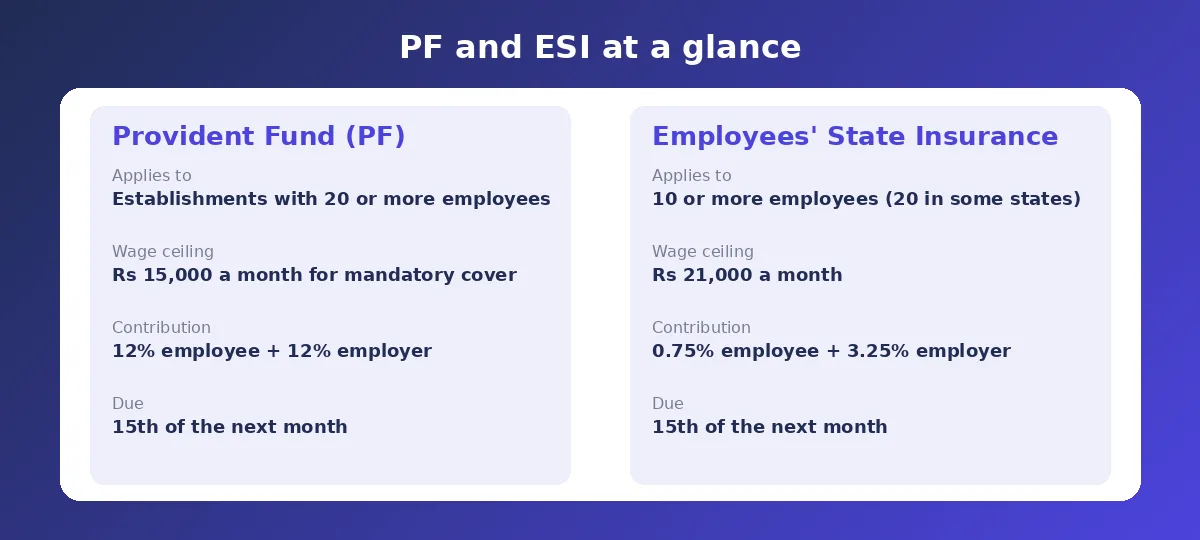
PF and ESI at a glance
Provident Fund (PF)
PF is a retirement savings scheme run by the EPFO. An establishment with 20 or more employees must register. Below 20, you can register voluntarily with your employees' consent, but once you have opted in, it is hard to step back.
- Who counts: employees on your payroll, and one source notes that contract workers engaged through a principal employer count toward the 20.
- Contribution: 12% of wages from the employee and 12% from the employer.
- Where the employer share goes: part of it (8.33%) goes to the pension scheme on wages up to Rs 15,000, and the rest to the provident fund account. There is also a small insurance contribution and an admin charge on top.
- Wage ceiling: mandatory cover applies to employees earning up to Rs 15,000 a month. Employees above that can be covered voluntarily.
- Due date: by the 15th of the following month.
Employees' State Insurance (ESI)
ESI provides medical and cash benefits to lower-paid employees. It applies to establishments with 10 or more employees in notified areas, and 20 or more in a few states, so check your own state.
- Wage ceiling: employees earning up to Rs 21,000 a month are covered.
- Contribution: 0.75% from the employee and 3.25% from the employer, on gross wages.
- Due date: by the 15th of the following month.
A quick example
Take an employee with monthly wages of Rs 14,000. PF is 12% on both sides, so Rs 1,680 is deducted from the employee and Rs 1,680 is paid by the employer.
Now take another with gross wages of Rs 20,000, who is covered by ESI. The employee pays 0.75%, which is Rs 150, and the employer pays 3.25%, which is Rs 650.
What the new wage definition changes
Under the Code on Wages, "wages" means basic pay, dearness allowance and retaining allowance. Other pay items such as HRA, conveyance and overtime can be excluded, but only up to 50% of total remuneration. Anything above that is added back into wages.
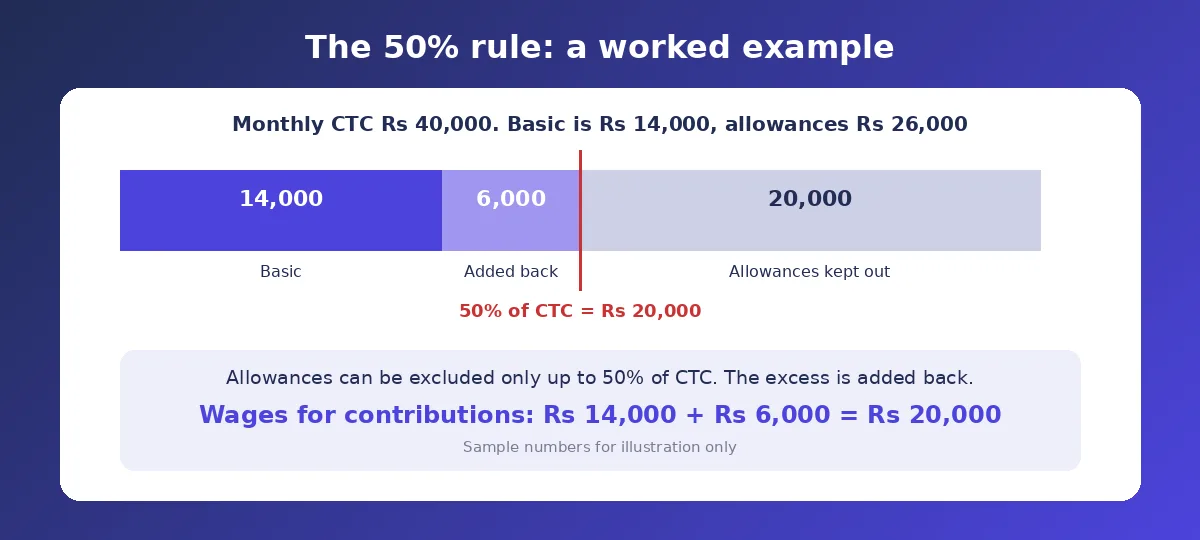
This matters most for companies that keep basic pay low and put the rest into allowances. In the example above, the CTC is Rs 40,000 with a basic of Rs 14,000. Allowances can be excluded only up to Rs 20,000, so Rs 6,000 is added back, and wages come to Rs 20,000.
- ESI: the contribution base follows the new wage definition, so more people can become eligible.
- Gratuity and bonus: these are calculated on the revised wage figure.
- PF: contributions are still mandatory only up to the Rs 15,000 ceiling, but the way "wages" is read for PF is still being finalised. Do not restructure salaries on a guess.
Monthly routine
- Finalise attendance and salary.
- Work out PF and ESI wages for each employee.
- Deduct the employee share from salary.
- Add the employer share to your liability.
- Pay both before the 15th of the next month, and file the return or challan on the respective portals.
- Keep the payment receipts with the payroll file.
Payroll is usually the biggest cost in a service business. Many founders only see it as one line in the books, but keeping it clearly separated from client revenue makes it easier to see what each engagement really costs you. See [Internal link -> How to Track Client Profitability] for that approach.
Common Mistakes
- Assuming PF only starts at 20 employees and forgetting to count contract workers.
- Deducting ESI on employees above the wage ceiling, or stopping at the wrong time.
- Paying on the 20th because "the month is not over".
- Restructuring salaries before the PF rules are clear.
- Missing the ESI registration when headcount crosses the state threshold.
- Not keeping challans and return acknowledgements.
Frequently Asked Questions
Is PF mandatory for companies with fewer than 20 employees?
No. It becomes mandatory at 20 employees. Below that, you can register voluntarily with the consent of your employees.
What is the PF contribution rate?
12% from the employee and 12% from the employer on PF wages, with mandatory cover for wages up to Rs 15,000 a month.
What are the ESI rates for 2026?
0.75% from the employee and 3.25% from the employer, for employees earning up to Rs 21,000 a month.
Did the Labour Codes change the PF wage ceiling?
No. The Rs 15,000 ceiling remains until it is revised. What changed is the definition of wages, which affects how some contributions and benefits are calculated.
When are PF and ESI due?
By the 15th of the following month.
Related guides:
Annual Compliance Checklist for a Private Limited Company
How to Track Client Profitability
Bookkeeping in Excel: Step-by-Step System for Small Businesses
Run a service business? See every client's money on one screen.
MoneyGence shows who has paid, who is overdue and by how many days, with GST-ready invoices, bank reconciliation and renewal alerts alongside your TDS work. Free for up to 2 clients, no credit card needed.
Start free with 2 clients See how it works →