
On this page 9 sections
Agencies, consultancies and production houses pay freelancers all the time. A designer for a week, a video editor for a campaign, a consultant for a quarter. Most of those payments are simple bank transfers, and the TDS side is often an afterthought until the CA raises it in March.
The rules themselves are not hard. The difficulty is knowing which rate applies, and since April 2026 even the section numbers have changed.
What changed from 1 April 2026
You may still see people say "194J" and "194C", and for now that shorthand is widely understood. But for payments made on or after 1 April 2026, the legal reference is Section 393, and returns use payment codes rather than the old section numbers. Payments made on or before 31 March 2026 stay under the old Act.
When you must deduct TDS
If your business pays a resident for professional or technical services, you deduct TDS when the total paid or credited to that one person crosses Rs 50,000 in the year. The deduction applies when you credit the amount in your books or pay it, whichever comes first.
Which rate applies
This is where most mistakes happen. The same freelancer can fall under different rates depending on what the work is.
Rebuild with the Table button, 3 columns:
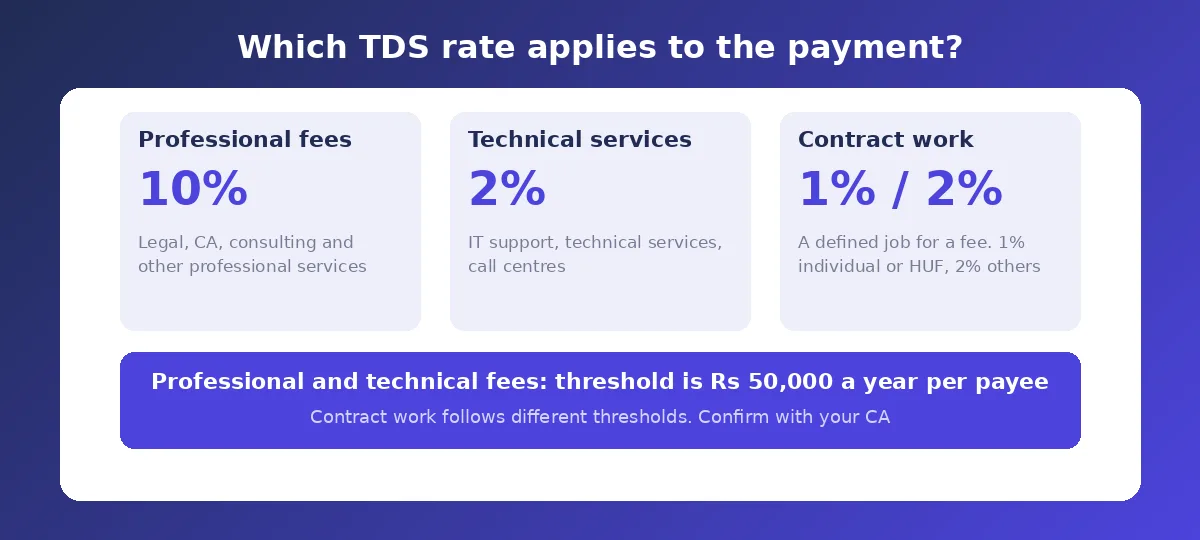
| Nature of payment | Rate | Typical examples |
|---|---|---|
| Professional services | 10% | Legal, CA, consulting, other professional fees |
| Technical services | 2% | IT support, technical services, call centres |
| Contract for a defined job | 1% for individual or HUF, 2% for others | Production work, event execution, printing jobs |
A worked example
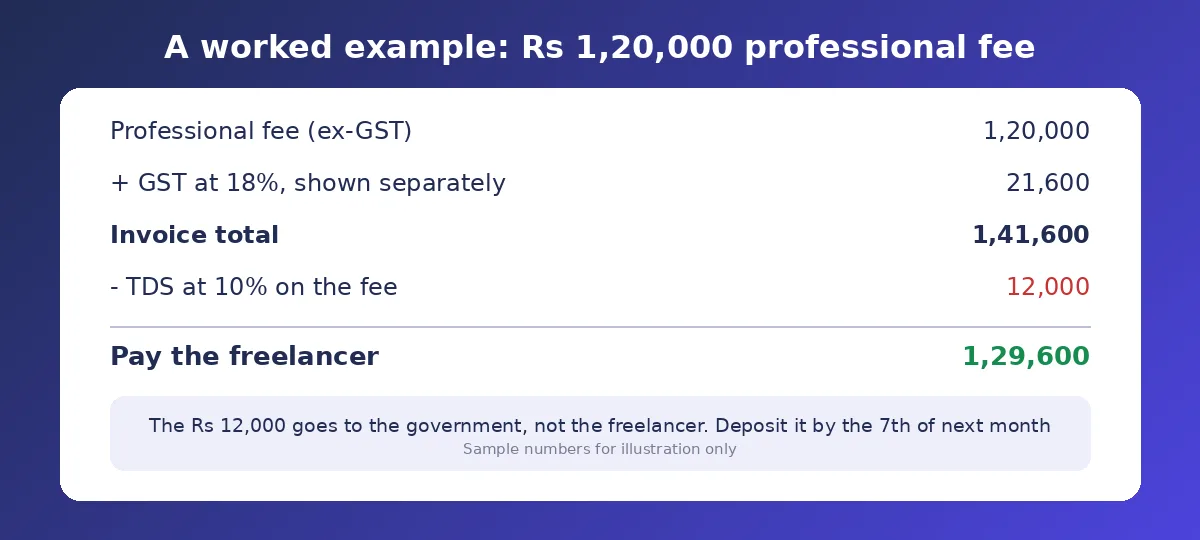
Say you pay a consultant a professional fee of Rs 1,20,000, and the consultant charges 18% GST on top, shown separately on the invoice.
- TDS is worked out on the fee excluding GST when GST is shown separately. So 10% of Rs 1,20,000 is Rs 12,000.
- The invoice total is Rs 1,41,600 (fee plus Rs 21,600 GST).
- You pay the consultant Rs 1,41,600 minus Rs 12,000, which is Rs 1,29,600.
- You deposit the Rs 12,000 with the government and give the consultant a TDS certificate, so they can claim credit.
PAN, deposit and returns
- Collect the PAN first. If a vendor does not give a PAN, a higher TDS rate (generally 20%) can apply.
- Deposit by the 7th of the next month. For March, the date is later, typically 30 April.
- File the quarterly TDS return. It reports each deduction against the vendor's PAN.
- Issue the certificate. The vendor needs it to claim the tax in their own return.
What happens if you miss it
There are interest charges for deducting or depositing late, and late fees on delayed returns. There is also a business-expense impact. Under the new Act, a share of the payment (30%, as the sources I checked state) can be disallowed in computing your business income when TDS was not deducted or deposited properly. Your CA can tell you the exact consequence for your case.
If you also pay vendors who may be registered micro or small enterprises, remember that payment timelines apply separately. We cover that in [Internal link -> MSME 45-Day Payment Rule for Service Businesses].
MoneyGence tracks vendor costs against a client's ledger, which helps you see what each client job has cost. It does not replace your TDS working, so keep your deduction and deposit records alongside it.
Common Mistakes
- Applying 10% to everything, or 1% to everything.
- Waiting until the total crosses Rs 50,000 before thinking about it, then realising earlier payments were also covered.
- Calculating TDS on the GST-inclusive amount when GST is shown separately.
- Not collecting PAN.
- Depositing late because the 7th passed quietly.
- Still quoting only "194J" in documents for payments made after 1 April 2026.
Frequently Asked Questions
Is TDS applicable on freelancer payments?
Yes, if the payment is for professional or technical services or covered contract work, and the amounts cross the threshold. The rate depends on the nature of the work.
What is the TDS rate on professional fees in FY 2026-27?
10% for professional fees, and 2% for technical services, when payments to one person exceed Rs 50,000 in the year.
Is Section 194J still valid after April 2026?
For payments made on or after 1 April 2026, the relevant provision is Section 393(1) of the Income-tax Act, 2025. The old section number is still used informally, but the legal reference has changed.
Is TDS deducted on the amount including GST?
If GST is shown separately on the invoice, TDS is generally calculated on the amount excluding GST.
What if the freelancer has no PAN?
A higher rate, generally 20%, can apply. Ask for the PAN before the first payment.
Related guides:
MSME 45-Day Payment Rule for Service Businesses
GST Invoice Format for Services
Bookkeeping in Excel: Step-by-Step System for Small Businesses
Official references
Run a service business? See every client's money on one screen.
MoneyGence shows who has paid, who is overdue and by how many days, with GST-ready invoices, bank reconciliation and renewal alerts alongside your TDS work. Free for up to 2 clients, no credit card needed.
Start free with 2 clients See how it works →