
On this page 11 sections
If you freelance or run a one-person consultancy, there is a good chance you have heard the phrase "just file under 44ADA". It sounds like a shortcut, and for many people it is. But it comes with conditions, and the people who get into trouble are usually the ones who did not read them.
This guide explains how the scheme works, who qualifies, what you give up, and the one mistake that can pull you into a tax audit.
What Section 44ADA is
Section 44ADA is a presumptive taxation scheme for specified professionals. Instead of working out your actual profit from every expense, you treat 50% of your gross receipts as your taxable income. The law presumes the other half went on expenses. You file a simplified return, ITR-4, and you do not need detailed books or a tax audit if you meet the conditions.
Who can use it
- Resident professionals in the specified professions, such as lawyers, doctors, architects, accountants and engineers. Technical consultants and certain other notified professions are also covered.
- Not eligible: LLPs, companies and non-residents.
- Brokerage and commission businesses are not treated as professions for this scheme.
The limits
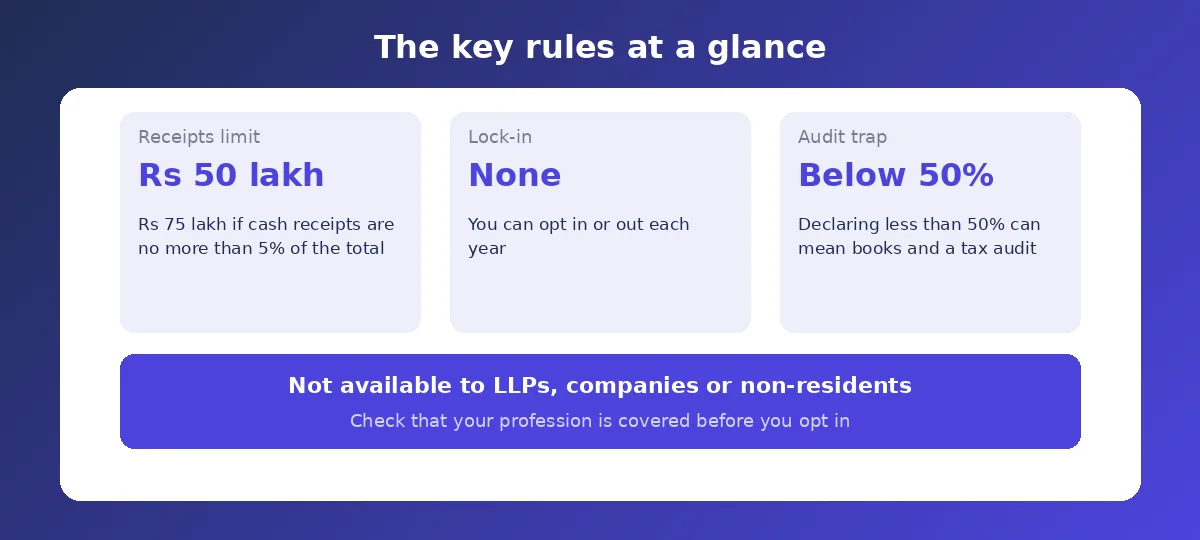
The standard limit is gross receipts of Rs 50 lakh in the year. If your cash receipts are no more than 5% of the total, the limit goes up to Rs 75 lakh. In practice, that means at least 95% of what clients pay you must come through banking channels such as bank transfer or UPI. Most freelancers already meet that.
If your receipts cross the applicable limit, you cannot use the scheme for that year.
A worked example
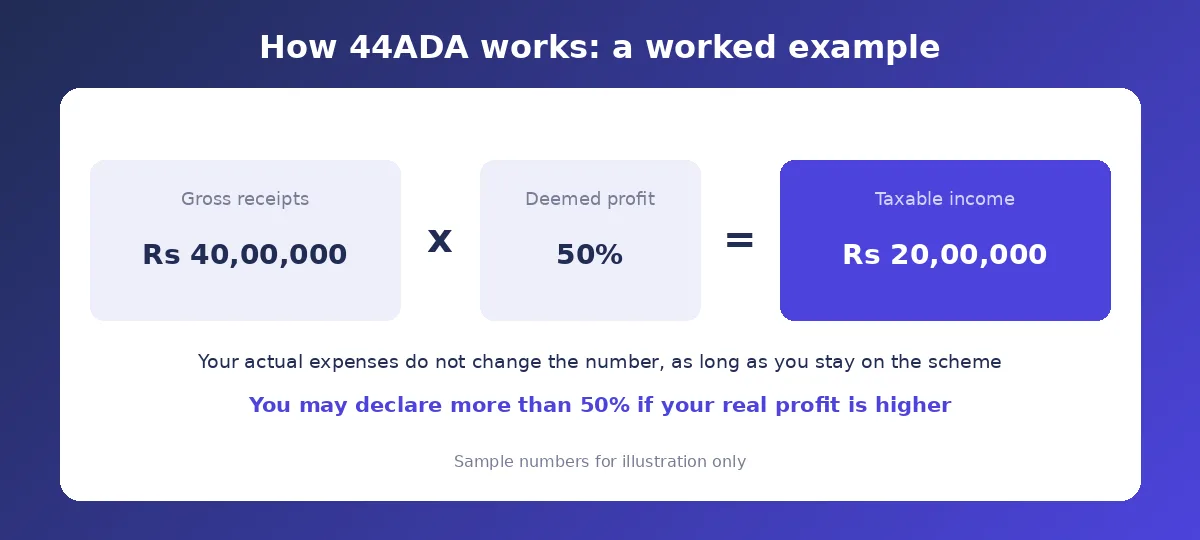
Say your gross receipts for the year are Rs 40 lakh, all received by bank transfer. Under the scheme, your deemed profit is 50%, which is Rs 20 lakh. That is the figure on which you are taxed, whether your real expenses were Rs 10 lakh or Rs 25 lakh.
What you give up
- Deductions for actual expenses. The 50% is the final income. You cannot also deduct rent, salaries or software costs.
- Loss carry-forward. If your real business ran at a loss, the scheme will not help you claim it.
- Flexibility within the year. Whichever way you file, your declared income has to be consistent with your return.
The audit trap
There is no five-year lock-in for 44ADA, unlike the business version. You can opt in one year and out the next. But if you declare income lower than 50% of receipts while your total income is above the basic exemption limit, you must maintain books of account and get them audited. Many freelancers fall into this when they think their real profit is lower and try to declare it.
Should you use it
- Work out your real expenses. If they are well under 50% of receipts, the scheme probably saves you tax and effort.
- Check your receipts against the limits, and your cash receipts against the 5% condition.
- Check your profession. If you are not sure it is covered, ask.
- Think about the year after. There is no lock-in, so you can switch if your expenses rise.
- Look at the rebate. For resident individuals under the new tax regime, one source says income up to Rs 12 lakh can be effectively tax-free through the rebate, which means receipts up to about Rs 24 lakh could attract no tax under 44ADA. Confirm this with your CA, since rules and eligibility conditions can change.
Advance tax, TDS and GST
- Advance tax: presumptive taxpayers are generally allowed to pay it in a single instalment by 15 March. Confirm the current rule with your CA.
- TDS: clients may deduct TDS from your fees. That tax is credited against your final liability when you file. See [Internal link -> TDS on Payments to Freelancers and Professionals].
- GST: this is separate from income tax. Crossing the threshold means registering whichever tax scheme you use. See [Internal link -> GST Registration for Service Providers].
Common Mistakes
- Assuming every freelancer qualifies without checking the profession.
- Declaring less than 50% without knowing it triggers books and an audit.
- Ignoring the 95% banking-channel condition and taking large cash payments.
- Claiming expenses on top of the 50%.
- Forgetting to claim credit for TDS deducted by clients.
- Not realising an LLP or a company cannot use the scheme.
Frequently Asked Questions
What is Section 44ADA?
It is a presumptive taxation scheme under which eligible professionals declare 50% of their gross receipts as income and skip detailed books and a tax audit.
What is the turnover limit for 44ADA?
Gross receipts of Rs 50 lakh, or Rs 75 lakh if cash receipts are no more than 5% of the total.
Can a freelancer use Section 44ADA?
Yes, if the freelancer is a resident individual in a specified profession. Eligibility depends on the nature of the work, so confirm with your CA.
Which ITR form is used for 44ADA?
ITR-4, also known as Sugam.
Is there a lock-in for 44ADA?
No. Unlike the business scheme, you can opt in or out of 44ADA each year.
What changes under the Income-tax Act, 2025?
The provision is renumbered and reported to be brought together with the other presumptive schemes under a single section. Sources say the 50% rate, the limits and the audit exemption are unchanged for tax year 2026-27.
Related guides:
TDS on Payments to Freelancers and Professionals
GST Registration for Service Providers
Private Limited vs LLP vs Sole Proprietorship for a Service Business
Official references
Run a service business? See every client's money on one screen.
MoneyGence shows who has paid, who is overdue and by how many days, with GST-ready invoices, bank reconciliation and renewal alerts alongside your Income Tax work. Free for up to 2 clients, no credit card needed.
Start free with 2 clients See how it works →