
On this page 11 sections
Most founders pick their business structure in a hurry. A client wants an invoice, a friend suggests "just make a company", and a form gets filed. Months later the tax bill, the audit requirement or an investor's question shows that the choice was not neutral.
For a service business with no factory and no stock, the decision is mostly about four things: liability, tax, compliance and funding. This guide compares a sole proprietorship, an LLP and a private limited company on each, so you can decide with your eyes open.
The three structures at a glance
Sole proprietorship
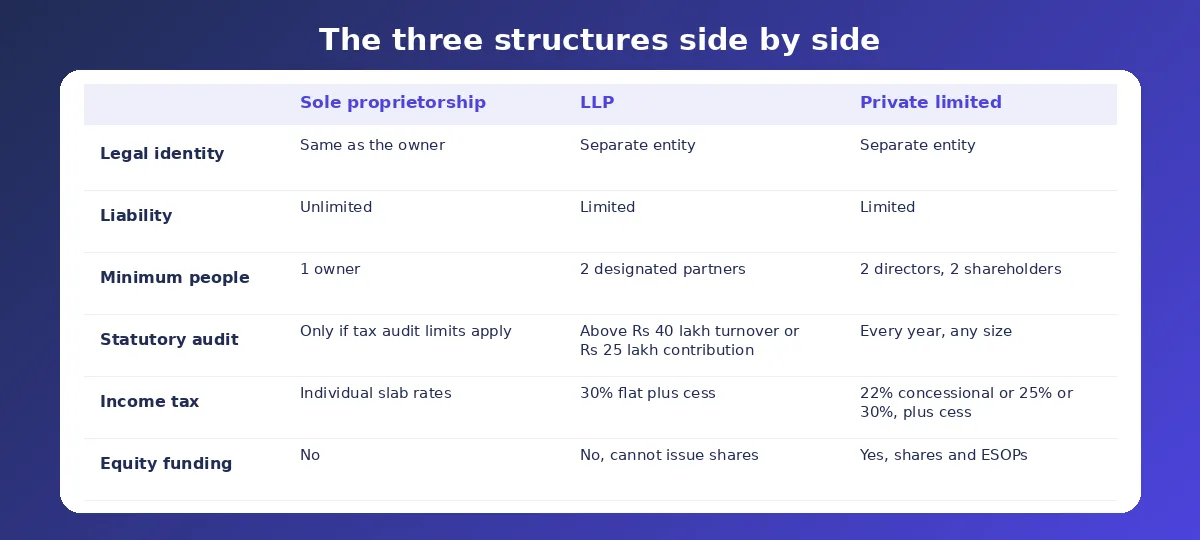
This is the simplest way to run a service business. You and the business are legally the same person. There is no separate registration for the structure itself, though you may still need GST, a shop and establishment registration or Udyam.
- Good for: freelancers, consultants and very early-stage agencies with one owner.
- Compliance: the lightest of the three. No company or LLP filings, only your income tax return and any GST returns.
- Tax: income is taxed in your hands at individual slab rates.
- The catch: liability is unlimited. If the business owes money or loses a dispute, your personal assets can be at risk. You also cannot raise equity or give shares.
LLP
A limited liability partnership is a separate legal entity. Partners' liability is limited to what they agreed to contribute, and the running of the business is set out in an LLP agreement.
- People: at least two designated partners, at least one of them resident in India.
- Audit: only required if turnover exceeds Rs 40 lakh or contribution exceeds Rs 25 lakh. Below that, an LLP does not need a statutory audit.
- Annual filings: Form 11 (annual return) and Form 8 (statement of accounts and solvency). The usual dates are 30 May and 30 October, but confirm them for your year.
- Tax: a flat 30% plus surcharge and cess. For an LLP with income below Rs 1 crore, that works out to about 31.2% with cess. Partners' share of profit is not taxed again in their hands.
- The catch: an LLP cannot issue shares, so raising venture funding or giving ESOPs is not realistic.
Private limited company
A private limited company is also a separate legal entity with limited liability, but it carries the most compliance.
- People: at least two directors and two shareholders.
- Audit: a statutory audit every year, whatever your turnover.
- Annual filings: AOC-4, MGT-7, director KYC, an AGM and at least four board meetings. See Annual Compliance Checklist for a Private Limited Company.
- Tax: the concessional regime taxes a company at 22% (about 25.17% with surcharge and cess) if you meet the conditions. Otherwise it is 25% or 30%. Dividends you take out are taxed again in your hands.
- The plus side: you can issue shares, bring in investors and offer ESOPs to attract talent.
What the tax difference looks like
As a rough illustration, take a profit of Rs 20 lakh. An LLP at 31.2% pays about Rs 6.24 lakh. A company under the 22% regime at about 25.17% pays about Rs 5.03 lakh. The company looks cheaper on paper, but it also has audit costs, and when you take money out as dividends or salary there is a second layer of tax or deductions to work through.
Compliance and cost
Roughly, compliance load rises from sole proprietorship to LLP to private limited company. A company needs an audit every year, ROC filings and board meetings. An LLP has two annual filings and an audit only above the limits. A sole proprietorship has none of the ROC work. Fees for accountants and company secretaries rise in the same order.
Funding and credibility
- If you plan to raise equity from angels or venture investors, a private limited company is the usual choice, since investors expect shares.
- If you plan to stay bootstrapped, an LLP can give limited liability without the extra compliance.
- Some larger clients prefer to deal with a registered entity rather than an individual. It is worth asking the clients you most want to win.
How to decide
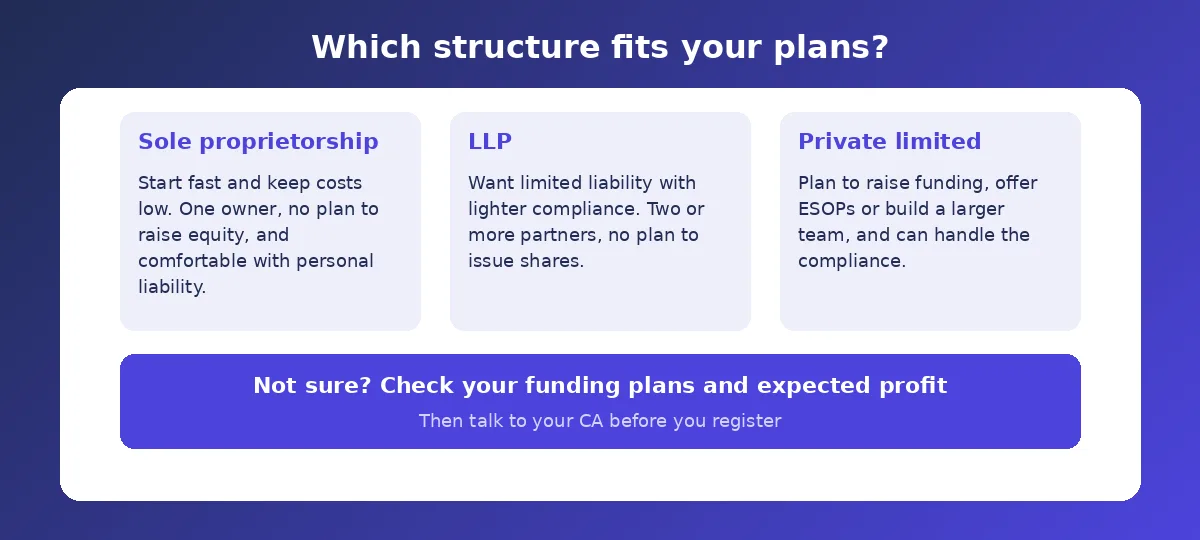
- Will you raise equity or give ESOPs in the next few years? If yes, lean towards a private limited company.
- How large will your profit be? Higher profits can make the company tax rate more attractive. Lower profits often make a lighter structure sensible.
- How much compliance can you handle? A company needs a company secretary or CA on a regular basis.
- How much risk are you comfortable carrying personally? If the answer is "not much", avoid a sole proprietorship.
- Talk to your CA with your expected profit and funding plans before registering.
Other registrations are separate from your structure. You will still need to consider GST Registration for Service Providers and Udyam Registration for Service Businesses, whichever route you pick.
Common Mistakes
- Registering a private limited company for a small solo business and then struggling with the compliance cost.
- Choosing an LLP and later finding that investors will not fund it.
- Staying a sole proprietor while taking on large contracts with real liability.
- Choosing on tax alone, ignoring audit cost and dividend tax.
- Not thinking about how to move from one structure to another later.
- Assuming one registration covers GST, Udyam and others.
Frequently Asked Questions
Which is better for a service business: private limited or LLP?
Private limited suits businesses that want to raise equity or give ESOPs. An LLP suits businesses that want limited liability with lighter compliance and no plan to issue shares.
Is an audit mandatory for an LLP?
Only if turnover exceeds Rs 40 lakh or contribution exceeds Rs 25 lakh in a financial year.
Is an audit mandatory for a private limited company?
Yes. A private limited company needs a statutory audit every year, regardless of turnover.
What is the tax rate for an LLP and a private limited company?
An LLP pays a flat 30% plus surcharge and cess. A private limited company pays 22% under the concessional regime if conditions are met, otherwise 25% or 30%, plus surcharge and cess.
Can a sole proprietor have limited liability?
No. A sole proprietorship has no separate legal identity, so the owner's liability is unlimited.
Related guides:
How to Register a Private Limited Company in India
Official references
Run a service business? See every client's money on one screen.
MoneyGence shows who has paid, who is overdue and by how many days, with GST-ready invoices, bank reconciliation and renewal alerts alongside your Company Registration work. Free for up to 2 clients, no credit card needed.
Start free with 2 clients See how it works →