

On this page 6 sections
Month-End Close Checklist for Small Businesses in India
Most small businesses do not close the month. They just keep going, and the books get sorted out in a rush when the CA asks for numbers in March. By then a missed invoice from June is a puzzle, and a payment entered twice in August has already been repeated three times.
A month-end close is simply a fixed routine that you run at the start of every month, so the previous month is checked, agreed and finished. Done properly, it takes a few hours for a small business, and it makes the year-end far less painful.
Why bother every month
- Errors are cheap to fix when they are fresh. A wrong entry from last week is easy to trace. One from last year is not.
- You see your real position. Revenue, costs, receivables and cash are only trustworthy once everything is recorded.
- GST, TDS and payroll deadlines stop sneaking up. The checklist builds them into the routine.
- Your CA gets cleaner books, which usually means a smaller bill and fewer questions.
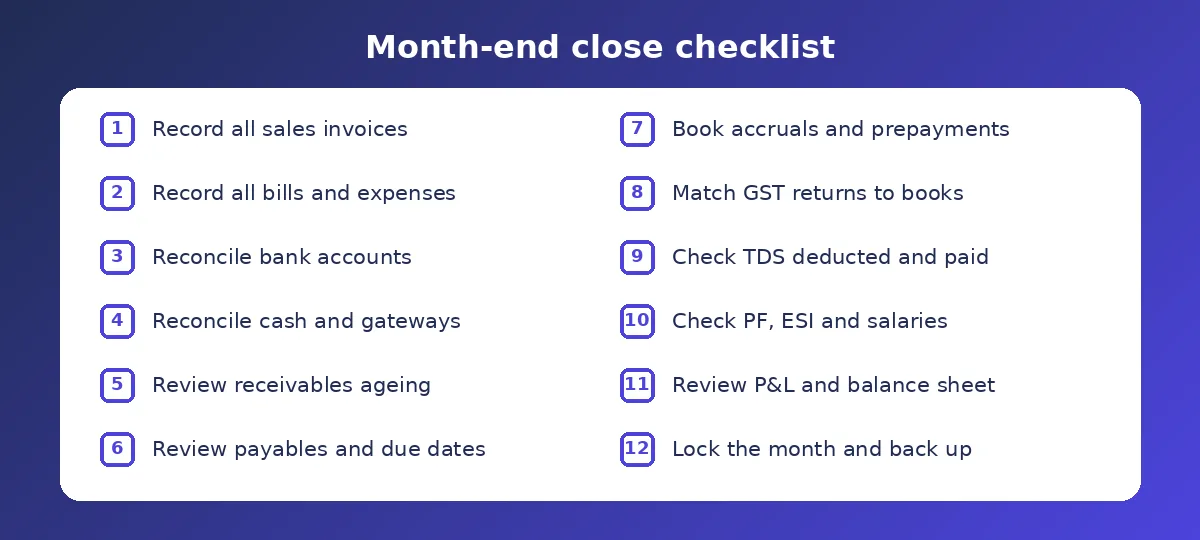
The 12 steps
1. Record all sales invoices
Make sure every invoice raised in the month is in your books, with the right client, GST and date. Check the invoice number series for gaps.
2. Record all bills and expenses
Enter every vendor bill, reimbursement and card expense. Chase missing bills now, not at year-end.
3. Reconcile bank accounts
Match each bank line against your books and explain the differences. We cover it step by step in How to Do a Bank Reconciliation.
4. Reconcile cash and payment gateways
Count petty cash and compare it with the book balance. If you use a payment gateway, match its settlement report with the bank credits, since fees and refunds are usually netted out.
5. Review receivables ageing
List unpaid invoices by age, and follow up on the oldest first. How to Track Client Receivables explains how.
6. Review payables and due dates
Check which vendor bills are due, and flag any registered micro or small suppliers close to the 45-day limit. See MSME 45-Day Payment Rule for Service Businesses.
7. Book accruals and prepayments
Record work you have done but not yet billed, costs you have incurred but not yet received a bill for, and payments made in advance for future months. Without this, a month's profit can look far better or worse than it really is.
8. Match GST returns to your books
Compare your sales register with the figures in your outward supplies return, and your purchase register with the input tax credit shown in the auto-drafted statement on the GST portal. Fix mismatches before you file. Check your own due dates for each return.
9. Check TDS deducted and paid
Confirm that TDS was deducted on every payment that needed it and that it was deposited on time. Rates are in TDS on Payments to Freelancers and Professionals.
10. Check PF, ESI and salaries
Make sure salaries are booked, statutory deductions match the payroll, and the contributions are paid by their due dates. See PF and ESI for Small Businesses.
11. Review the profit and loss and balance sheet
Compare this month with last month. A cost that doubled, a revenue line that vanished, or a balance that makes no sense is usually an entry error.
12. Lock the month and back up
Once everything agrees, lock the period in your accounting software so nobody changes it by accident. Save a copy of the reports and your reconciliations.
A five-day schedule that works
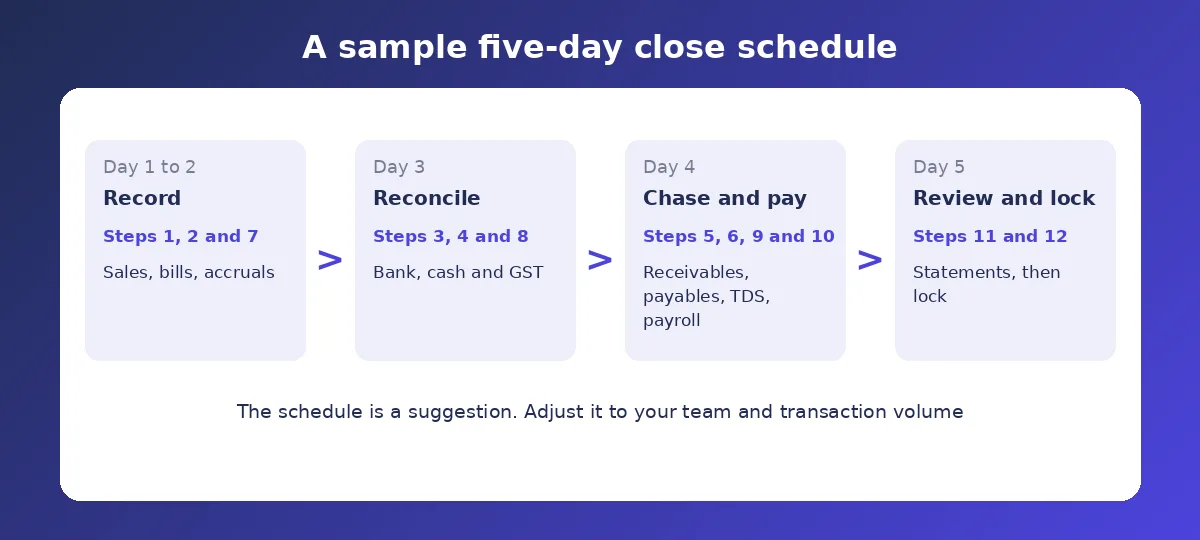
This is only an example. If you have few transactions, you may finish in two days. If you handle hundreds of invoices, you may need more. What matters is that the order stays the same: record first, reconcile next, review last.
Common Mistakes
- Starting the review before all invoices and bills are in.
- Skipping the bank reconciliation because "the balance looks right".
- Forgetting accruals, so profit looks inflated in some months and crushed in others.
- Leaving the period open, so old entries change quietly.
- Closing on a different day every month.
- Treating the close as one person's job with no backup.
Frequently Asked Questions
What is a month-end close?
It is the routine of recording all transactions for the month, reconciling accounts, reviewing the numbers and locking the period.
How long should a month-end close take?
For a small business, a few hours to a few days, depending on how many transactions you have. A common target is the first five working days of the next month.
What is the difference between accruals and prepayments?
An accrual is something that belongs to this month but has not been billed or paid yet. A prepayment is something you paid for in advance that belongs to a future month.
Do I need to close the books every month if I only file GST quarterly?
It is still a good habit. Quarterly filing changes your return schedule, not the benefit of catching errors early.
Can I do the month-end close in Excel?
Yes, if your volume is low. Keep one sheet per step, and a tick column for the checklist. Larger teams usually move to accounting software.
Related guides:
How to Do a Bank Reconciliation
Bookkeeping in Excel: Step-by-Step System for Small Businesses
Official references
Run a service business? See every client's money on one screen.
MoneyGence shows who has paid, who is overdue and by how many days, with GST-ready invoices, bank reconciliation and renewal alerts alongside your Calculators work. Free for up to 2 clients, no credit card needed.
Start free with 2 clients See how it works →